
Before anything else — if you’re reading this for yourself: you are believed.
Whatever you experienced, however long it went on, however complicated your feelings about it are right now — you are believed. You don’t have to explain it. You don’t have to make it make sense. You don’t have to have left yet for what happened to you to be real and wrong and not your fault.
If you’re reading this because someone you love is a survivor — thank you for looking for the right words. That search itself is an act of love.
Support messages for domestic violence survivors require something different from every other kind of support message. They can’t push. They can’t pressure. They can’t say “why don’t you just leave” — because leaving is the most dangerous moment, and because the decision belongs entirely to the person in it. What they can do is something quieter and more essential: remove isolation. Confirm that someone is believed. Hold the door open without forcing anyone through it.
That’s what every message in this post is built to do.
If you also need resources or guidance for this situation, the National Domestic Violence Hotline is available 24/7 at 1-800-799-7233.
What are support messages for domestic violence survivors? Support messages for domestic violence survivors are trauma-informed words of belief, solidarity and non-judgmental presence offered to someone who has experienced domestic abuse. Unlike generic encouragement, genuine support messages for domestic violence survivors never push, never question the survivor’s choices, and never make support conditional on leaving — they simply hold space and confirm: you are believed, you are not alone, and I am here.
💬 Best Support Message for a Domestic Violence Survivor Example: “I believe you. I’m not going to ask questions or push you to do anything. I just need you to know that whatever you decide, whenever you decide it, I am here — and my door is always open. You are not alone in this.” This works because it does the three things survivors most need to hear: belief without interrogation, presence without pressure, and an open offer that belongs entirely to them. No timeline. No conditions. Just: I’m here.
“For broader support, our support messages covers every difficult situation. For any type of struggle, our support messages for someone struggling offers words of presence.”
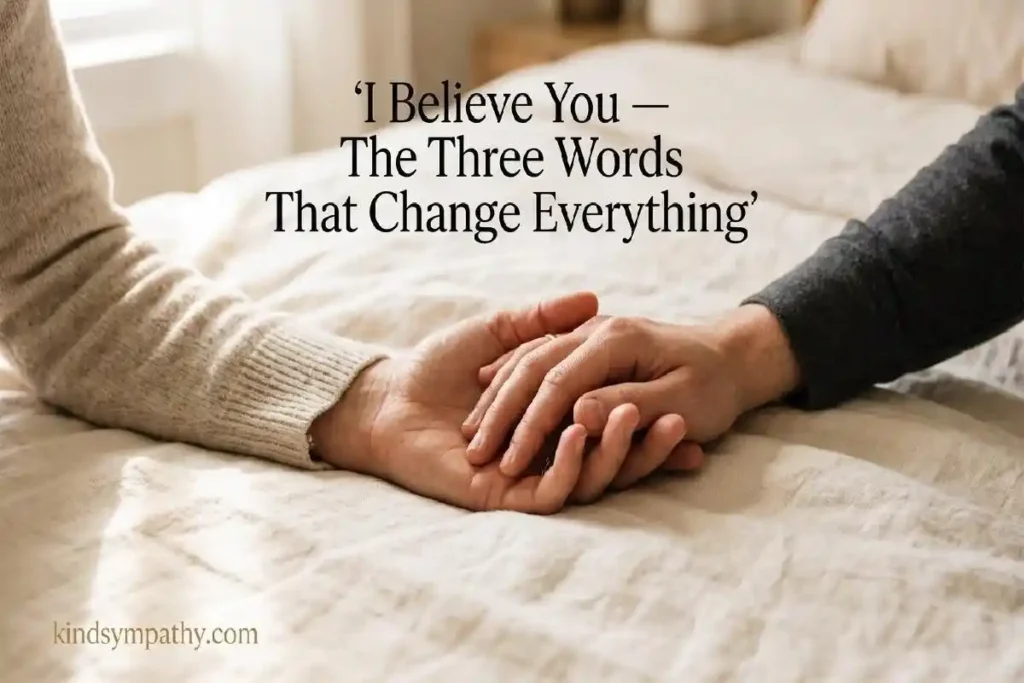
“I Believe You” — The Words That Change Everything
The most healing thing a survivor can hear is also the simplest. These short DV survivor support messages lead with belief — because that’s where all real support begins.
- I believe you. Full stop. No questions, no doubts, no “but.”
- What happened to you was not okay. And it was not your fault.
- You don’t have to convince me. I’m already on your side.
- I hear you. I believe you. I’m here.
- Whatever you choose to do, whenever you choose to do it — I will support you. No pressure. Just me.
- You are not crazy. You are not dramatic. You are not “too sensitive.” You are someone who was hurt, and I believe you.
- The fact that it’s complicated doesn’t make it less real. I know that. I believe all of it.
- You’ve been carrying this alone for too long. You don’t have to anymore. Not with me.
- Nothing you tell me will make me think less of you. Nothing.
- I’m not going to pretend I fully understand everything. But I believe you — and I’m here.
- You are not what was done to you. You are so much more than that.
- It took courage to say what you said. I want you to know it was heard. Completely.
- I’m not going anywhere. Whatever this looks like — I’m staying.
- You matter. What happened to you matters. And you deserve support that reflects that.
- The person who hurt you was wrong. You were never the problem.
Support Messages for Domestic Violence Survivors — Deep, Sustained Care
Surviving domestic abuse is not a moment — it’s a long, non-linear journey through trauma, complexity, and slow rebuilding. These deeper domestic violence care messages are for the person who needs more than a quick text. For the conversations that matter.
- I know that what you’re going through isn’t simple, and I’m not going to pretend it is. Abuse does something complicated to the way you see yourself and the situation — and that’s not weakness. That’s what it’s designed to do. I see through all of it, to you. And I believe you.
- I want to say something I mean completely: I will never judge you for staying, for going back, for the feelings you have about someone who hurt you, or for the timeline that is yours and not mine. You get to move through this in whatever way you need to. I’ll be here either way.
- The love you had for that person was real. The fear is real. The grief is real. And the harm they caused is also real. All of those things can be true at the same time, and none of them cancel each other out. I’m not asking you to simplify it. I’m just asking you to let me be here while you live inside the complexity of it.
- People on the outside often don’t understand why leaving is so hard. I want you to know I’m not one of those people. I understand — at least as much as I can from the outside — that this isn’t a simple choice. And I’m not going to add to the pressure you’re already carrying.
- You may have been told, by them or by your own mind, that you won’t be believed. That people will take sides. That it’s too complicated to explain. I’m here to tell you: not by me. I believe you without a single caveat.
- Trauma changes how we see ourselves. It can make us feel responsible for things that were done to us. I want to say this clearly: the way he treated you was about him, not about you. You did not cause it. You did not deserve it.
- I know there are days when it doesn’t feel like surviving feels like surviving. When everything is exhausting and heavy and the future feels impossible to imagine. On those days — I’m here. Not to fix it. Just to be here.
- I don’t need you to be over this. I don’t need you to be healed. I don’t need you to be anything other than exactly where you are. You’ve been asked to be enough for too many people for too long. With me, you just get to be.
Leaving an Abusive Relationship — Messages That Don’t Push (But Hold the Door Open)
Leaving domestic abuse is statistically the most dangerous moment in the experience. These leaving abusive relationship support messages are carefully written to open a door without ever pushing someone through it — because the timing and the decision belong entirely to the survivor.
- You know your situation better than anyone. I trust your judgment, even when things look complicated from the outside. Whatever you decide — I support you in it.
- If there ever comes a day when you want help making a plan, or just someone to talk to about options, I’m here. No pressure. Just an open offer that doesn’t expire.
- I want you to know that whenever you’re ready — for anything — I’ll be ready too. There’s no deadline on my support and no conditions attached to it.
- The door at my end is always open. Whether that means a conversation, a place to go, or just someone to call at 3am. It’s open. It’ll stay open.
- You get to decide what comes next. I’m not here to decide for you. I’m here to support whatever you decide, and to be a safe place while you figure it out.
- Safety looks different for different people in different situations. I trust you to know what safety means in yours. I’m here when it feels right to reach out.
- There’s no wrong way to survive this. Whatever you need to do to get through — I’m not here to judge it. I’m here to support it.
“For uplifting words during the healing journey, our uplifting messages for hard times and words of comfort offer hope without toxic positivity.”
Abuse Recovery Messages — For the Long Journey After
Life after leaving, or life during ongoing healing, is its own complex terrain. These abuse recovery messages are for the long stretch — the triggers, the complicated grief, the slow, nonlinear rebuilding of self.
- Healing from abuse doesn’t go in a straight line. There are good days and then days when it all rushes back. You don’t have to pretend otherwise with me.
- The grief of what you lost — the relationship you thought you had, the future you planned, the version of yourself before — all of that is real. You’re allowed to mourn it, even alongside the relief.
- Some days you might feel strong. Some days you might feel like you’re back at the beginning. Both are valid. Recovery isn’t linear and I’m not keeping score.
- What abuse can do to someone’s sense of self is one of its most lasting effects. The work of remembering who you are — underneath everything that was done to you — takes time. I’ve got time. I’ll be here.
- There will be things that bring it back. Sounds, dates, situations. I just want you to know: when those moments come, you’re allowed to reach out. You don’t have to manage your triggers alone.
- You’ve been through something most people can’t imagine. The fact that you’re still here, still building something, still choosing yourself — that’s not small. That’s extraordinary.
- Survivors are often told to “move on.” I won’t say that to you. You’ll move through this in your own time, in your own way. I’ll be alongside you for whatever that looks like.
Support Messages for Domestic Violence Awareness — For Allies Standing By
Sometimes the person reading this isn’t a survivor — they’re a friend, family member, or colleague who wants to show up right. These you are not alone DV messages are for supporters who want to say something real without overstepping.
- I want you to know that I’m a safe person. Whatever’s going on, you can tell me. I won’t push, I won’t judge, and I won’t tell you what to do. I’ll just listen.
- I’ve noticed some things that concern me and I care about you. I’m not asking you to tell me anything. I just want you to know I see you, I’m worried, and I’m here — no questions, no pressure.
- You deserve to be safe. I believe that. And I believe whatever you tell me about why you’re not. I’m here whenever you’re ready to talk.
- I don’t know everything that’s happening. But I know enough to know you’ve been going through something hard. I’m not going anywhere. My door is genuinely open.
- If you ever need a safe place to go — mine is available. No explanation required. No plan needed. Just a safe place. It’s yours whenever you need it.
Survivor Strength Messages — Honoring What It Took to Survive
These messages acknowledge something that often goes unsaid: surviving abuse takes a specific, extraordinary kind of endurance. These survivor support words name that directly — without toxic positivity, without minimizing what was hard.
- Surviving is not a small thing. Every day you got through was an act of endurance that most people will never fully understand. I understand it — at least enough to be in awe of you.
- The strength it takes to survive something like this, often while protecting others, often while still loving the person hurting you — I can’t fully fathom it. But I can recognize it. And I do.
- You are not weak for having stayed. You are not weak for being hurt. You survived something that was designed to break you. That is not weakness. That is resilience.
- You may not feel like a survivor yet. You may not feel strong. Those feelings are real — and so is what you’ve endured. The label doesn’t have to fit right now for the truth of it to matter.
- The version of you that comes through this — whatever that looks like — is someone I’m already proud of. You’re fighting for yourself. Even when it doesn’t feel like fighting. Even when it feels like just getting through the day.
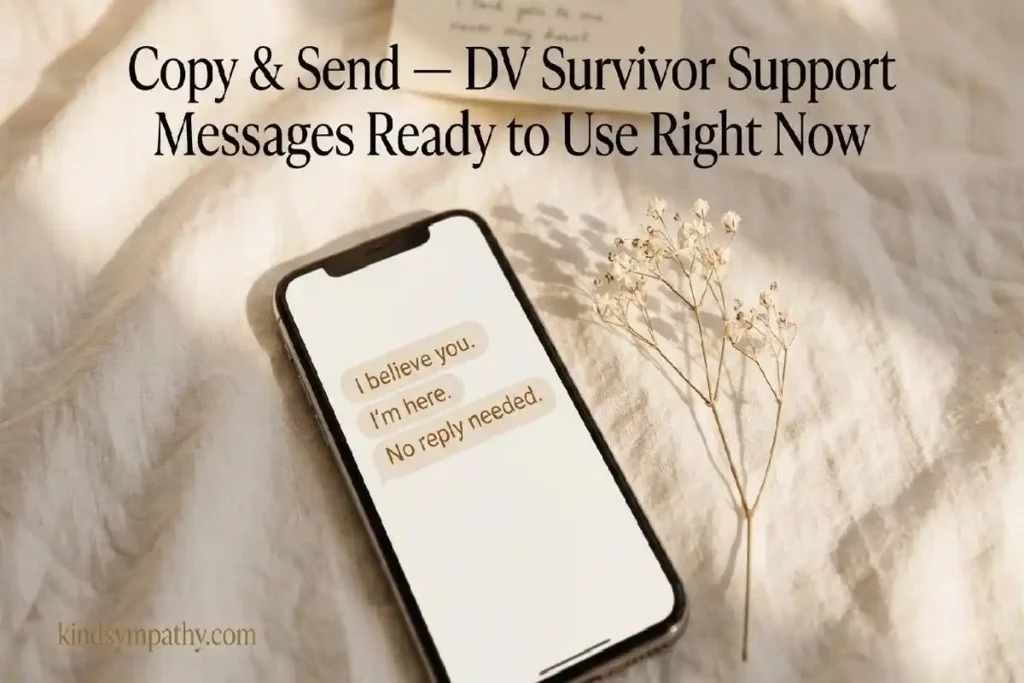
Copy & Paste DV Survivor Support Messages 📋
Trauma-informed, ready to use. Just copy this 👇
For the first time they tell you: “Thank you for telling me. I know how much it took to say that. I believe you — completely, without question. You don’t have to say anything else unless you want to. I’m just here.”
For a text when you want them to know you’re thinking of them: “Thinking of you today. No need to respond. I just didn’t want any time to pass without you knowing: I’m still here, I still believe you, and I haven’t forgotten.”
For someone still in the situation: “I’m not going to tell you what to do. That decision is yours and I respect that completely. I just need you to know: whenever you need anything — someone to talk to, a place to go, a plan — I’m here. The door’s open. It stays open.”
For a card: “I wanted you to have something to hold that says: you are believed, you are not alone, and there is someone in your life who thinks what happened to you was wrong and is in your corner completely. That someone is me.”
For someone in recovery after leaving: “You got out. I know that’s not the whole story — that leaving is just the beginning of a long journey. I’m here for the whole journey, not just the dramatic moments. I’m here for the ordinary hard days too.”
For someone far away: “The distance between us doesn’t change what I want you to know: I believe you. I’m proud of you. And if you ever need anything — call me. Any time. I will always pick up.”
For a colleague or acquaintance: “I don’t know everything and I’m not asking. I just want to say — if you’re going through something hard at home, you’re not alone. I’m a safe person. My number is there whenever you need it.”
For the anniversary of leaving: “I’ve been thinking about you today — what you went through to get here, what it took, what you survived. I’m so grateful you’re still here. And I’m so proud of everything you’ve built since.”
What NOT to Say to a Domestic Violence Survivor
These are said constantly — by people who care. They still cause harm. Here’s what to skip and what to say instead.
❌ “Why didn’t you just leave?” Why it stings: Leaving is the most dangerous moment in an abusive relationship — statistically, the time of highest risk. It also implies the victim is responsible for the abuse. It is never that simple. ✅ Say instead: “I know leaving isn’t simple. I trust you to know your situation better than I do.”
❌ “But they seem so nice.” Why it stings: Abusers often present very well publicly. This statement implicitly questions the survivor’s credibility. ✅ Say instead: “I believe you. What happens behind closed doors is what matters.”
❌ “Are you sure it was abuse? Maybe they just have a temper.” Why it stings: Questions and minimizes the survivor’s reality. Makes them doubt themselves further. ✅ Say instead: “You don’t need me to define it. If it felt wrong, it was wrong. I believe you.”
❌ “You should have left sooner.” Why it stings: Assigns blame to the victim for the timeline of the situation they were trapped in. ✅ Say instead: “You got through it in the way that you could. I’m just glad you’re here.”
❌ “I never liked them anyway.” Why it stings: Puts the survivor in the position of defending the person who hurt them — or feeling guilty for their own love. ✅ Say instead: “This isn’t about them right now. It’s about you, and how I can support you.”
❌ “Have you tried couples therapy?” Why it stings: Couples therapy is generally contraindicated in abusive relationships and can increase danger. This also implies the problem is relational rather than one-sided. ✅ Say instead: “Your safety comes first. What would feel helpful to you right now?”
❌ “You’re so strong — I could never go through that.” Why it stings: “Strong” can feel like another performance requirement. And many survivors feel anything but strong. ✅ Say instead: “What you’ve been through is enormous. I’m not asking you to be strong with me. You can just be.”
One-Line Support Messages for Domestic Violence Survivors ✨
Quiet, true, and powerful enough to stand alone. For cards, texts, or Pinterest pins.
- I believe you. Everything. Without question.
- What happened to you was wrong. You were never the problem.
- You don’t have to be okay. You don’t have to be strong. You just have to be here.
- Your story is yours. I’ll never ask you to rewrite it.
- You are not alone. Not while I’m around.
- Surviving is enough. More than enough.
- The door is always open. No questions. No conditions.
- You are more than what was done to you.
- Whatever you decide, whenever you decide it — I support you.
- Your feelings about this are allowed to be complicated. They make sense.
- You deserved better. You still do.
- I see you. The real you. And you are remarkable.
- Still here. Still believing you. Still not going anywhere.
Short Text or Long Message — What’s Right for a Survivor?
This decision is more safety-sensitive here than anywhere else in this series.
Send something short when contact needs to be discreet — when someone may be monitored, when you’re not sure what’s safe to say in writing, or when the survivor needs to feel held without anything requiring a response. A brief, warm text that says I’m thinking of you, no reply needed is sometimes the most powerful thing possible. Short domestic violence support text messages keep the door open without creating anything that could be used against the survivor.
Go longer only when you know they’re in a safe space to receive it — after leaving, during recovery, or in a private conversation they’ve initiated. A longer message in the right moment can be something they return to again and again. A card they can keep somewhere safe has real and lasting power.
One important note: never put anything in writing — text, card, or otherwise — that could create risk if read by the wrong person. If there’s any uncertainty about safety, a quiet in-person conversation or a discreet call is better than a written record. Our guide to safely supporting someone leaving an abusive relationship has more on navigating this.
💡 5 Things to Know Before You Support a DV Survivor
Tip 1: Believe first. Ask questions never. The single most important thing you can do is believe without qualification. Don’t ask “are you sure?” Don’t offer alternative explanations. Don’t share your doubts. Just say: I believe you. That phrase alone can begin to undo years of gaslighting.
Tip 2: Let them lead. Always. The decision about what to do, when to do it, and how — belongs to the survivor. Your role is not to rescue or push. It’s to be a consistent, reliable, non-pressuring presence. Offering options is okay. Insisting on them is not.
Tip 3: Use their name. Keep it personal. “I believe you, Sarah” is different from “I believe you.” In a situation where someone has been told their reality isn’t real for a long time, being seen and named specifically is powerful. Specific is the opposite of being erased.
Tip 4: Don’t disappear if they go back. Survivors often return to abusive relationships multiple times before leaving permanently. Research shows the average survivor leaves 7 times before leaving for good. If you disappear when they go back, you remove the safety net at exactly the moment it’s most needed. Stay. Don’t withdraw support based on their choices.
Tip 5: Understand the long, complex nature of trauma recovery. Research on the psychology of trauma, grief and recovery shows that healing from abuse is a non-linear, multi-year process — and that consistent social support is one of the most significant protective factors. Harvard Health’s work on the emotional impact of trauma on the body reinforces this: trauma leaves lasting physical and emotional marks, and the sustained presence of trusted people genuinely accelerates healing. Stay in it for the long haul. That is the whole job.
❓ FAQ — Support Messages for Domestic Violence Survivors
What is the best support message to send a domestic violence survivor?
The best support messages for domestic violence survivors lead with belief, offer presence without pressure, and make no demands. Try: “I believe you. I’m not going to ask questions or tell you what to do. I just want you to know I’m here — whenever you need anything, for as long as you need it, with no conditions.” That’s it. Belief first, always.
What are some short support message examples for a DV survivor I can send right now?
Short domestic violence support text messages are especially important when discretion matters. Try: “Thinking of you. No need to reply. Just wanted you to know I’m here.” Or: “I believe you. That’s all. I’m here.” Keep them brief, warm, and free of any language that requires a response or creates a paper trail that could cause harm.
What do you write in a card for a domestic violence survivor?
Write something that gives without asking. Try: “I wanted you to have something to hold that says: you are believed, you are not alone, and someone in your life thinks what happened to you was wrong and is completely, unconditionally in your corner.” That’s what to write in a DV survivor support card — belief, solidarity, no conditions.
Should I send support by card or text for a domestic violence survivor?
Depends entirely on the safety situation. If the survivor has a private phone and safe space, both can be meaningful. If there’s any risk of messages being monitored, discreet verbal conversations are safer than written records. When it is safe to write — text for immediate connection, card for something lasting they can keep and return to in quiet moments.
Is it okay to say “I don’t know what to say” to a domestic violence survivor?
Yes — always better than silence, and far better than saying the wrong thing. “I don’t know what to say, but I know I believe you and I’m here” is honest, safe, and connecting. Research on trauma, isolation, and recovery consistently shows that the antidote to the isolation abuse creates is other people who show up and stay. And Harvard Health’s work on trauma’s effect on the body and mind confirms that genuine human presence — imperfect, stumbling, honest — is one of the most healing things a survivor can receive. Say the honest imperfect thing. Then stay.