You’re standing in the florist.
There are lilies and roses and chrysanthemums and white orchids, and they’re all beautiful, and they’re all different, and you know — vaguely — that flowers have meanings, but you can’t remember what any of them are. And then you pick something, and you’re handed a small card, and the pen hovers.
Two problems, same moment. Which flowers are right for a sympathy arrangement? And what on earth do you write on the card?
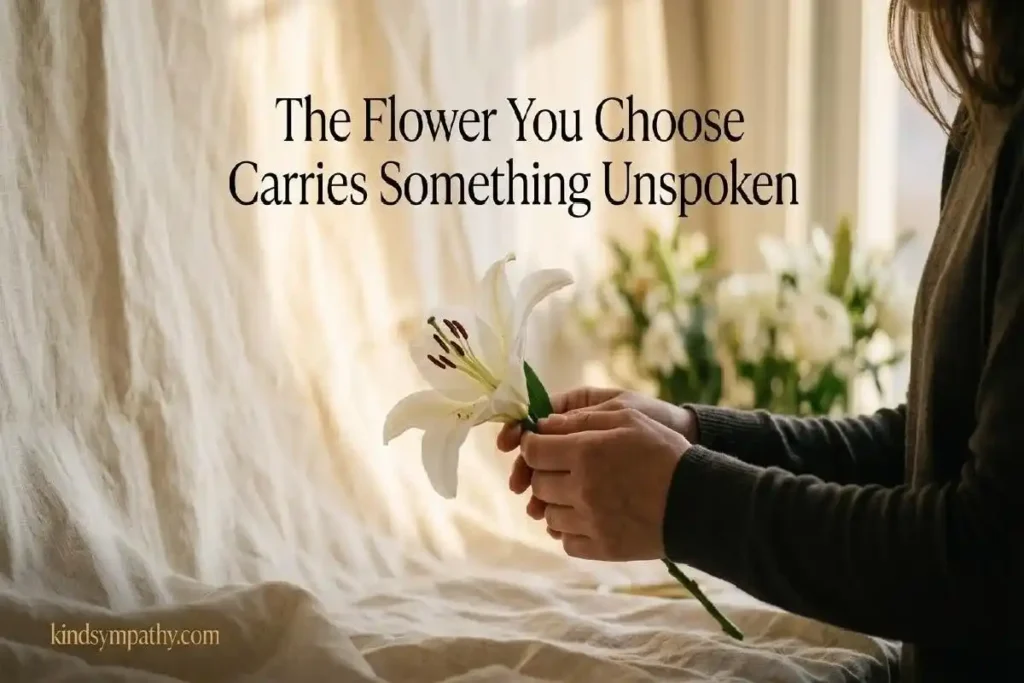
This guide solves both at once. Because sympathy flowers meaning matters — not in a rigid, Victorian way, but in the sense that the flower you choose carries something unspoken, and choosing with awareness makes the gesture feel more considered. And then the card — the two lines that travel with the bouquet to someone’s door — those need to be right too.
Whether you’re sending a sympathy arrangement to a funeral, to a grieving home, or to mark an anniversary, this guide covers condolence flowers meaning, what to write on sympathy flowers, and everything in between. For the longer card formats, our guide to what to write in a sympathy card covers everything else.
What is sympathy flowers meaning? Sympathy flowers meaning refers to the traditional and contemporary associations of different flowers used in condolence arrangements — what each bloom is understood to represent in the context of grief, loss, and remembrance. Understanding sympathy flowers meaning helps you choose an arrangement that communicates something specific and considered alongside your condolences.
💬 Best Sympathy Flower Card Message: “These flowers are a small part of the love I have for you and for [name]. I hope they bring a little warmth to a very hard week.” This works because it acknowledges both the flowers and the grief — making the gesture feel personal rather than generic — and names the person who died, which is always the most meaningful thing a sympathy message can do.
“Once you choose the flowers, our what to write on sympathy flowers helps you complete the gift. For full gift ideas, our sympathy gift ideas covers everything else.”
Why Flower Meanings Matter — Even in Modern Grief
Let’s be honest: most people don’t consciously choose sympathy flowers for their symbolism. They choose what looks beautiful, what the florist recommends, what’s in season.
But there’s value in knowing what the most common condolence flowers meaning is — because it helps you make a more considered choice, and because some flowers carry associations that matter to the people who receive them. A family who grew lilies in their garden and associate them with the person who died will feel something specific when lilies arrive. A family from a different cultural background may respond differently to chrysanthemums than a UK family would.
Understanding the funeral flower meaning of what you’re sending is about intentionality. Not obligation.
Sympathy Flowers Meaning — The Most Common Condolence Flowers Explained
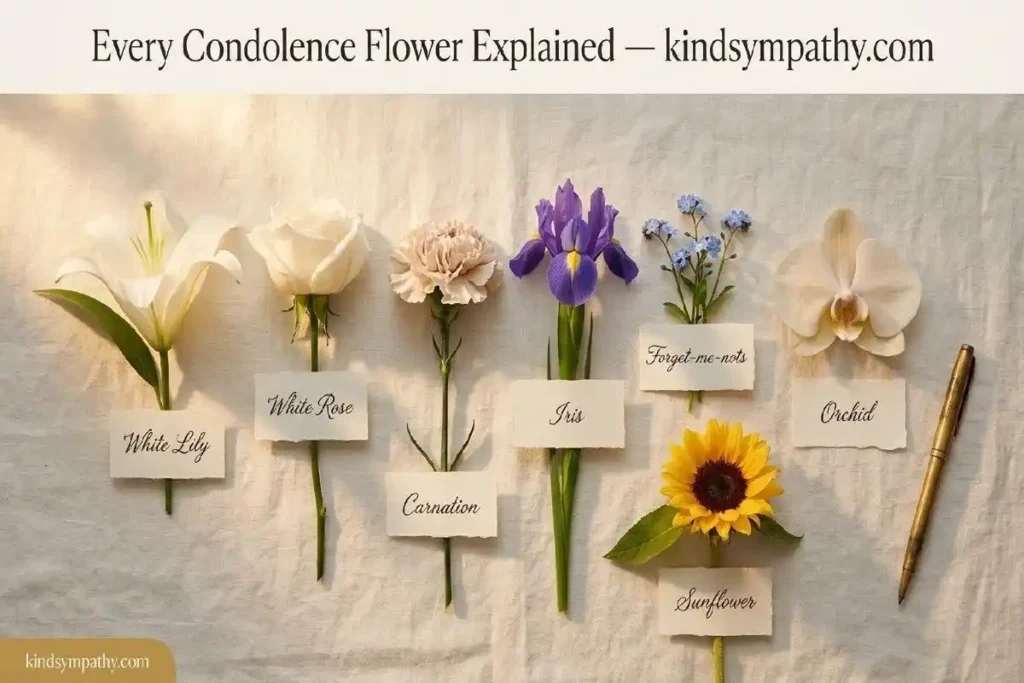
White Lily — Sympathy Flowers Meaning: Peace and Restored Innocence
White lilies are the most commonly associated flower with funerals and sympathy flowers meaning in Western traditions. They represent the restoration of the soul to a state of innocence, and peace after death. The white stargazer lily and the Madonna lily are particularly associated with sympathy arrangements.
What they say: Purity, peace, the soul’s transition.
When to choose them: White lilies are appropriate for almost any sympathy arrangement. They’re traditional, universally understood, and deeply beautiful.
What to write on the card: “These lilies are for [name]. For the peace they deserve, and for the love that carried them.”
One note: Some people find lilies overpowering — the scent is very strong. If you know the recipient is sensitive to scent or has pets (lilies are toxic to cats), opt for a different flower.
White Rose — Sympathy Flowers Meaning: Reverence and Honour
White roses carry sympathy bouquet meaning of reverence, honour, and spiritual love. They’re associated with new beginnings as much as endings — often used in sympathy arrangements to represent the hope that something of the person continues.
What they say: I honour who they were. Spiritual love. New beginnings alongside the loss.
When to choose them: White roses are appropriate for any relationship and any loss. They’re understated, elegant, and carry meaning without overwhelm.
What to write on the card: “White roses for [name]. Sent with everything I had no words for.”
Red Rose — Sympathy Flowers Meaning: Love and Respect
Red roses in a sympathy arrangement carry a different meaning from red roses in romance — they represent love in its most profound form, and deep respect for the person who has died. They’re often appropriate when the bereaved person and the deceased had an intense, close, loving relationship.
What they say: My love for them is real and enduring. I honour the bond you had.
When to choose them: For partners, parents, or a very close friend loss. Red roses in grief aren’t inappropriate — they’re powerful.
What to write on the card: “Red roses for [name] — because the love didn’t stop when they did.”
Chrysanthemum — Sympathy Flowers Meaning: Grief and Respect (Cultural Variations)
Chrysanthemums carry different funeral flower meaning depending on cultural context. In many European countries, chrysanthemums are specifically and exclusively associated with death and mourning — they’re the flower of funerals, not of celebration. In East Asian traditions, white chrysanthemums are associated with grief and lamentation.
In the US and UK, they’re less specifically funerary — white chrysanthemums in a mixed arrangement are neutral and lovely.
What they say: Grief acknowledged. Respect for the loss.
When to choose them: For formal sympathy arrangements. Be aware of cultural context if sending to families from different backgrounds.
What to write on the card: “These flowers carry the weight of the loss with you. I’m thinking of you and of [name].”
Carnation — Sympathy Flowers Meaning: Love and Devotion
Carnations in sympathy arrangements carry meaning related to love, devotion, and purity. White carnations represent pure love and luck; pink carnations carry remembrance; red carnations represent admiration.
What they say: Love and remembrance. The specific colour carries specific meaning.
When to choose them: Carnations are versatile, long-lasting, and beautiful in mixed sympathy arrangements. White carnations are particularly appropriate for sympathy.
What to write on the card: “Sent with love for [name] and for you. I’m here.”
“For a complete gift basket with flowers, our sympathy basket ideas and bereavement gift ideas have curated options.”
Orchid — Sympathy Flowers Meaning: Eternal Love and Beauty
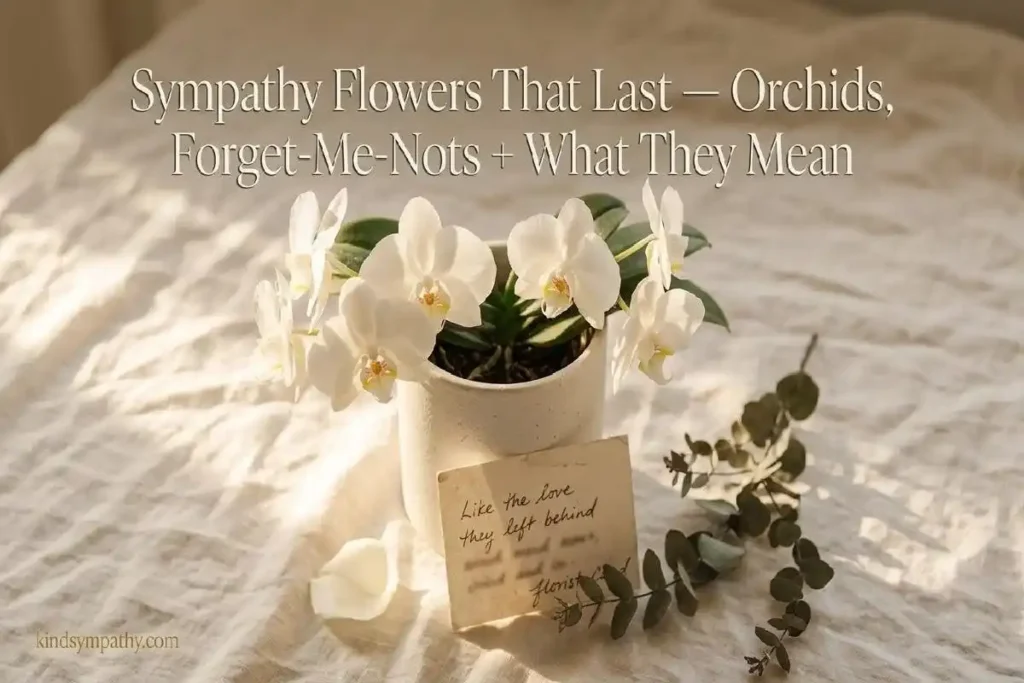
Orchids — particularly white orchids — carry condolence flowers meaning of eternal love, strength, and beauty. They’re elegant, long-lasting, and increasingly common in sympathy arrangements for their ability to remain beautiful for weeks.
What they say: Their love was extraordinary. Beauty that endures.
When to choose them: Orchids are a particularly beautiful choice for a sympathy plant (potted) rather than a cut arrangement — they last much longer. Good for close relationships.
What to write on the card: “Orchids last longer than most flowers. That felt right for [name].”
Forget-Me-Not — Sympathy Flowers Meaning: Remembrance
The meaning is right there in the name. Forget-me-nots are specifically associated with remembrance — with the act of keeping someone in memory. They’re a beautiful addition to any sympathy arrangement when the message is about continuing to remember.
What they say: I will not forget them. Neither should the world.
When to choose them: For anniversary arrangements, birthday arrangements (after a loss), or when the message of the flowers is specifically about remembrance.
What to write on the card: “Forget-me-nots for [name]. So they know we won’t.”
Iris — Sympathy Flowers Meaning: Hope and Faith
The iris carries meaning related to hope, faith, and wisdom — and was associated in Greek mythology with the messenger between earth and heaven. In sympathy arrangements, irises are chosen to express hope and the belief that something of the person continues.
What they say: Hope alongside the grief. Faith that something endures.
When to choose them: For families where faith or hope is an important part of how they’re processing the loss.
What to write on the card: “Irises for [name]. For the hope that something beautiful continues.”
Sunflower — Sympathy Flowers Meaning: Adoration and Loyalty
Sunflowers in a sympathy context carry meaning related to adoration, warmth, loyalty, and the celebration of a joyful life. They’re increasingly used in sympathy arrangements specifically chosen to celebrate the personality of someone who was vibrant, warm, and full of life.
What they say: They were a light. They made everything warmer. The world was better with them in it.
When to choose them: For someone who was known for their warmth, their energy, their joy. Sunflowers are a beautiful choice when the family has said they want to celebrate the person rather than mourn the loss.
What to write on the card: “Sunflowers for [name]. Because they were exactly this — warm, bright, facing toward the light.”
Tulip — Sympathy Flowers Meaning: Perfect Love and Rebirth
Tulips — particularly white and purple tulips — carry meaning related to perfect love, rebirth, and the connection between life and what comes after. White tulips represent forgiveness and worthiness; purple tulips represent royalty and admiration.
What they say: Love that was complete. Something new beginning in the wake of ending.
When to choose them: Spring arrangements, when tulips are in season. Beautiful for younger people’s losses or when the theme of hope is important.
What to write on the card: “Tulips for [name]. For the love that was perfect, and the hope that something continues.”
Sympathy Flowers by Occasion — What to Send and When
For a Funeral or Memorial Service
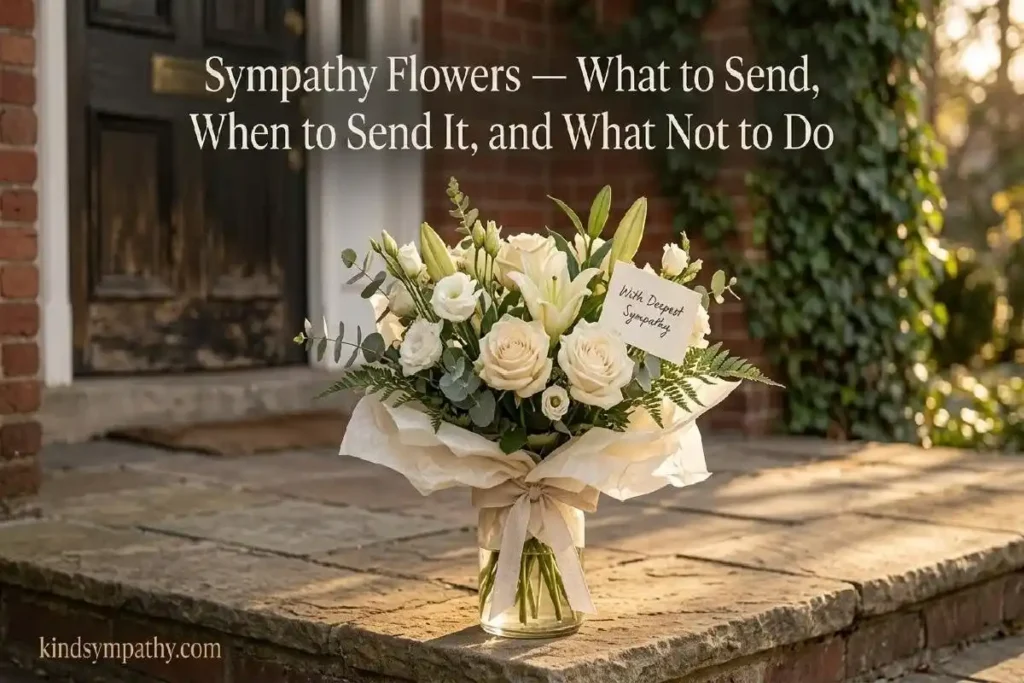
For funeral flowers, white and pale arrangements are most traditional — white lilies, white roses, white chrysanthemums. The arrangement should be elegant and understated. Strongly scented flowers (particularly lilies) may be overwhelming in an enclosed space.
Best choices: White roses, white lilies, white orchids, mixed whites.
For the Family Home (Condolence Delivery)
Flowers sent to the family home can be slightly more personal — chosen to reflect the person who died rather than following strict funeral convention. A bereaved person receiving flowers at home often appreciates something that feels like it was chosen specifically rather than ordered generically.
Best choices: Whatever the deceased or the bereaved person loves. Ask someone who knows, or choose based on what you know of them.
For an Anniversary or Long-Term Remembrance
For flowers sent on an anniversary or birthday, choose something with specific remembrance meaning — forget-me-nots, white roses, or the deceased’s favourite flower. Potted plants (orchids, small rosebushes) are particularly good for anniversary occasions because they outlast cut flowers.
Best choices: Forget-me-nots, white roses, orchids (potted), the deceased’s signature flower.

What to Write on Sympathy Flower Cards — By Flower and Occasion 📋
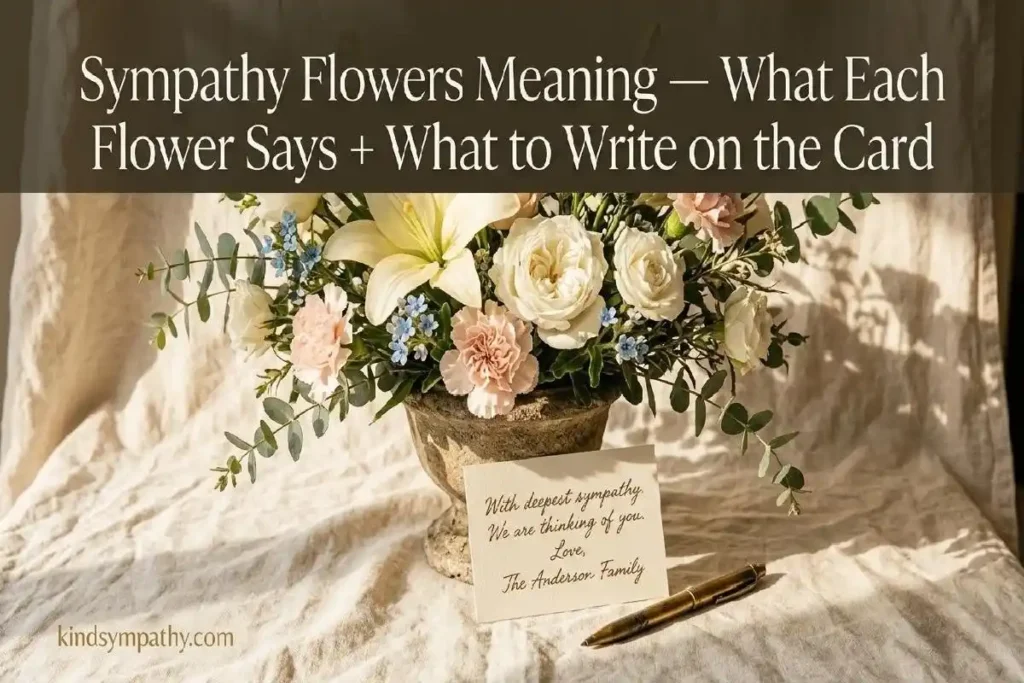
The card that accompanies flowers should be brief, specific, and personal. Here are complete sympathy flower card messages ready to use. Just copy this 👇
With white lilies: “White lilies for [name]. For peace. For everything they were.”
With white roses: “These roses are for you and for [name]. Sent with love that doesn’t have words.”
With orchids (potted): “Orchids — because they last. Like the love they left behind.”
With forget-me-nots: “Forget-me-nots. So they know we won’t.”
With sunflowers: “Sunflowers for [name]. Because they were exactly this kind of light.”
With a mixed white arrangement: “These flowers are for [name]’s memory. And for yours. With everything I couldn’t say.”
For a funeral arrangement: “In memory of [name]. Loved. Remembered. Always.”
For flowers on an anniversary: “For [name]’s anniversary. Because the date still matters and so does [he/she/they].”
For flowers on a birthday: “Happy birthday, [name]. These are for you, wherever you are.”
For a potted plant: “This will keep growing. Like the love they left behind.”
What NOT to Do When Sending Sympathy Flowers
Even the most beautiful flowers can create problems. These are worth knowing.
❌ Sending lilies to a household with cats. Why it matters: Lilies are highly toxic to cats. If you know the family has a cat, choose a different flower entirely. ✅ Send instead: Roses, orchids, carnations, or non-toxic alternatives.
❌ An arrangement that requires the family to arrange it. Why it misses: A grieving family doesn’t have energy to find vases, trim stems, or arrange flowers. Bring or send them in a vase, or choose a potted plant. ✅ Send instead: Flowers already in water and vase, or a potted orchid or plant.
❌ A very strongly scented arrangement for an enclosed space. Why it matters: Strong lily or freesia scent in a small room can be overwhelming during long days of visitors. ✅ Send instead: A more lightly scented arrangement for indoor use.
❌ Flowers sent without any card. Why it misses: Flowers without a card arrive anonymously. The bereaved family shouldn’t have to guess who sent them. ✅ Always include: A card with your name. Even if it’s just your name and one line.
❌ A generic card message with no personal content. Why it misses: “With sympathy” alone, without a name or anything personal, feels like a corporate gesture. ✅ Write instead: Their name, and one genuine sentence. That’s all it takes. Our guide to what to write on sympathy flowers has 50 ready-to-use messages.
Flower Colour Meaning in Sympathy — A Quick Reference
| Colour | Sympathy Meaning |
|---|---|
| White | Peace, purity, sympathy, innocence |
| Pale pink | Grace, admiration, gentleness |
| Purple | Respect, admiration, royalty |
| Yellow | Friendship, warmth (less traditional for sympathy) |
| Red | Deep love, respect, devotion |
| Lavender | Serenity, spirituality, remembrance |
| Blue/Iris | Hope, faith, wisdom |
💡 5 Tips for Choosing and Sending Sympathy Flowers
Tip 1: Choose flowers they’d recognise. The most meaningful sympathy flowers are the ones connected to the person — their favourite flower, the ones from their garden, the ones always associated with them in life. That specificity transforms a beautiful gesture into a personal one.
Tip 2: Consider longevity. Cut flowers last a week at most. A potted orchid, a small plant, or a living arrangement lasts weeks or months. For a close relationship, or for an anniversary, consider something that will outlast the cut arrangement. Research on the psychology of grief and meaningful objects confirms that lasting physical gifts carry ongoing meaning for bereaved people.
Tip 3: Always write the card yourself. The florist’s generic card is not the same as your handwriting, your words, their name. Write the card yourself. Even one sentence. Even just: “With all my love — [your name].” The personal touch is the whole point.
Tip 4: Think about the occasion specifically. Flowers for a funeral are different from flowers for a grieving home which are different from flowers for an anniversary. Match the arrangement to the occasion. Our broader guide to sympathy gift ideas for every type of loss covers occasions where flowers might be paired with something else.
Tip 5: Follow up. Flowers last a week. The grief lasts much longer. The most meaningful thing you can do after sending flowers is follow up — a text, a call, a card — two or three weeks later, when everyone else has stopped. Harvard Health’s research on the long-term physical and emotional impact of grief confirms that sustained human connection after a loss is far more important than any single early gesture.
❓ FAQ — Sympathy Flowers Meaning
What are the best sympathy flowers to send after a loss?
The best sympathy flowers meaning for most situations is carried by white lilies and white roses — both are traditional, universally understood, and deeply beautiful. If you know the family well, choose flowers connected to the deceased’s personality or favourites. For a vibrant, joyful person, sunflowers are increasingly appropriate. For a religious family, irises carrying hope and faith. Our guide to what to write on sympathy flowers covers the card messages for every choice.
What does the white lily mean in a sympathy arrangement?
The white lily meaning funeral is peace and the restoration of innocence — the soul returning to a state of purity. White lilies are the most traditionally associated flower with Western funerals and carry universal condolence flowers meaning in most English-speaking countries. Note that they’re highly toxic to cats, so check before sending to a household with pets.
What do you write in a card that accompanies sympathy flowers?
Keep it brief and specific. Use the deceased’s name. Try: “These flowers are for [name]. And for you. Sent with everything I couldn’t say.” Or: “White roses for [name] — because the love didn’t stop.” Our complete guide to what to write on sympathy flowers has 50 ready-to-use messages for every flower and every relationship.
What flowers should I avoid sending as a sympathy bouquet?
Avoid strongly scented arrangements (particularly heavy lily arrangements) for small, enclosed spaces. Avoid lilies entirely for households with cats. Avoid bright, celebratory colours (vivid orange, bright yellow) unless you know the family specifically wants a celebration-of-life approach. And avoid sending flowers without a personal card — the card is as important as the flowers.
Is it okay to send non-traditional flowers in a sympathy arrangement?
Completely — and increasingly common. Sympathy flowers meaning is evolving, and many families now prefer arrangements that reflect the deceased’s personality rather than following traditional convention. Research on the psychology of grief and human connection supports personalised tribute over convention when it comes to meaningful gesture. And Harvard Health’s work on the emotional experience of bereavement confirms that what matters most is that the gesture feels genuine and specific — not that it follows a script. Send the sunflowers if they were a sunflower person. That’s the right choice.