
The phone sits face-up on the counter. Just in case.
Dinner is made for one. Or two, plus the kids — but one chair stays quietly empty. There’s a time zone difference you’ve memorized without meaning to. And somewhere between the pride and the fear, there’s a particular kind of loneliness that doesn’t have a clean name — because the person you love is alive and serving and coming back, and still somehow, inexplicably, you miss them in a way that takes your breath away.
Military families carry something civilian life doesn’t fully prepare you to understand. The waiting. The uncertainty. The strength it takes to hold everything together at home while someone you love does something you can barely let yourself think about in detail. The way months can stretch and compress at the same time. The way “deploy” becomes a word that changes the shape of every plan you made.
These support messages for military families aren’t about making the deployment easier — nothing does that. They’re about making the family feel less invisible in it. Less alone in the waiting. Seen, acknowledged, and supported by the people around them — including you.
“For military death specifically, our sympathy messages for veterans honors that sacrifice. For the broader support collection, see support messages .”
What are support messages for military families? Support messages for military families are words of care and solidarity sent to the spouses, parents, children, and loved ones of service members — particularly during deployment. The best support messages for military families acknowledge the specific, ongoing sacrifice of the family left behind: the waiting, the worry, the strength it takes to keep going, and the love that endures across every distance.
💬 Best Support Message for a Military Family Example: “I know you’re holding so much right now — the house, the kids, the worry, the waiting, the pride — all of it at once. I want you to know that what you’re doing takes real strength. You’re not doing this alone. I’m right here, and I’m not going anywhere while they are.” This lands because it names exactly what military families actually carry — and so rarely get acknowledged for. Not just the missing, but the managing. The quiet daily endurance of someone keeping life going while everything feels suspended.
“For broader support, our support messages covers every difficult situation. For any type of struggle, our support messages for someone struggling offers words of presence.”
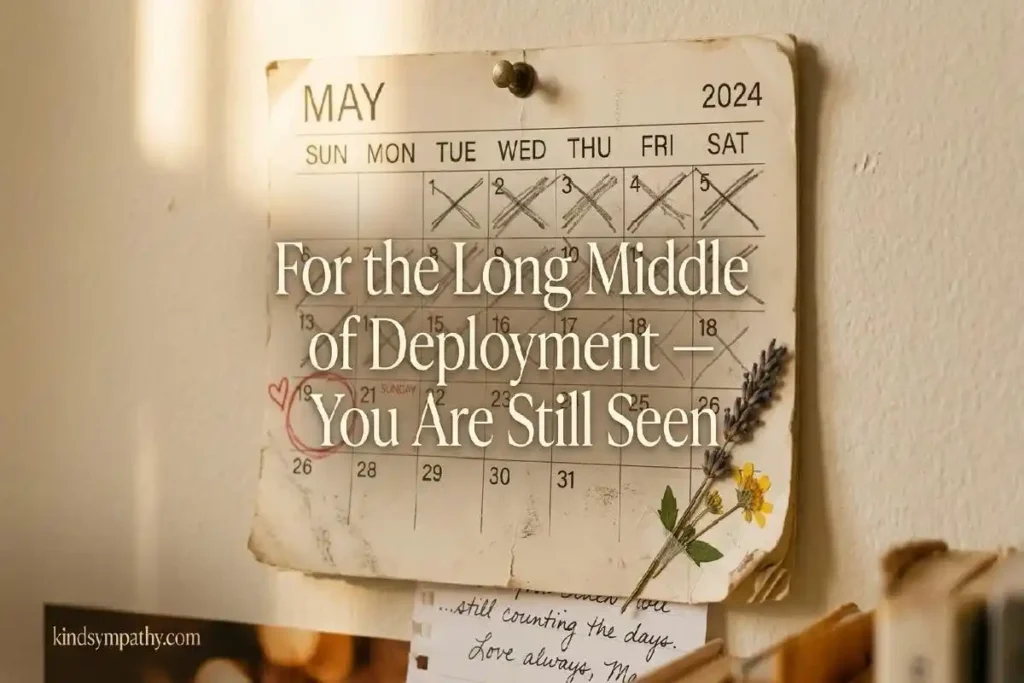
For the Military Spouse — Messages That See What You’re Really Carrying
Military spouses are often the ones nobody remembers to ask about. They’re managing homes, children, jobs, fear and longing — all while projecting strength for everyone around them. These military spouse support messages see that, specifically and directly.
- You are doing something extraordinary — and I mean the everyday version of extraordinary. Keeping everything running. Being there for everyone. Doing it without your person. That’s not small.
- I know the pride and the missing exist in you at the same time. You don’t have to choose which one to feel. I see both.
- You’ve held so much together while they’ve been away. I hope someone’s asking how you are. So: how are you?
- The strength it takes to be a military spouse doesn’t always look dramatic. Sometimes it just looks like getting through another Tuesday. I see those Tuesdays. They count.
- Deployment is hard on the whole family — but it’s a particular kind of hard for the one who stays. I want you to know I see that particular hard. And I’m here for it.
- You don’t have to be okay all the time. Not with me. Tell me how it really is.
- I’ve been thinking about you — not in a worried way, in a “you’ve been remarkable and I wanted to say so” way.
- Your person is serving. And so are you — just in a different and often invisible way. That service matters too.
- I know some days are harder than others. Some days the waiting gets very loud. I’m here for those days especially.
- You’re running the whole show at home while counting down the days. That deserves to be said out loud: you are doing something hard, and you’re doing it well.
Heartfelt Support Messages for Military Families During Deployment
Deployment stretches across months. These deeper military deployment support messages are for the long middle stretch — when the novelty of other people’s concern has worn off and the family is just quietly enduring.
- I know deployment has settled into something more routine now — not easier, just familiar. I want you to know I haven’t stopped thinking about what you’re carrying. I haven’t moved on just because time has.
- Months into this and you’re still standing. Still managing. Still showing up for the kids, for work, for everything. You might not see how remarkable that is. I do.
- There’s a particular kind of missing that comes with military deployment — not the clean grief of a loss, but the suspended waiting grief of loving someone who is somewhere you can’t reach. I can’t take that away. But I can sit with you in it.
- You’ve built a version of daily life that works while they’re gone. That took effort and creativity and a lot of quiet determination. I see that, and I admire it more than you probably know.
- The person at home during deployment doesn’t get a ceremony. Doesn’t get a send-off or a return parade. But what they carry is real and heavy and worthy of recognition. This is me, recognizing it.
- I know the hardest moments probably aren’t the dramatic ones — they’re the random Wednesday evenings when you just wish things were normal. I’m thinking of you on those Wednesdays.
- Your kids are lucky to have a parent who shows up fully even when they’re going through something this hard. They see it, even if they can’t name it yet. So do I.
- There are things you’ve had to figure out alone that you shouldn’t have had to figure out alone. I’m sorry for every one of those moments. And I’m here for the next one — you don’t have to do the next thing alone.
“For thinking of you messages during long separations, our uplifting messages for hard times and thinking of you messages keep the connection strong.”

Deployed Soldier Family Support — Messages for Parents and Children Too
It’s not just spouses. Parents with deployed children carry their own particular weight. Kids miss the parent who is gone in ways they don’t always have words for. These army family care messages are for the whole family circle.
For the Parents of a Deployed Service Member
- Sending your child to serve is one of the most profound acts of sacrifice a parent can make. The pride and the fear live side by side in you — and I want you to know both are completely valid.
- I think about you when I think about military sacrifice — not just the person serving, but the parents who raised them and love them and wait for them. You deserve support too.
- The worry you carry as a parent never fully switches off. I see that. I’m here for it — any time you need to talk, or not talk, or just have company.
- Your child is serving this country. That says something about them — and something about you, who raised them. I’m proud of you both.
For the Children of Deployed Parents
- Kids who grow up with a deployed parent learn things about strength and patience that most people never have to learn. That’s not easy. And it’s not fair. But it’s real, and it matters.
- If you know a child with a deployed parent, these messages work: “I know you miss your mom/dad. That missing is because you love them so much. And they love you just as much back — from wherever they are right now.”
- Children of military families do something not every child is asked to do: they learn to love someone across a very long distance. That deserves to be acknowledged, not just expected.
“For uplifting words during the healing journey, our uplifting messages for hard times and words of comfort offer hope without toxic positivity.”
Service Member Family Support — What to Write in a Card (When You Want It to Mean Something)
A card to a military family isn’t like most other cards. It needs to hold more — the pride, the worry, the specific texture of military life — without being generic. Here’s what to write in a military family support card that actually lands.
- I wanted to send you something physical — something you could hold — that says: the sacrifice your family is making is seen and honored by the people around you. This card is that.
- No card fully captures what military families go through. But this one tries to carry a simple truth: you are not forgotten in this. You are supported. And you are not as alone in the waiting as it sometimes feels.
- Keep this somewhere you’ll find it on a hard day. It says: someone who knows what you’re carrying thinks you are remarkable, and is thinking about you more than you know.
- Words feel inadequate against the size of what your family carries. But silence feels worse. So here: love, admiration, and a genuine offer to show up however I can.
- This card is just one person’s way of saying thank you — to the whole family. To the one who serves, and to the ones who hold everything together while they do.

Messages for When the Service Member Comes Home
Homecoming is complicated in ways that don’t always match the joyful images. Reintegration is real work. These messages acknowledge that with warmth and without pressure.
- Welcome home messages aren’t always about the fanfare — sometimes it’s about the quiet. The readjusting. The finding-your-way-back-to-each-other. I’m here for all of it, not just the celebration.
- Homecoming is a beautiful thing — and it’s also a transition that takes time. I hope you give yourselves all the grace you need. And I hope you know I’m here for the whole adjustment, not just the party.
- I am so glad they’re home. And I know “home” takes a little while to really settle. No rush on any of it. We’re all just glad you’re together.
- After all the waiting, having them back doesn’t always feel the way you imagined. That’s okay. It’s real, and it takes time, and there’s no wrong way to come back to each other.
Patriot Family Messages — Honoring the Whole Family’s Service
The military life isn’t just the service member’s sacrifice. Entire families live it. These patriot family messages honor that with the weight it deserves.
- Military families serve too. In different ways, with different sacrifices, but real ones. I want to say thank you — not just to the person in uniform, but to every person who loves them and waits for them.
- The sacrifices military families make are quiet, daily, and often invisible to people who haven’t lived them. I see them. I honor them. And I’m grateful.
- What your family has given — the time apart, the uncertainty, the holding-it-together — that is a contribution to something larger than any one household. Thank you doesn’t cover it, but it’s what I have.
- You don’t always get told that the whole family serves. I want to say it clearly: you do. And it matters.
Copy & Paste Military Family Support Messages 📋
Ready when you need them. Just copy this 👇
For a military spouse during deployment: “I’ve been thinking about you a lot lately. Not worried exactly — just aware of how much you’re carrying and how quietly you’re doing it. I want you to know you don’t have to carry all of it alone. I’m here. What do you need this week?”
For a short text check-in: “Just checking in — no update needed, no pressure to reply. Just wanted you to know someone’s thinking about you and your family today. That someone is me.”
For a card during deployment: “This card is small. What it’s trying to say isn’t. It says: the sacrifice your family makes is real and it’s honored, and you are not forgotten by the people around you. Not even a little.”
For parents of a deployed service member: “Raising someone with the courage to serve took a family with the same quality of heart. I think about your son/daughter often, and I think about you too. Your pride and your worry are both completely understandable. I’m here if you ever need to talk.”
For a homecoming: “Welcome home doesn’t cover the size of what this moment is. I’m just so glad your family is together again. Take all the time you need. We’ll all be here when you’re ready.”
For a military family during the holidays: “The holidays feel different with an empty chair. I just want you to know someone sees that — and is thinking about your whole family today, and the person who isn’t at the table right now.”
For a long deployment: “I know it’s been a long stretch. I know the weeks blur and the milestones come and go without the person you want there for them. I haven’t stopped checking in in my head — and I won’t stop checking in for real either.”
For when they deploy for the second or third time: “Each deployment takes its own kind of courage — from the one going and the one staying. I know this one isn’t your first. I also know that doesn’t make it easier. I’m here the same way I was last time, and the time before.”
What NOT to Say to a Military Family
These are said with good intentions constantly. They still miss the mark. Here’s what to avoid — and what actually helps.
❌ “I don’t know how you do it.” Why it stings: However well-meant, it can feel othering — like they’ve been made into a category rather than a person. And often the implication is that they have no choice but to do it. ✅ Say instead: “What you’re managing is a lot. How are you actually holding up?”
❌ “At least they’re not in a combat zone” / “At least they’re safe.” Why it stings: Minimizes the worry. Military families know deployment risk better than anyone — and “at least” never comforts. ✅ Say instead: “I imagine the not-knowing is its own hard thing. I’m here if the worry gets loud.”
❌ “Your spouse knew what they were signing up for.” Why it stings: May be true, but it dismisses the very real difficulty of what the family lives through. Choosing something doesn’t make it easy. ✅ Say instead: “I know this life comes with real sacrifice. That sacrifice deserves to be acknowledged.”
❌ “I could never do what you’re doing.” Why it stings: Makes the military family feel exceptional in a way that separates rather than connects. They don’t want to be admired from a distance — they want to feel less alone. ✅ Say instead: “I can only imagine how hard some days are. I want you to know you’re not doing this with just your own strength — you’ve got people behind you.”
❌ “They’ll be home before you know it.” Why it stings: Minimizes the length of deployment. Months are not “before you know it” when you’re living them hour by hour. ✅ Say instead: “I know the time feels long. I’m going to keep checking in so you’re not doing it alone.”
❌ “Let me know if you need anything.” Why it stings: Puts the burden on someone who’s already overwhelmed to identify and articulate their needs. They often won’t. ✅ Say instead: “I’m bringing dinner Thursday. Is there anything specific you or the kids would like?” Be specific. Military families are often too exhausted to ask.
❌ “You must be so proud.” Why it stings: True, but incomplete and sometimes tone-deaf. Pride and terror coexist in military families. Leading with only pride can feel like the fear is being erased. ✅ Say instead: “I know pride and worry travel together in this. Both make complete sense.”
One-Line Military Family Support Messages ✨
For texts, cards, lapel pins, or Pinterest graphics.
- The ones who wait are serving too.
- Pride and worry can live in the same heart. Both are welcome here.
- You are not doing this alone — not while I’m around.
- The empty chair is noticed. Your person is honored.
- Military family life asks a lot. You give even more.
- What you carry at home is its own kind of service.
- The strength to wait is just as real as the strength to go.
- This deployment will end. I’ll be here through every day of it.
- You’re holding the whole world together. Let me hold some of it with you.
- Proud of the one who serves. Proud of the family that makes it possible.
- Across every time zone — you are loved and you are not forgotten.
- The waiting is hard. You are harder.
- Thank you — to the whole family, for what the whole family gives.
- I see you. I’m here. I’m not counting down without you.

Short Text or Long Message — What Does a Military Family Need?
Military family life has its own rhythms — and the right message length shifts with where in the deployment cycle they are.
Send something short often. A quick text on a random Wednesday, a brief “thinking of you” that arrives without needing a response — these build the pattern of consistent presence that military families often feel disappears after the first few weeks. Short military family support text messages say: I haven’t moved on. I’m still here. You’re still on my mind. No action required.
Go longer for milestones — the midpoint of deployment, a first holiday apart, the anniversary of the send-off, homecoming week. These moments deserve something proportionate. A longer message, or a card they can keep, says: I thought about you at this exact moment, because this moment matters. Our guide to what to write in a care package note for military families has more on making every piece of contact count.
The one thing that matters most: don’t let the weeks go by silently. Military families often report that people check in heavily at the beginning of deployment, then slowly go quiet. The weeks in the middle — when the family is just quietly enduring — are exactly when a message means the most.
💡 5 Ways to Actually Support a Military Family
Tip 1: Show up for the practical things without being asked. Offering to “let them know if they need anything” almost never results in the help being asked for. Military families are often managing too much to add “asking for help” to the list. Instead, show up with specifics: “I’m taking the kids Saturday so you can have a morning to yourself.” That’s the kind of help that changes weeks.
Tip 2: Remember the dates that matter. The deployment anniversary. The expected homecoming window. Holidays. Birthdays the service member is missing. Put them in your calendar. Reach out specifically. “I know today is the first birthday [child’s name] has had without dad there — thinking of you all today” is worth more than a dozen general check-ins.
Tip 3: Use their name. Talk about the absent person specifically. “How is [name] doing?” and “I’ve been thinking about [name] over there” tells the family that their loved one is remembered as a real person, not just an absence. That specific remembering is a gift.
Tip 4: Don’t just send it once. The message you send at the start of deployment matters. The one you send in month four — when most people have gone quiet — matters more. Set recurring reminders. Monthly check-ins are not too many.
Tip 5: Understand that military families carry a complex emotional mix. Research on the psychology of prolonged separation and grief shows that the ambiguous loss experienced during deployment — missing someone who is living and will return — is its own form of grief, with its own emotional complexity. Harvard Health’s work on the impact of sustained stress and loneliness on wellbeing confirms what military families know in their bones: sustained connection with people outside the deployment makes a measurable difference to how families cope. Be that connection. Consistently, practically, for as long as it takes.
❓ FAQ — Support Messages for Military Families
What is the best support message to send a military family during deployment?
The best support messages for military families acknowledge the full weight of what the family carries at home — not just the pride, but the daily endurance. Try: “I know you’re holding so much right now — the house, the worry, the kids, the waiting. What you’re doing is real strength, and I want you to know you’re not doing it alone.” It sees the whole picture, not just the surface.
What are some short military family support message examples I can send right now?
Short support messages for military families work best as regular, consistent check-ins. Try: “Thinking of you and your family today. No need to reply — just wanted you to know.” Or: “Still here. Still thinking about you. How’s this week been?” Brief and consistent beats eloquent and occasional every time.
What do you write in a card for a military family?
Write something that sees them, not just the situation. Try: “This card is for the family at home — for the waiting, the managing, the loving someone across such a distance. That sacrifice is real and it is honored by the people who know you.” That’s what to write in a military family support card that goes beyond generic.
Should I send support to a military family by card or text?
Both — for different purposes. Texts build the ongoing pattern of presence that matters so much during long deployments. Cards work best at milestones: the start of deployment, holidays apart, homecoming, or a particularly long stretch when you want them to have something physical to hold. Do both if you can. Do the text especially if you can only do one — and do it more than once.
Is it okay to say “I don’t know what to say” to a military family?
Always better than saying nothing. Military families often feel like their experience is hard for civilians to fully understand — and “I don’t fully understand, but I care about you and I’m here” actually bridges that gap rather than pretending it doesn’t exist. Research on connection, loneliness and social support confirms that the act of showing up — even imperfectly — is what matters. And Harvard Health on the effects of sustained isolation underscores why consistent human contact matters so deeply during prolonged difficult periods. Send the honest message. Then send another one in three weeks.