

70+ heartfelt messages for every situation.”
You care. That’s the problem.
You’ve been thinking about what to say for days. You’ve typed things and deleted them. You know exactly what they’re going through — or at least you know you can’t fully know — and every message you draft either sounds too small or too much or weirdly formal for someone you’ve known for years.
Here’s the thing: that’s the friendship working. The people who care the most are the ones who freeze. The ones who send the hollow “I’m so sorry for your loss” and move on are the ones who weren’t really paying attention.
You’re paying attention. And sympathy messages for a friend don’t have to be perfect to land. They have to be real. They have to sound like you. They have to say: I see you, I’m here, and I’m not going anywhere.
That’s the whole job. And these messages are here to help you do it.
What are sympathy messages for a friend? Sympathy messages for a friend are words sent by one friend to another during grief or loss — and they carry a different weight than any other condolence. A friend’s message can be more honest, more personal, more direct than anything a formal relationship allows. The best ones sound exactly like the friendship: warm, real, and completely without distance.
💬 Best Sympathy Message for a Friend Example: “I’ve been trying to figure out what to say for days. I keep landing in the same place: I love you, I’m here, and I’m not going to be one of the people who disappears when things get hard. You’re not getting rid of me. Call me whenever — 2am included. I mean every word.” This works because it’s honest about the difficulty of finding words — which itself is comforting — and then follows it with total commitment. That combination of vulnerability and loyalty is what friendship actually looks like in grief.
“For the complete collection, visit our sympathy messages guide. If your friend has lost their best friend, our sympathy messages for loss of best friend speaks to that unique grief.”

is hurting. We’re here to help.”
Short Sympathy Messages for a Friend (Quick, Real, No Distance at All)
The best short sympathy messages for a friend don’t sound like sympathy cards. They sound like you — the actual you, the one who texts in lowercase and knows exactly how they take their coffee. These work for texts, for the note inside a card alongside something longer, and for all the check-ins that come after the first week when everyone else has stopped reaching out.
- “I love you. I’m here. Neither of those things are changing.”
- “You don’t have to be okay right now. Not with me.”
- “I’ve been thinking about you nonstop. Just want you to know that.”
- “I’m here for the ugly cry, the silence, and everything in between.”
- “I don’t have the right words. But I have time, and love, and I’m not going anywhere.”
- “You’ve always shown up for me. It’s your turn to let me show up for you.”
- “No agenda, no pressure. I just want to be close.”
- “I’m so sorry. That’s it. I just love you and I’m so sorry.”
- “Grief is weird and messy and I’m here for all of it.”
- “Tell me everything or tell me nothing. Either way, I’m here.”
- “I’m going to keep texting. Even if you don’t reply.”
- “I’m not doing the disappearing act. Just so you know.”
- “You matter to me more than I usually say. This is me saying it.”
- “I’ve got food, wine, and absolutely nowhere else to be. Say the word.”
- “I love you. That’s the whole message.”
Heartfelt Long Sympathy Messages for a Friend (When You Need to Say More Than a Sentence)
These longer sympathy messages for a friend are for when the friendship is deep enough that a text isn’t enough — for handwritten cards, for the message you send when it’s been a few days and you want to say something that really lands. These don’t sound formal. They sound like a friend who’s been sitting with this.
If you’re looking for messages for a specific type of loss, our complete sympathy messages guide covers everything from loss of parent to pet loss, organized by situation.
- “I’ve been going back and forth on what to say, and I keep coming back to this: I’m not trying to fix it. I know I can’t. I just want to be in your corner — not just this week, but when everyone else has moved on and it’s still very much not okay for you. That’s when I’ll still be here.”
- “You’ve been one of the people I count on most. The fact that you’re going through something this hard and there’s nothing I can do makes me feel completely useless in the best possible way — because it means I care this much. Please let me be there, even if being there just means sitting with you.”
- “Grief doesn’t play by the rules. It shows up when it feels like it, in places you didn’t expect, long after you thought you’d gotten a handle on it. I know that. And I want you to know that I’m available for all of it — not just the first week, but the third month, and the first anniversary, and every day it comes back between now and then.”
- “I keep picking up my phone to text you something useful and putting it back down because nothing sounds right. So here’s the most honest thing I’ve got: I love you. I’m devastated that you’re going through this. And I am absolutely not going anywhere.”
- “You don’t have to perform any version of coping for me. You can be a mess. You can be angry. You can be weirdly fine and then suddenly not fine at all. You can say the same things on repeat. I can take all of it — because that’s what this is for.”
- “I know you probably feel like you’re a burden on people right now. You’re not. Not to me. I’d rather be here for this than have you go through it without me. Please let me in.”
- “I’ve been thinking about everything you’re carrying right now and I just — I want to carry some of it. Not the grief itself, I can’t do that. But the practical stuff. The not-being-alone stuff. The 2am stuff. I’m here for all of that.”
- “Here’s what I know about you: you’ll eventually be okay. Not today, maybe not for a while. But you will — because I’ve watched you get through things before. And this time you don’t have to do it alone. I’m right here.”
- “Please don’t disappear into this. I know it’s tempting to go quiet — to just get through it privately. But I want you in my life through all of it, including the hard parts. Especially the hard parts.”
- “I don’t need you to be strong. I don’t need you to have it together. I just need you to let me be here. That’s the whole ask.”
What to Write in a Sympathy Card for a Friend (Words That Sound Like You, Not a Card Shop)
Writing sympathy messages for a friend in a card is actually easier than it sounds — because the whole point is to sound like yourself, not like a prepared message. These are warm, personal, and real. They read like they were written by someone who loves the person receiving them.
For a full guide on how to structure and format what you write inside a card, our sympathy card wording guide covers everything.
- “I didn’t want to just send a text. I wanted you to have something to hold. This card is me — my love, my presence, my total refusal to disappear. You’ve got me.”
- “The fact that I’m sending a card means I wanted you to have something you can come back to. This is it: I love you. I’m here. And I will still be saying both of those things months from now.”
- “I know cards can feel a bit formal. So just to be clear — this is your best mate who loves you, handing you a small piece of paper that says: I’ve got you. Completely.”
- “No fancy words. Just this: you’re one of my people. And when one of my people is going through something this hard, I show up. Consider me shown up.”
- “I wanted to write you something you could keep — something that still says all the same things in three months when it’s still hard. So here it is: I love you, I’m not going anywhere, and none of that has an expiry date.”
- “May this card find you on a day when you need it most. And may it remind you that you have someone in your corner who is completely, stubbornly, totally on your side.”
- “This card is a small stand-in for a very large hug. Consider yourself held.”
- “I couldn’t find the words either. So I just picked the card that said ‘with love’ and am filling the rest with all the things I actually mean: I love you, I’m here, please call me.”
- “You’ve gotten me through hard things. Let me get you through this one.”
- “With all my love — not just today, but every day this is still hard.”
Sympathy Text Messages for a Friend (Send One Right Now, Before You Second-Guess Yourself)
Stop overthinking it. Your friend needs to hear from you today — not when you’ve found the perfect words, not after you’ve edited it four times. These sympathy text messages for a friend are ready to send as-is. They sound like you, they land warm, and they do the most important thing: they show up.
Go. Send one now.
- “Hey. I just wanted to say I love you and I’m thinking about you.”
- “I’ve been so rubbish at knowing what to say. But I love you and I’m here.”
- “Can I come over tonight? I’ll bring food. You don’t have to talk.”
- “I know I said it the other day but I mean it more now: I’m here. Really here.”
- “You’ve been on my mind constantly. How are you actually doing?”
- “Don’t feel like you need to reply. I just wanted you to know someone’s thinking about you.”
- “I’m not going to stop checking in. Just so you know.”
- “What do you need today? Food? Company? Total silence? I can do any of those.”
- “I love you. That’s all.”
- “I was just thinking about you and wanted to say so. You’re not alone in this.”
- “I know the hard days come in waves. I’m here for the wave days especially.”
- “I miss you. Not in a pressuring way — just in the ‘you matter to me’ way.”
- “You don’t have to have it together to talk to me. I literally prefer the real version.”
- “Whatever today is — I’m in your corner.”
- “Just dropping in to say I haven’t forgotten, and I’m not going to.”
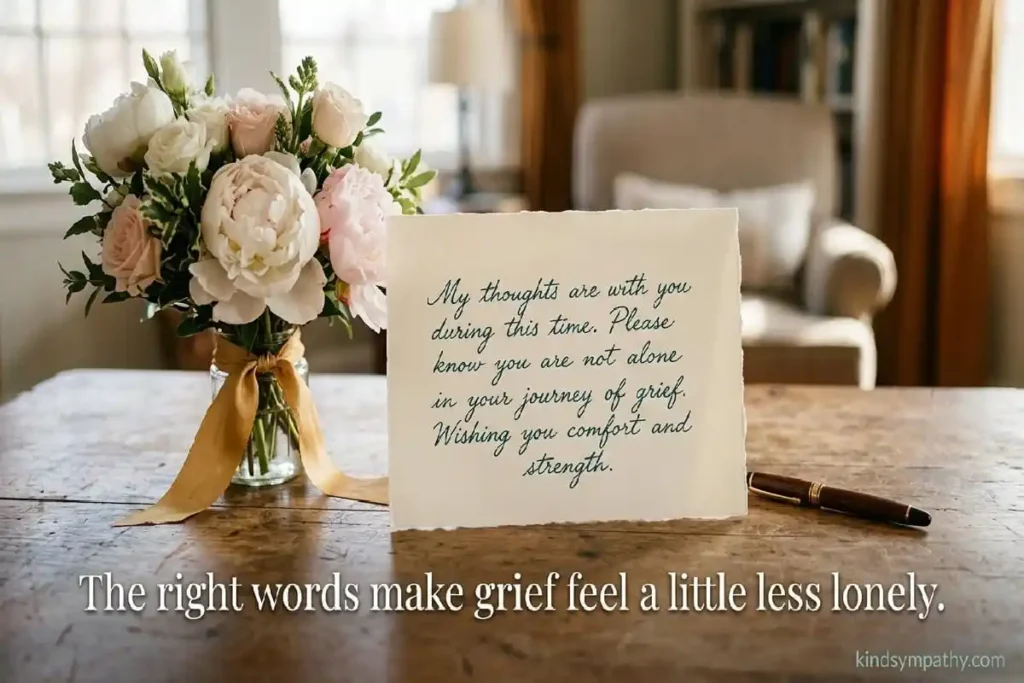
Find the perfect message at kindsympathy.com”
Messages for When Your Friend Is Really Struggling (For the Hard Conversations)
Sometimes the usual check-in isn’t enough. Sometimes your friend is in the thick of real, deep grief — not just sad, but struggling. These grief messages are for those moments. They’re not light. They’re not quick. They’re the messages that come from a place of deep friendship and deep love.
- “I’m worried about you. Not in a way that puts any pressure on you — I just want you to know that someone is paying close attention. I see how hard this is. And I’m here for the full weight of it.”
- “You don’t have to protect me from how bad this feels. I can handle it. Bring it.”
- “I know some days the grief is manageable and some days it just isn’t. Both of those versions of you are welcome here.”
- “I’m not going to tell you it gets easier. But I will tell you that I’ll still be here when it does. And in every hard day between now and then.”
- “Please don’t disappear into this alone. I know it’s tempting. But you matter to me — and that means I need to know you’re okay, even when okay just means still here.”
- “You’ve been carrying so much. I see it. You don’t have to do it alone.”
- “Grief changes over time. I’ll be here for all the different shapes it takes.”
- “There’s no version of ‘too much’ that applies to you. I promise.”
- “You’ve gotten me through things. Let me get you through this.”
- “I love you. Not the brave, holding-it-together version — all of you. Including this.”
Condolence Messages for a Friend: What to Say When the Loss Is Someone Else’s
Sometimes you’re reaching out because your friend has lost someone — a parent, a partner, a sibling. These condolence messages for a friend are built for that situation: warm enough to acknowledge the specific loss, personal enough to sound like the friendship.
- “I can’t imagine what you’re going through right now. I just know that I love you and I’m here.”
- “Losing someone you love is one of the hardest things. I’m not going to pretend otherwise. I’m just going to stay close.”
- “There are no words for this kind of loss. So I’m just showing up instead.”
- “Your grief is valid and real and exactly as big as it feels. And I’m here for all of it.”
- “I know everyone will say something — let me be the one who means it the most.”
Professional Version (For the Friend Who Is Also a Colleague)
When your friend is also your colleague, the message can be a little more measured — but it should never lose the warmth of the friendship. These walk that line.
- “Beyond the work stuff — I just want you to know I’m thinking about you as a friend. Please let me know if you need anything at all.”
- “I know we spend most of our time talking about work. Today I just want to say: I’m here for you, as a friend, completely.”
- “Please take whatever time you need. As a colleague, the team has everything covered. As a friend, I’ve got you.”
- “You don’t have to be professional about how you’re feeling right now. Not with me.”
- “I’m here — both as a colleague who will handle whatever needs handling, and as a friend who is absolutely in your corner.”
Faith-Based Messages for a Grieving Friend
For friends whose faith matters to them, these messages blend spiritual comfort with genuine, personal warmth.
- “I’m praying for you — not just the words of it, but really, genuinely praying for peace to find you.”
- “I believe you’re being held by something bigger right now. And I’m right here alongside that.”
- “May your faith be a shelter right now. And may my friendship be one too.”
- “Lifting you up in prayer today and every day. I love you.”
- “I believe that love this real doesn’t end. I’m holding onto that for both of us.”
What NOT to Say to a Grieving Friend (Even Well-Meaning Words Can Miss)
Here’s the thing about being a friend — the expectations are higher. What’s forgivable from a distant acquaintance can really sting from someone who knows you well. Here’s what to avoid.
❌ “I know how you feel.” Why it misses: Even as a close friend, your grief experience isn’t the same as theirs. This can inadvertently shift the focus to you. Say instead: “I can’t fully know what this is like for you. I just want to be here for it.”
❌ “You need to stay busy.” Why it misses: Busyness delays grief — it doesn’t process it. And it subtly suggests that feeling the grief is the wrong choice. Say instead: “Rest if you need to. Feel it if you need to. I’ll be here either way.”
❌ “At least…” Why it misses: Any “at least” from a close friend stings harder than from a stranger — because you should know better. Say instead: Just skip it. Start with “I’m so sorry” and mean it.
❌ “Just let me know if you need anything.” Why it misses: As a friend, you can do better than a vague offer. This puts the burden on the grieving person to figure out what they need and ask for it. Say instead: “I’m coming over Thursday. What would help — food, company, just someone to sit with?”
❌ “I’ve been so busy, I’m sorry I haven’t reached out sooner.” Why it misses: It makes the grief about your schedule. Even if it’s true, leave it out. Say instead: Just reach out. No explanation needed.
❌ “You should really think about talking to someone.” Why it misses: Unsolicited advice — even from a close friend — can feel like a deflection, like you’re passing them off rather than staying. Say instead: “I’m here to listen. And if you ever want to talk to someone professionally, I’ll help you find someone good.”
❌ “You’re so strong — you’ll get through this.” Why it misses: It assigns them a role. It implies that falling apart isn’t an option. Friends are supposed to be the safe space where the strength doesn’t have to happen. Say instead: “You don’t have to be strong right now. Not with me.”
One-Line Sympathy Messages for a Friend (For Cards, Pins, the Perfect Text)
Each one is a complete thought — real enough to stand alone, warm enough to send right now.
- “You don’t have to be okay right now. Not with me.”
- “I’m not going anywhere. That’s the whole message.”
- “Grief is weird. Friends are weirder. I’m here for both.”
- “I love you more than I know how to say in a text.”
- “The ugly cry is safe with me. Always.”
- “I’m in your corner. No conditions, no timeline.”
- “You’ve shown up for me. Let me show up for you.”
- “Call me. Don’t call me. I’m here either way.”
- “I’ll still be here when everyone else has moved on.”
- “I see you. I love you. I’m not going anywhere.”
- “Nothing you’re feeling is too much for me to handle.”
- “You matter to me. This matters to me. I’m here.”
Copy & Paste Sympathy Messages for a Friend — Use These Right Now 👇
Every one of these is ready to go. The most important thing is sending something today.
Quick text to your friend: “Hey. I’ve been thinking about you nonstop. I don’t have the right words, but I love you and I’m not going anywhere. Call me whenever — or don’t, and I’ll just keep texting.”
A heartfelt card: “You’re one of my people. And when one of my people is going through something this hard, I show up. I wanted you to have something physical that says: I’ve got you. Completely. No expiry date.”
For a friend who lost a parent: “Losing a parent changes things in a way that’s hard to describe from the outside. I’m not going to pretend I fully understand it. I’m just going to be here — today and in all the hard days that follow.”
For a friend who lost a partner: “I can only imagine how different everything feels right now. Please don’t go through this alone. I’m here — for the practical stuff, the 2am stuff, all of it.”
For a friend who lost a child: “I don’t have words for this. I just have love for you — enormous, unconditional, completely here. Please let me in.”
For a friend who lost a pet: “I know some people don’t get it. I do. They were your family. I’m so sorry. And I’m here.”
For a friend who is struggling with grief long-term: “I know it’s been a while. I also know grief doesn’t follow a schedule. I’m still here — and I meant it when I said I would be.”
For a friend who’s been isolating: “I’ve noticed you’ve gone a bit quiet. No pressure at all — I just wanted you to know I’m thinking about you and I’m here whenever you’re ready.”
For a friend who always takes care of everyone else: “You take care of everyone around you. Please let me take care of you for a bit. Tell me what you need. If you don’t know — that’s fine, I’ll figure it out.”
For a friend going through grief at a difficult time of year: “The holidays are going to feel different this year. I wanted to check in before they arrived and say: I haven’t forgotten, and I’m here through whatever these days look like for you.”
5 Tips for Writing Your Own Sympathy Message for a Friend
Tip 1: Sound like yourself — not like a card. Your friend doesn’t need formal language. They need you. Write the way you text. Use the word you’d actually say. If you’d normally start with “hey” — start with “hey.” Authenticity is the whole point of friendship, and it’s the whole point of this message.
Tip 2: Use their name — and mention the loss specifically. “I’m so sorry about your mum” hits differently than “I’m sorry for your loss.” “I keep thinking about [person]” is more comforting than anything generic. Naming the loss — and the person — tells your friend: I’m not going through the motions. I’m actually paying attention.
Tip 3: Send something today. Don’t wait for the perfect words. Research on the psychology of grief and human connection is consistent: the thing people remember about grief is who showed up. An imperfect message sent today is worth everything a perfect one delayed never delivered. Your friend needs to hear from you now, not once you’ve figured out what to say.
Tip 4: Make a specific offer instead of a vague one. “Let me know if you need anything” is friendship shorthand for “I care but I don’t know what to do.” Most grieving people can’t identify what they need — and they won’t ask. Try: “I’m coming over Thursday evening — do you want me to bring food?” or “I’ll handle the grocery run this week. What do you need?” Specific offers get taken up. Vague ones don’t.
Tip 5: Keep showing up — especially after week one. The first wave of support always comes. What doesn’t come is the third month, the first anniversary, the random Tuesday. Harvard Health’s research on the emotional impact of grief on the body is clear that sustained connection is what actually supports recovery. Keep texting. Keep checking in. Your friend won’t forget who stayed.
Short or Long: What Works for a Grieving Friend?
Short works best when you need to check in quickly, when your friend is in the acute grief phase and overwhelmed, or for the regular low-pressure touchpoints over weeks and months ahead. “I love you, I’m thinking about you, no need to reply” — that’s enough for a Tuesday evening.
Long works best when you’re writing a card, when you have something real and specific to say, when time has passed and you want to acknowledge the full weight of what they’ve been carrying. A heartfelt letter from a friend months after a loss can mean everything.
Whatever the length — sound like yourself, name the loss, make a specific offer. For more across all types of grief and loss messages, our complete bereavement messages guide has everything by relationship and situation. And if you want to do something alongside words, our thoughtful sympathy gift guide has ideas that show up in ways messages alone sometimes can’t.

Find both at kindsympathy.com”
❓ FAQ: Sympathy Messages for a Friend
What is the best sympathy message to send a friend who is grieving?
The best sympathy message for a friend is one that sounds like you — not like a formal condolence. Something like: “I don’t have the right words. I just know I love you and I’m not going anywhere. Call me whenever — 2am included.” Three things: honesty about not having perfect words, complete commitment, and a specific offer. That’s what friendship actually sounds like in grief.
What are some short sympathy messages for a friend I can send right now?
A few to use directly: “I love you. I’m here. Neither of those things are changing.” / “You don’t have to be okay right now. Not with me.” / “I’m not doing the disappearing act. Just so you know.” Short sympathy text messages for a friend are often the most powerful — they’re immediate, they ask nothing back, and they say the most important thing: you haven’t been forgotten.
What do you write in a sympathy card for a friend?
Write like you’d text them, but more. Use their name. Reference the specific loss if you can. Make it clear this isn’t a one-time check-in. A strong friend-to-friend sympathy card: “You’re one of my people. No fancy words — just this: I’ve got you. Completely. No expiry date.” Our sympathy card wording guide has more on format and structure.
Should I send a sympathy card or a text when a friend is grieving?
For a close friend — do both. A sympathy text message for a friend breaks the silence immediately and says I’m here right now. A card is something lasting — a physical object they can return to when the texts have scrolled away. Texts for the immediate reach-out, card to follow. If you can only do one: text first, always.
Is it okay to say “I don’t know what to say” to a grieving friend?
With a friend? Absolutely — and often it’s the most disarming and comforting thing you can say. It signals: I’m not performing sympathy. I’m actually trying to get this right because you matter to me. Research on the psychology of grief and human connection shows that honesty and presence matter more than perfect language. And Harvard Health’s research on the emotional impact of grief on the body confirms that sustained friendship support has real, measurable healing effects. Say you don’t have the words. Show up anyway. Keep showing up. That’s what friends do.

you care too much to get it wrong.”







Pingback: 60+ Heartfelt Sympathy Messages for a Neighbor
Pingback: 60+ Heartfelt Sympathy Messages for Loss of Best Friend
Pingback: Funny Sympathy Messages for Close Friends — 40 Ideas