Nobody tells you there’s a clock on grief until you feel it ticking.
It starts small. A month after the loss, someone says something about “getting back to normal.” Three months in, the condolence cards have stopped coming. Six months later, someone says — with complete kindness, complete obliviousness — “you seem to be doing so much better.” And grief, which hasn’t gone anywhere, learns to go underground.
The truth about grief is that it doesn’t follow anyone else’s schedule. It doesn’t respond to social expectations or the passage of time. It shows up at the supermarket, at 3am, on a Tuesday that means nothing to anyone else but everything to you. And people grieving often end up carrying not just the loss — but the weight of everyone else’s discomfort with how long they’re taking to “get over it.”
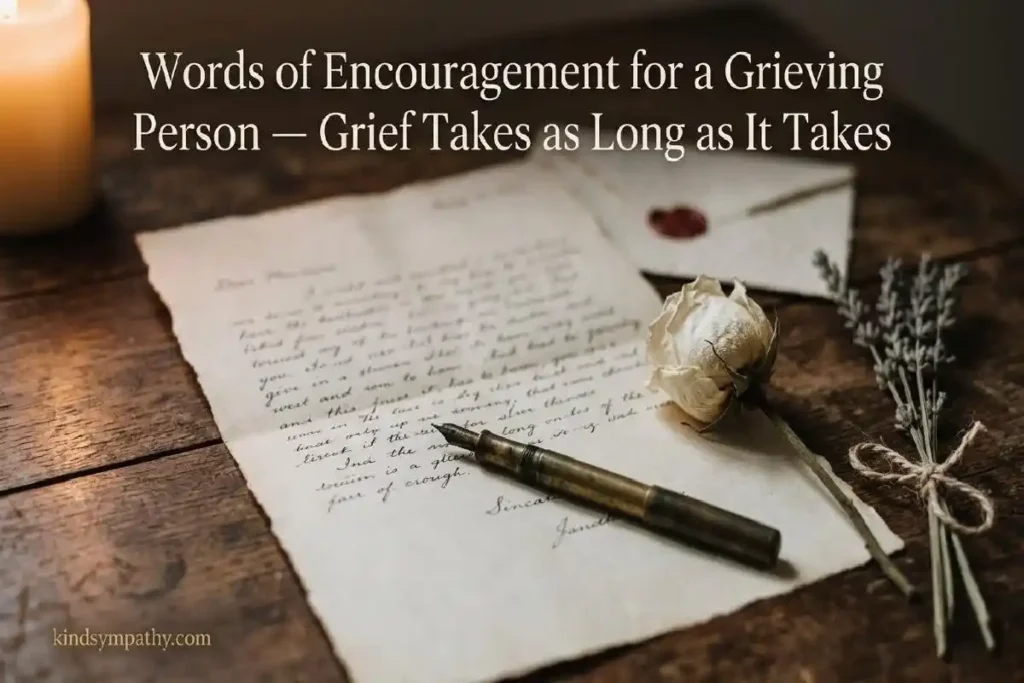
Words of encouragement for a grieving person have one job: to push back against all of that. Not to rush. Not to comfort by minimising. But to say, specifically and without conditions: however long this takes is exactly the right amount of time. And I’m here for all of it.
These grief support encouragement messages are built for the long arc of loss — for the days that catch you off guard, the anniversaries nobody else remembers, and the quiet ordinary grief that doesn’t look dramatic but doesn’t hurt any less. Our guide to what to say to someone who is grieving covers the broader landscape if you want it.
What are words of encouragement for a grieving person? Words of encouragement for a grieving person are messages that offer genuine comfort without rushing the process — acknowledging that grief takes its own time and that the person moving through it doesn’t need to be fixed, finished, or further along. The best words of encouragement for a grieving person don’t push toward healing. They stand beside someone in the loss, for as long as it takes.
💬 Best Words of Encouragement for a Grieving Person Example: “I’m not going to tell you it gets easier. I’m going to tell you that I’m not going anywhere while you find out for yourself. There’s no timeline on this. Grief takes as long as it takes — and I’ll still be here at month six the same way I’m here today.” This works because it refuses the false comfort of “it’ll be okay soon” and replaces it with something more honest and more sustaining: I will be here. Not eventually. Not after you’ve made progress. Right now, and for whatever comes after.
“For comfort words broadly, our words of comfort covers many situations. For long-term grief support, our grief support messages speaks to the ongoing journey.”
First Things First — Short Encouragement Messages for Someone Grieving
In the early days of grief, people are often too raw for long messages. What they need is something brief that lands gently and asks nothing in return. These short words of encouragement for a grieving person do exactly that.
- You don’t have to be okay. Not yet. Not on anyone else’s schedule.
- Grief doesn’t follow a timeline — and neither should you.
- However you’re moving through this, you’re doing it right.
- You’re allowed to miss them as much as you do, for as long as you do.
- There is no correct way to grieve. Only your way.
- I’m not going anywhere. However long this takes.
- The love you had for them was real. The loss is real. The grief is completely real.
- You don’t have to be strong right now. You don’t have to be anything.
- I’m here. Not to say the right thing — just to be here.
- Missing them this much only means you loved them this much. That’s not something to get over.
- You can take up all the time you need. I’ll still be here.
- Some days will be worse than others. I’m not keeping track. I’m just keeping you company.
- You are not behind in your grief. There is no behind.
- Whatever today looks like — I’m thinking of you through all of it.
- Grief changes shape but it doesn’t go away. I know that. I’m not waiting for it to.

Words of Encouragement During Grief — For the People Who Are Still in It
These deeper messages are for the grieving person who needs someone to see them in the middle of the long stretch — not just at the beginning when the loss was fresh, but weeks and months later, when the world has moved on and they haven’t.
- Everyone else seems to have moved on. I want you to know I haven’t. I still think about them. I still think about you. The fact that time has passed doesn’t mean the loss has shrunk — and I’m not going to pretend otherwise.
- Grief at six months is different from grief at six weeks. But it isn’t smaller. It just looks different. I want you to know I understand that, and I’m here for whichever version of it you’re living in right now.
- There’s a particular loneliness in grief that sets in when other people stop mentioning the person you’ve lost — as if saying their name might remind you of something you’ve been trying to forget. I’m not worried about reminding you. I want to say their name. I want to keep them present. Tell me about them, if you want to.
- I know some days you feel the absence more than others. And I know those days don’t announce themselves — they just arrive. On all of those days, quiet or loud, named or unnamed, I am thinking of you.
- You’re doing something very hard. It doesn’t always look hard from the outside. Sometimes grief looks like going to work and answering emails and making dinner and appearing perfectly functional. But I know what’s underneath. And I’m here for that version too.
- People will tell you that grief gets easier with time. Some of it does. Some of it doesn’t — it just becomes more familiar. You don’t have to pretend either way. I can handle your honesty about where you actually are.
- The person you were before this loss and the person you are becoming through it are both real. The grief is the bridge between them — and it’s yours to walk at your own pace. I’ll be on the other side when you get there. And I’ll check in along the way.
- I carry you in my thoughts more than you probably realise. On ordinary days and significant ones. On the days you’ve mentioned are hard and on the ones you haven’t. You are not forgotten in your grief.
Encouragement During Grief — Messages That Honour the Person Who Was Lost
One of the most meaningful things you can offer a grieving person is to keep their loved one real — not as a ghost they should be moving on from, but as a person who mattered and still does. These messages do that.
- I’ve been thinking about [name/them] too. Not because I’m trying to remind you of what you’ve lost — but because they were real, they mattered, and pretending otherwise feels wrong. I want to keep talking about them if that ever helps.
- The person you lost deserves to be remembered. Not just in the first weeks — for as long as you need to remember them. I’m not going to let their name become something we avoid.
- Grief this deep is proof of love this real. I don’t want you to rush past it. It’s one of the most human things about you.
- Some of the best things I know about you are things you loved about them. That love doesn’t go anywhere. It just has to find a new shape.
- Whatever the relationship — parent, child, partner, friend, pet — the loss is yours to feel completely. No comparison. No measuring against how long you “should” be affected. They mattered. That’s all grief needs.
“For deeper support, our support messages collection and words of comfort offer more targeted options for specific situations.”
Grieving Friend Encouragement — For the Close, Honest Friendship
Some friendships have enough history that you can say the real thing without softening it. These messages are for the people you know well enough to be honest with.
- I’m not going to sit here and tell you it all happens for a reason. I don’t know that it does. What I know is that you loved someone, and that person is gone, and that’s genuinely awful. I’m here with you in that reality.
- I miss them too. Not the way you do — I know that. But enough to understand why you do. Enough to want to talk about them when you’re ready.
- You’ve been carrying this quietly for a while. You don’t have to keep it quiet with me. You can say their name. You can fall apart. You can talk about them or not talk about them. Whatever you need — I’ll match.
- I know there are things you haven’t said to anyone about the grief. You don’t have to say them to me either. But I want you to know the space exists, if you ever want it.
- Remember when [shared memory involving the person]? I think about that sometimes. I think about how much they would have loved knowing how you’re doing. And I think about how much we both miss them.
Healing Grief Messages — For the Longer Passage (Months or Years On)
Grief doesn’t end. It transforms. These healing grief messages are for the longer timeline — the first-year anniversaries, the random ambush of remembering, the new version of ordinary that has to be built from scratch.
- A year ago everything was different. I know anniversaries are their own kind of hard — not just the date, but the counting. I’m thinking about you especially today.
- The first [holiday/birthday/anniversary] without someone is its own particular grief. I just wanted to make sure you knew someone remembered that today is different — and harder — than it used to be.
- Grief changes you. The person you’re becoming through it is still you — just a version that has known real loss and real love. That person deserves gentleness. I hope you give it to yourself.
- You’ve been rebuilding something new since you lost them. That takes longer than anyone tells you. And it doesn’t mean you’ve left them behind. They’re in the foundation.
- The fact that you still miss them this much isn’t a sign you haven’t healed. It’s a sign you loved them well. Those are not opposites.
Words of Encouragement for a Grieving Person — In a Card (What to Write)
A grief card sent weeks, months, or years after the loss is one of the most powerful gestures someone can make. Here’s what to write in a grief encouragement card that doesn’t feel like a cliché.
- I picked this card because I wanted to say something, not just send something. That something is: I’m still here. The loss hasn’t faded from my awareness. And you haven’t faded from my care.
- Most cards arrive in the first week. This one is coming later on purpose — because I know that later is when the grief often gets harder, not easier. I wanted you to have something that said: I know that. I haven’t forgotten.
- Keep this somewhere you’ll find it on one of the harder days. It says: you are remembered, your grief is valid for however long it lasts, and someone in your life is paying attention. That someone is me.
- This card doesn’t have a timeline in it. No “hope you’re feeling better soon.” Just love — plain, ongoing, with no conditions attached to how you’re doing.
Copy & Paste Words of Encouragement for a Grieving Person 📋
Ready to use exactly as they are. Just copy this 👇
For the first few weeks after a loss: “I just want you to know — there’s no rush. You don’t have to be doing well. You don’t have to have it together. Grief takes as long as it takes and I’m here for all of it, not just the beginning.”
For months after, when you want to check in: “I know it’s been a while since [the loss]. I also know that doesn’t mean the grief has packed up and left. I’ve been thinking about you — and about them. How are you, really?”
For someone who seems to be putting on a brave face: “I see you being so strong for everyone else. I just want to make sure someone is asking: how are you actually doing? You don’t have to have the brave answer with me.”
For a grief card sent later than usual: “This card is late — on purpose. I know the first wave of support comes early. I wanted to send something when the noise had quieted and you might still be carrying the weight of this alone. You’re not alone.”
For a close friend who’s lost someone: “I miss them too. And I know that’s not the same as your missing them — but I wanted you to know their loss echoes for more than just you. They mattered. So do you, especially right now.”
For a text on a grief anniversary: “I’ve been thinking about you today specifically. I know what today is. I didn’t want it to pass without someone saying: I remember. I’m here. How are you doing with it?”
For someone who said grief was “silly” for their type of loss: “There’s no category of loss that’s too small to grieve. If you loved them and they’re gone — that’s real. You’re allowed to feel every bit of it.”
For long-term grief that seems to be isolating someone: “I’ve noticed you’ve gone a bit quiet lately. I wondered if the grief has been loud recently. I’m not asking you to talk about it — I’m just asking you to know I haven’t moved on from it, even if other people have. I’m still here.”
What NOT to Say to a Grieving Person
These come from love. They still leave marks. Here’s what to replace them with.
❌ “I know how you feel.” Why it stings: Every grief is its own specific shape. This assumes a commonality that flattens the uniqueness of what they’re experiencing. ✅ Say instead: “I can’t know exactly what this feels like for you. But I want to understand, if you ever want to share.”
❌ “They’re in a better place.” Why it stings: This may or may not align with the grieving person’s beliefs — and it implies the loss should feel better because of it. It often doesn’t. ✅ Say instead: “I don’t know what to say to make this hurt less. I just know I’m here.”
❌ “At least you had them for [X years].” Why it stings: “At least” is always minimising. Gratitude for time together doesn’t reduce the pain of the ending. ✅ Say instead: “The time you had together was real and precious. That doesn’t make the loss any smaller.”
❌ “You need to get back out there / keep busy.” Why it stings: Grief doesn’t get better by being distracted from. This implies the solution is avoidance. ✅ Say instead: “Let me know when you feel ready to [activity]. And if you never are, that’s okay too.”
❌ “They wouldn’t want you to be sad.” Why it stings: Attempts to use the deceased person as an argument against the grief. The person lost isn’t here to confirm that — and being sad is a natural response to love and loss. ✅ Say instead: “Missing them this much is one of the most human things about you. I’m not going to argue with it.”
❌ “You should be feeling better by now.” Why it stings: Puts a timeline on grief that has no timeline. Immediately makes the grieving person feel like they’re failing. ✅ Say instead: “Grief doesn’t follow a schedule. You take as long as this takes. I’m not going anywhere.”
❌ “Life goes on.” Why it stings: True, technically. Also completely beside the point when someone is in acute grief. Feels dismissive of the enormity of the loss. ✅ Say instead: “The world keeps moving, I know. You don’t have to move with it until you’re ready.”
One-Line Words of Encouragement for a Grieving Person ✨
Each of these is a complete message — for a card, a text, or a Pinterest graphic someone saves on a hard day.
- Grief takes as long as it takes. I’ll be here the whole time.
- Missing them is proof of how much you loved them.
- There’s no deadline on grief. Not from me.
- You’re not behind. You’re just in it.
- The love was real. The grief is real. Both are allowed to last.
- Some days the loss feels as fresh as the first day. That’s grief, not weakness.
- You can say their name with me. Always.
- No rush. No timeline. Just presence.
- Grief doesn’t mean you haven’t healed. It means you loved.
- Still here. Still thinking of you. Still thinking of them.
- The quiet grief is just as real as the loud kind.
- I haven’t moved on. I’m still with you in this.
- You’re carrying something enormous. You don’t have to carry it alone.
- Long grief is not broken grief. It’s deep love with nowhere left to go.
Short Check-In or Long Message — What Does a Grieving Person Actually Need?
With grief, this question is really about when in the journey you’re reaching out.
Send something short on ordinary days — not just anniversaries, but random Tuesdays when you think of them. A brief grief encouragement text message that says I’m thinking of you today, no response needed is often worth more than a long, carefully crafted message sent only on milestone dates. Grief is everyday. Your presence should be too.
Send something longer on the dates that matter — anniversaries of the loss, birthdays of the person who died, the first holidays without them. These deserve more. A longer message, or a card sent deliberately, says: I know what day this is. I came anyway. That specificity is everything in grief. Our guide to what to write on grief anniversaries goes deeper on how to mark those dates well.
One rule above all: keep showing up past the first month. Grief research consistently shows the months after the initial support tapers off are often the hardest. Be the person who reaches out at month four.
💡 5 Things to Know Before You Encourage Someone Who Is Grieving
Tip 1: Remove the timeline from your language. Any sentence that contains “by now,” “already,” “still,” or “shouldn’t you be” is a timeline sentence. Delete it. Replace it with something open-ended. “I’m here for as long as this takes” removes the clock entirely.
Tip 2: Say their name. The name of the person who died is not a trigger — it’s a lifeline. Most grieving people are desperate for someone to say the name out loud, to keep the person real and present. Don’t avoid it. Use it.
Tip 3: Don’t wait for the “right time.” There isn’t one. Grief doesn’t have a convenient window. Send the message on the random Tuesday. The unexpected contact — the one that arrives when nobody else is checking in — is often the one that means most.
Tip 4: Ask questions about the person, not just about the grief. “How are you doing?” is good. “What do you miss most about them?” is extraordinary. It shifts the conversation from managing grief to honouring the person who was lost. That distinction changes everything.
Tip 5: Understand that grief reshapes, it doesn’t disappear. Research on the psychology of grief and long-term loss shows that grief doesn’t follow a linear progression toward “acceptance” — it shifts, it resurfaces, it changes form over years. People don’t get over the loss of someone they loved; they get around it. And Harvard Health’s work on grief and the body confirms that unacknowledged, unsupported grief has lasting physical and emotional effects. Your presence — not for weeks, but for the long arc — genuinely matters to how someone carries their loss. Be in it for the long arc.
❓ FAQ — Words of Encouragement for a Grieving Person
What are the best words of encouragement for a grieving person?
The best words of encouragement for a grieving person remove the clock. Try: “There is no timeline on this, and I’m not going to put one on it. I’m here — at month one, at month six, at the anniversary. Grief takes as long as it takes. I’ll still be here.” That’s not a comfort — it’s a commitment. And commitments are what grieving people most need to hear.
What are some short words of encouragement for a grieving person I can send right now?
Short grief encouragement messages work best as spontaneous, regular contact. Try: “Thinking of you today — and of them.” Or: “Grief doesn’t follow a timeline. Neither does my being here.” Or: “You can say their name with me. Anytime.” Brief, genuine, and with no action required in return.
What do you write in an encouragement card for a grieving person?
Write something that removes expectation. Try: “This card has no timeline in it. Just love — ongoing, without conditions, for however long this grief lasts. I’m not going anywhere.” That’s what to write in a grief encouragement card that actually reaches someone months or years into the loss.
Should I send grief encouragement by card or text?
Both — timed differently. Texts are for the everyday presence that grief actually needs: a Tuesday check-in, a note on an anniversary, a “thinking of you” that arrives when they didn’t expect it. Cards are for the moments that deserve something lasting — a one-year anniversary, a first holiday without the person, or simply when you want them to have something physical to hold on the hardest days. Don’t underestimate the power of a card that arrives late deliberately.
Is it okay to say “I don’t know what to say” to a grieving person?
Not just okay — often the most honest and connecting thing you can offer. “I don’t have the right words for this. I just know I didn’t want to say nothing” is real. It shows up. It doesn’t pretend. Research on the psychology of grief and connection shows that the feeling of not being alone in grief is profoundly healing — and that genuine presence, however imperfect, is more sustaining than polished condolences. Harvard Health’s work on grief confirms this: people who feel supported through their grief carry it differently. Say the honest imperfect thing. Then come back and say something again in a month.