It doesn’t look like anything. That’s the part nobody prepares you for.
From the outside, the person with a chronic illness might look completely fine. They smile at dinner. They come to things. They answer “I’m okay” because it’s faster than the truth, and the truth takes fifteen minutes to explain, and most people’s eyes start to glaze a little by minute three.
What people don’t see is the morning negotiation with their own body. The mental maths of energy — calculating exactly how much a simple errand will cost them for the rest of the week. The grief of the life they had before the diagnosis, or the one they were supposed to have. The specific loneliness of managing something that has no ending, no neat recovery story, and no moment where you ring a bell and everyone claps.
Support messages for chronic illness are different from every other kind. They’re not for a crisis or a surgery. They’re for the long, invisible, never-finished struggle of living with something that doesn’t go away.
These long-term illness support messages are built for that reality — for the ordinary Tuesday that’s actually hard, for the person who’s been managing this for years and stopped expecting people to ask, and for the friend who wants to show up without making it a big production. Our guide to support words for someone dealing with ongoing health challenges has more alongside these.
What are support messages for chronic illness? Support messages for chronic illness are words of sustained care and acknowledgment sent to someone managing a long-term health condition — whether visible or invisible. Unlike get-well messages, good support messages for chronic illness don’t imply recovery is coming. They acknowledge the ongoing reality, validate the daily effort, and offer consistent presence with no expectation attached.
💬 Best Support Message for Chronic Illness Example: “I know there’s no finish line with what you’re managing. No bell to ring, no ‘all clear’ coming. I just want you to know that I’m not waiting for you to be better before I check in — I’m checking in because you matter to me, right now, exactly as things are.” This works because it names the central truth of chronic illness that most support messages miss entirely: there is no getting better. Removing that assumption — and replacing it with unconditional presence — is the most important thing you can do.
“For cancer support specifically, our support messages for cancer patient is closely related. For hospital stays, our encouragement messages for someone in hospital covers acute care moments.”
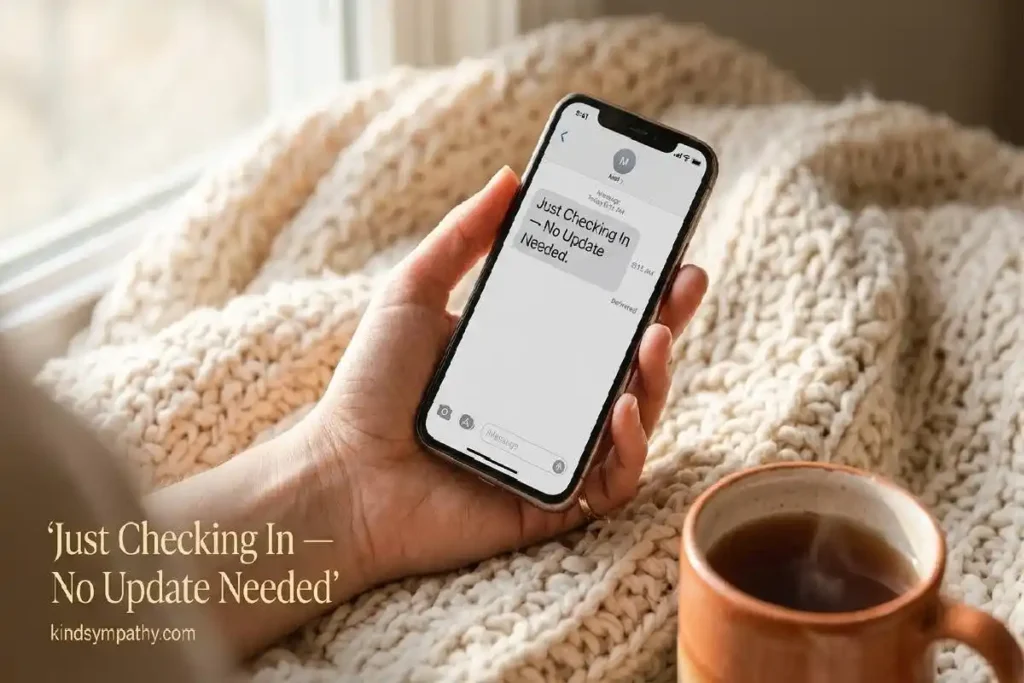
Just to Check In — Short Chronic Illness Support Messages
The best thing you can do for someone with a chronic illness is contact them regularly and without agenda. These short chronic illness support text messages are for exactly that — low-pressure, no-update-required, just a reminder that someone is paying attention.
- Just thinking about you today. No news required, no update needed. Just thinking.
- I know some days are harder than they look. I hope today is one of the easier ones.
- Not asking how you’re doing for an update — asking because I genuinely want to know.
- You don’t have to explain how you’re feeling. But I’m here if you want to.
- Living with chronic illness takes it out of a person in ways most people never see. I see it.
- I’m not waiting for you to feel better to reach out. I’m reaching out because I care about you right now.
- You’re managing something really hard every single day. I don’t want that to go unacknowledged.
- Some days just getting through is the whole achievement. I hope today you’re okay with that.
- I haven’t forgotten what you’re dealing with, even when life moves fast for me.
- Still here. Still thinking about you. Still not needing a progress report to show up.
- I know chronic illness doesn’t come with a timeline. Neither does my being in your corner.
- You look after yourself all day every day. Let me look after you a little too — even if it’s just this message.
- Thinking of you — not in a “hope you’re better soon” way, in a “you matter to me right now” way.
- The amount you manage without people noticing is extraordinary. I notice.
- I’m here for the hard days and the okay days and the days somewhere in between.

What Chronic Illness Actually Feels Like — Messages That Get It Right
People with chronic conditions often say the hardest thing isn’t the illness itself — it’s feeling like nobody truly understands what it costs to live with it. These chronic illness encouragement messages are written from a place of genuine understanding, not assumption.
- I know there’s a version of “fine” you give to people who ask, and then there’s how you’re actually doing. You never have to give me the first version. I want the second one — or no answer at all, whatever feels right.
- The energy it takes to manage chronic illness while also holding down a life — the appointments, the adjustments, the good days when you push too hard and pay for it later — most people genuinely don’t see that. I’m trying to see it. I think about it more than you probably know.
- One of the strangest things about chronic illness is that you can’t even explain it properly, because most people’s reference point for illness is something that ends. What you’re dealing with doesn’t end. That’s its own category of hard, and I want to acknowledge it clearly: what you’re living with is genuinely, significantly hard.
- I know some of what you’re managing is invisible — the pain that doesn’t show on your face, the fatigue that looks like laziness to people who don’t understand, the mental load of keeping track of everything your body requires. I don’t need to see it to believe it. I believe it.
- You have gotten so good at managing this quietly. Too quietly, sometimes. I want you to know you don’t have to manage it quietly with me. You can be frustrated. You can be exhausted. You can say it’s unfair — because it is.
- There’s a grief in chronic illness that doesn’t always get named — the grief for the life you had before, or the one you imagined having, or the things you used to do without thinking. That grief is real. I’m not going to rush you past it.
- You’ve adapted to so much. You’ve adjusted, cancelled, modified, explained, pushed through and rested. You’ve done all of it with more grace than most people manage on their best days. I see it. I genuinely admire it.
- I know you probably spend a lot of time making other people comfortable with your diagnosis. You don’t have to do that with me. I’m comfortable. Tell me whatever you want or nothing at all.
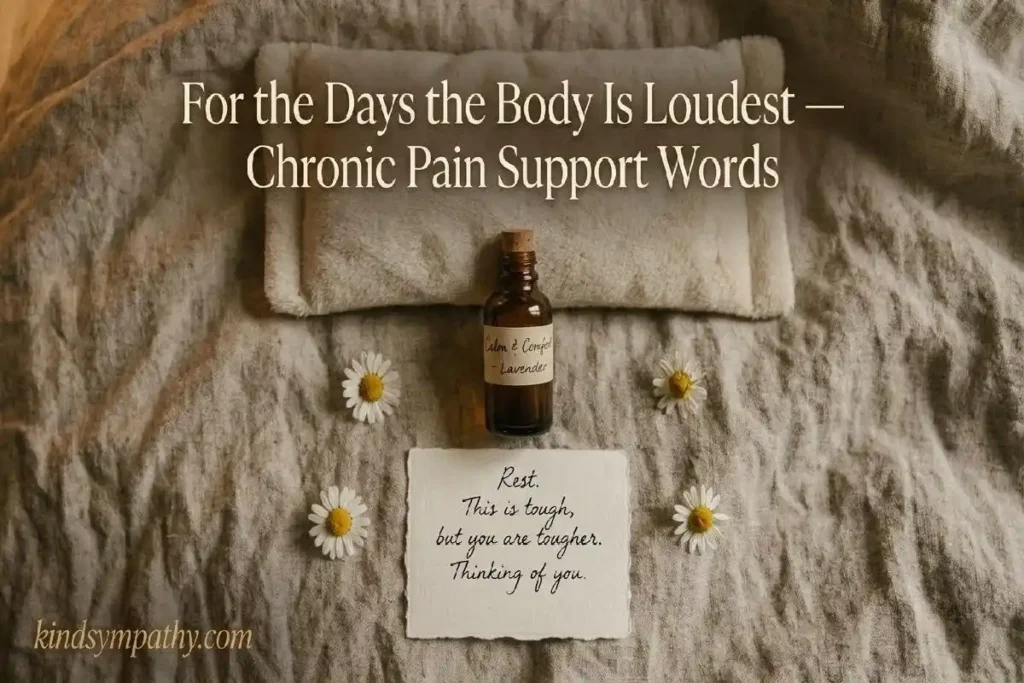
Chronic Pain Support Messages — For the Days the Body Is Loudest
Chronic pain has its own specific language, and people in it need to hear that the pain is real — not minimised, not compared to anything else, not explained away. These chronic pain support messages do none of that.
- I know today might be a high-pain day. I’m not going to try to fix it. I just want you to know I’m thinking about you through it.
- Chronic pain is exhausting in a way that goes beyond the physical — it wears on your mind, your mood, your sense of who you are. On a day like that, I just want to say: I see you. All of it.
- You don’t owe anyone a cheerful face when you’re in pain. Not even me. If you need to be honest about a bad day, I can handle it.
- Pain changes everything about how a day feels from the inside — even when from the outside you seem to be coping. I believe you completely, without needing to see it.
- Rest today. Not because it’ll fix everything — I know it won’t. But because your body is asking for it, and you deserve to listen to it without guilt.
- The worst part about chronic pain might be that it’s lonely — because pain this constant can’t be fully shared, only endured. I can’t take the pain. But I can make sure you know you’re not enduring it completely alone.
Invisible Illness Support Messages — For the Exhaustion of Looking Fine
Invisible illness — fibromyalgia, lupus, Crohn’s, ME/CFS, EDS, and dozens of others — comes with the added burden of constantly being disbelieved or dismissed. These invisible illness care words name that burden and sit with it.
- You look fine. I know that phrase has probably been the source of more frustration than most. I want to say clearly: I don’t need to see what you’re dealing with to believe it. Your experience is valid without proof.
- The amount of energy it takes to look fine while not feeling fine is its own invisible labour. I see that. Even when I can’t see the illness, I can see the effort.
- I’m so sorry that the world often requires you to prove something that shouldn’t need proving. I’m not one of those people. With me, you don’t have to prove anything.
- Invisible illness means invisible suffering, invisible effort, invisible grief. I’m going to try to make sure you’re less invisible to me — through regular check-ins, through remembering what you deal with, and through never asking you to justify it.
- You manage something real every day. The fact that it’s not always visible doesn’t make it less real. I know that. I believe that.

Autoimmune Support Messages — For the Long-Term, Unpredictable Journey
Autoimmune conditions are particularly complex — the flares, the remissions, the treatment adjustments, the never-knowing. These messages speak to that specific uncertainty.
- I know autoimmune conditions don’t follow a predictable path — good stretches and then setbacks, treatments that work and then stop working. The unpredictability is its own kind of exhausting. I’m not going anywhere through any version of it.
- Flares are brutal in a way that’s hard to explain to people who haven’t experienced them. You don’t have to explain it to me. I just want you to know I’m thinking about you through this one.
- I know remission doesn’t mean recovered, and a good stretch doesn’t mean the hard parts are done. I’m not going to assume things are fixed because you seem okay. I’m going to keep checking in because that’s what this kind of support looks like.
- The relationship between your body and your condition is complicated in ways even the doctors don’t always have answers for. That must be incredibly frustrating. I’m here — not with answers, but with consistent presence.
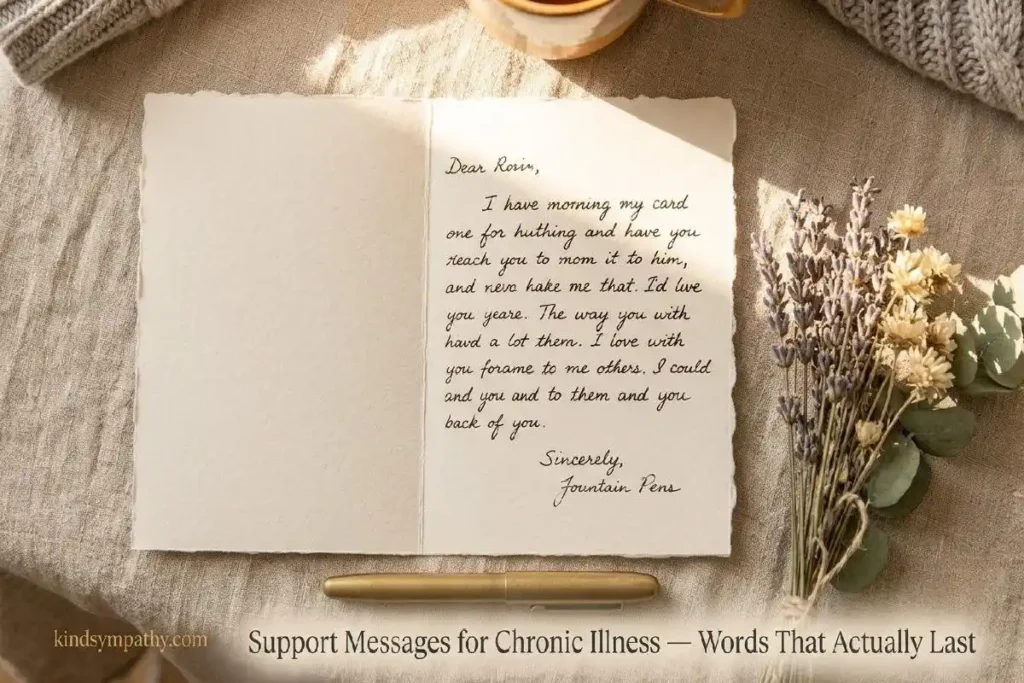
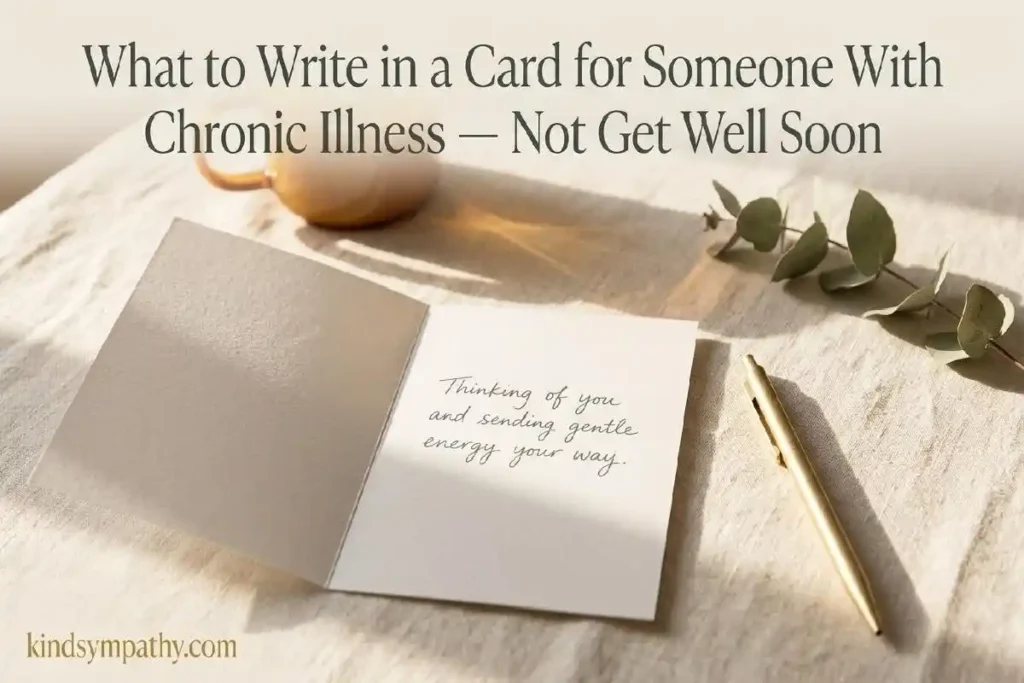
Chronic Illness Support for a Card — What to Write When Words Feel Insufficient
A card for someone with a chronic condition isn’t a get-well card. It needs to be something different — something that honours the ongoing reality rather than implying it’s about to change. Here’s what to write in a chronic illness support card that actually resonates.
- This card doesn’t say “get well soon” — because I know that’s not how this works. Instead it says: I see you, I’m with you in this, and I’m not waiting for a recovery to show up for you. You have me right now, exactly as things are.
- I wanted to send you something that acknowledged the reality of what you live with every day — not glossed over it with positivity. The reality is hard. And you handle it with more grace than I could. This card is just a small way of saying I know that.
- Keep this somewhere you’ll find it on a really hard day. It says: you are not as invisible as chronic illness tries to make you feel. Someone out here sees you clearly — and thinks you’re remarkable.
- No platitudes in this card. Just: I care about you, I believe what you’re going through is real and hard, and I’m in it with you for however long it lasts. Which is to say — for the long haul.
“For thinking of you messages during illness, our thinking of you messages for illness and thinking of you messages hospital are perfect for long-term check-ins.”
Copy & Paste Chronic Illness Support Messages 📋
Ready exactly as they are. Just copy this 👇
For a regular check-in (no update needed): “Hey — just checking in. Not for a health update, not for anything specific. I just wanted you to know I think about you and what you’re dealing with, and I haven’t forgotten. How’s this week been?”
For someone having a flare or bad stretch: “I heard things have been particularly rough lately. I’m not going to try to fix it or find a silver lining. I’m just going to say: I’m sorry. This is hard. And I’m here.”
For a close friend with a chronic condition: “You spend so much energy making your illness manageable for other people’s comfort. You don’t have to do that with me. You can just be honest. Tell me how it really is — I can handle the real version.”
For a card: “This isn’t a get-well card. There’s no ‘well’ in the traditional sense at the end of this road — and I know that. This is a ‘I see you, I respect what you’re managing, and I’m not going anywhere’ card. That’s all.”
For someone far away: “I wish I could be closer when you’re going through a hard stretch. Since I can’t, please know that from wherever I am, I think about what you deal with and I admire how you carry it. Call me any time.”
For someone who’s been managing this for years: “I know you’ve been dealing with this for a long time. I just want you to know that the length of time doesn’t make me more used to it — it makes me more aware of how much you carry. I haven’t moved on. I’m still paying attention.”
For a colleague or acquaintance: “I don’t know all the details of what you’re managing, but I know it’s a lot. I just wanted to say — I see you handling it, and I have a lot of respect for how you show up. If there’s anything that would make things easier, please say.”
For someone experiencing dismissal from others: “I’ve noticed that not everyone around you always seems to get it. I want to be clear about where I stand: I believe you completely. What you’re dealing with is real, and it’s hard, and you don’t have to explain it to me or justify it in any way.”
What NOT to Say to Someone With a Chronic Illness
These are said constantly — almost always with good intentions. Here’s why they land wrong and what helps instead.
❌ “But you don’t look sick.” Why it stings: The entire burden of invisible illness is already not being believed. This doubles down on it. ✅ Say instead: “I believe you. What you’re going through doesn’t need to be visible to be real.”
❌ “Have you tried [diet / supplement / positive thinking]?” Why it stings: People with chronic conditions have almost certainly tried everything. Suggesting basics implies they haven’t done enough. ✅ Say instead: “Is there anything I can do that would actually help? I want to support what works for you.”
❌ “At least it’s not [something worse].” Why it stings: Comparative suffering is never comforting. Their experience doesn’t become lighter because someone else’s is heavier. ✅ Say instead: “This is genuinely hard. I’m not going to put it on a scale.”
❌ “You just need to push through it.” Why it stings: People with chronic illness are pushing through it every single day. This implies they’re not trying hard enough. ✅ Say instead: “You’re managing so much every day. You’re allowed to rest too.”
❌ “I’m sure you’ll feel better soon.” Why it stings: With chronic illness, “soon” often isn’t how it works. This sets up false expectations and implies the person should be over it. ✅ Say instead: “I know there isn’t always a ‘better soon’ with this. I’m here for the long run.”
❌ “Everyone gets tired / sore / [symptom].” Why it stings: Chronic fatigue or pain is qualitatively different from ordinary tiredness. This flattens a serious condition into a universal experience. ✅ Say instead: “I can’t compare what I feel to what you’re living with — I know they’re different.”
❌ “You should be grateful it’s manageable.” Why it stings: Someone can be grateful and still be struggling. Gratitude doesn’t remove pain. ✅ Say instead: “You can feel however you feel about it. Struggling and being grateful aren’t mutually exclusive.”
One-Line Chronic Illness Support Messages ✨
Each stands alone — for a text, a card insert, or a Pinterest save on a hard day.
- I’m not waiting for you to feel better to show up for you.
- Managing chronic illness is a full-time job that nobody sees. I see it.
- You look fine. I know that doesn’t mean you feel fine. I believe the difference.
- There’s no finish line here — and I’m not waiting for one to care about you.
- Your worth is not tied to how well you’re managing today.
- Still here. Still checking in. No update required.
- Chronic doesn’t mean broken. It means ongoing. And so is my support.
- The days nobody asks are the days I’m thinking about you most.
- I believe every word you say about what your body is doing.
- You carry so much more than anyone sees. I’m trying to see it.
- Your hard days count even when they don’t look hard from the outside.
- I’m not here for when you’re better. I’m here now.
- Invisible illness is still real illness. I won’t forget that.
- You’re not too much. You’re not a burden. You’re someone I care about who happens to be managing something difficult.
Short Text or Long Message — What Works for Chronic Illness?
Chronic illness is a long-haul situation, and the right message length depends on where you are in the relationship — and where they are in the day.
Send something short often. Regular, light-touch check-ins matter more here than in almost any other context. People with chronic conditions often describe feeling forgotten — like they’ve become their illness, and since the illness doesn’t change, people stop checking in. A brief chronic illness support text sent on a regular Wednesday says: I still think about you. You’re more than a condition. I haven’t moved on. Do this consistently — set a reminder if you need to.
Go longer when something significant has happened — a new diagnosis, a difficult treatment, a particularly bad flare, or a time when they’ve opened up and you want to respond with full presence. Long messages work beautifully as handwritten letters or cards they can keep — something physical that says: I thought about you for more than a moment. Our guide to thoughtful care ideas for someone with a chronic condition has more on how to go beyond words.
The one thing that matters most: don’t wait until there’s news. The absence of news doesn’t mean the illness has gone anywhere. It means nothing has changed — which is its own hard thing to live with.
💡 5 Tips for Supporting Someone With a Chronic Illness Long-Term
Tip 1: Drop “get well soon” from your vocabulary for this person. It implies a recovery that may not come. Replace it with “I’m here for you” — which is both truer and more useful. Small language shift, enormous emotional difference.
Tip 2: Ask specific questions, not vague ones. “How are you?” can be exhausting when someone has a complex answer they’ve given hundreds of times. Try: “How’s your energy been this week?” or “Has the new treatment been any different?” Specific questions say: I’ve been paying attention. I know what’s happening for you.
Tip 3: Use their name. Keep the person separate from the condition. “How are you doing, Sam — not just the illness stuff, but you?” tells someone that you see them as a whole person, not a walking diagnosis. That distinction matters enormously.
Tip 4: Don’t disappear when nothing dramatic is happening. The middle stretches of chronic illness — when it’s just ongoing and manageable and not in crisis — are often when people feel most alone. No crisis means no one reaches out. That’s precisely when a regular check-in matters most.
Tip 5: Understand that chronic illness involves ongoing grief. Research on the psychology of long-term illness and identity loss shows that people with chronic conditions often experience sustained grief — for the life they had before, for the things they can no longer do, for the future they imagined. That grief doesn’t resolve. Harvard Health’s work on the emotional and physical toll of chronic conditions confirms that consistent social support — the kind that doesn’t require crisis to be activated — has measurable impact on how people live with long-term illness. Be the person who shows up on the ordinary days. Especially those.
❓ FAQ — Support Messages for Chronic Illness
What is the best support message to send someone with a chronic illness?
The best support messages for chronic illness remove the recovery assumption entirely. Try: “I’m not waiting for you to feel better to check in. I’m checking in because you matter to me right now, exactly as things are. There’s no finish line on my support.” That combination — no timeline, no condition, just presence — is what people with chronic conditions most rarely hear and most deeply need.
What are some short chronic illness support message examples I can send right now?
Short chronic illness support text messages work best as regular, low-pressure contact. Try: “Just thinking of you today — no update needed.” Or: “I know some days are harder than they look. Hope today is okay.” Or: “Still here. Still paying attention. How’s this week been?” Keep them brief, keep them frequent. Consistent beats elaborate.
What do you write in a card for someone with a chronic illness?
Don’t write “get well soon.” Write something that honours the ongoing reality instead: “This isn’t a get-well card — I know that’s not how this works. This is a ‘I see you, I’m with you, and I’m not going anywhere’ card.” That’s what to write in a chronic illness support card that actually reaches someone who’s heard all the generic versions already.
Should I send chronic illness support by card or text?
Both — strategically. Texts are for regular, low-key presence that says I haven’t forgotten. Cards are for the moments worth marking — a difficult anniversary of the diagnosis, a hard stretch, or simply because you want them to have something physical that carries your care. Text consistently; card occasionally with intention.
Is it okay to say “I don’t know what to say” to someone with a chronic illness?
Completely — and for chronic illness specifically, it can be refreshing. Most people say the wrong thing. “I don’t know exactly what to say — I just know I didn’t want to say nothing, and I want you to know I care about what you’re going through” is honest and doesn’t add to the list of unhelpful things. Research on chronic illness, isolation and social support shows that feeling genuinely seen — not managed or advised — is what matters most to people living with long-term conditions. And Harvard Health confirms that sustained human connection positively affects both emotional and physical health outcomes for people with chronic illness. Honesty over performance. Every time.