
You said yes before you knew what you were agreeing to.
“Would you be willing to say a few words?” Someone asked you that — a family member, a close friend, maybe the funeral director on a phone call you’d been dreading. And you said yes because it was the right thing to do, because you loved the person, because you couldn’t imagine someone else doing it.
And now you’re sitting in front of a blank screen, trying to compress an entire human life into five minutes of words that are supposed to do justice to someone irreplaceable, in a room full of people who are already crying, while you’re also trying not to cry yourself.
Eulogy templates don’t replace the personal — nothing can do that. But they give you the structure. The scaffolding. The place to put everything you already know about the person and let it become something speakable.
This guide walks you through exactly how to write a eulogy — the structure, the common mistakes, what to include and what to leave out — and then gives you five complete eulogy examples you can read, adapt, and make your own. Our guide to memorial message templates for services and tributes covers the shorter ceremonial formats if that’s what you need alongside this.
What are eulogy templates? Eulogy templates are structured frameworks for funeral speeches — complete or near-complete examples that help someone understand how to write a eulogy by showing what one actually looks and sounds like. The best eulogy templates are long enough to be genuinely useful, personal enough to feel real, and flexible enough to adapt to any relationship.
💬 Best Eulogy Opening Example: “I’ve been trying to write this for three days. I keep starting sentences and stopping them because nothing feels big enough. So I decided the only honest way to begin was to say that: there are no words big enough for [Name]. And then to try anyway — because they deserved someone trying.” This opening works because it names the impossibility of the task honestly, which immediately connects with everyone in the room who feels the same way. It sets a tone of genuine effort over polished performance — which is the right tone for a eulogy.
“For shorter funeral remarks, our sympathy speech for funeral covers less formal speaking. For memorial services beyond the funeral, our memorial message templates offers more options.”
How to Write a Eulogy — The Structure
Before the examples, let’s talk structure. A eulogy doesn’t have to be long — five to seven minutes is usually right. But it does need to move through a clear arc. Here’s the framework every good funeral speech template follows:
Part 1: The Opening (1–2 minutes) Introduce yourself briefly. Name your relationship to the person. Say something true about how hard this is — and say it honestly, not apologetically.
Part 2: Who They Were (2–3 minutes) This is the heart of the eulogy. Describe the person — not their biography, but their character. What were they like? What did they care about? What made them specifically themselves? Use stories, not summaries. One or two specific memories will always land harder than a list of accomplishments.
Part 3: What They Meant (1–2 minutes) Move from who they were to what they meant to you — and to the room. This is where grief and gratitude intersect. Acknowledge the loss. Acknowledge the love.
Part 4: The Close (30–60 seconds) End with something the audience can carry out with them. An instruction to honour the person. A final image of them. Something that completes the arc without forcing resolution.
That’s it. Four parts. Five to seven minutes. The rest is the person you’re honouring.
What to Include in a Eulogy (And What to Leave Out)
Include:
- Their name — used often and with warmth
- One or two specific stories or memories
- Something they said that captures who they were
- What the world loses with their absence
- What you carry forward because of them
Leave out:
- Long lists of accomplishments (these read as résumés, not eulogies)
- Anything that might embarrass or hurt members of the family
- Lengthy quotes that don’t reflect the person’s own voice
- A blow-by-blow account of their illness or death
- Anything you’re not sure you can get through without stopping
5 Complete Eulogy Templates — Read, Adapt, Make Yours
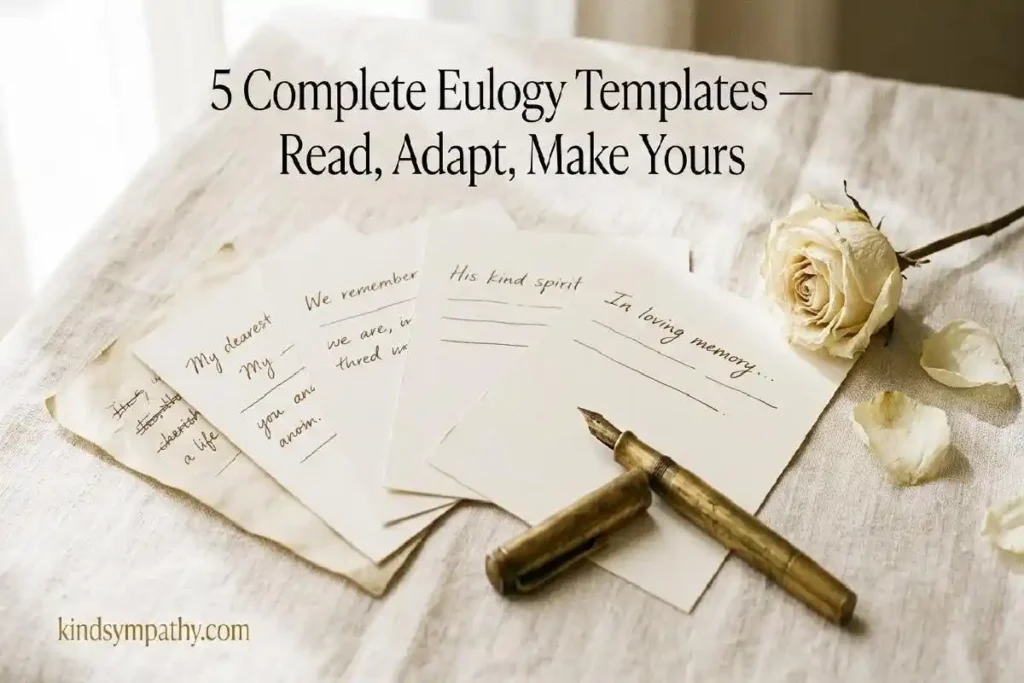
These are full eulogies — not outlines, not fragments. They run roughly 500–700 words each, which is five to seven minutes when spoken aloud. Read them. Underline what resonates. Replace the specifics with your own. They’re designed to be starting places, not final products.
Eulogy Template 1 — For a Parent
[This eulogy is written for a child delivering a tribute to a parent. Adapt pronouns and details as needed.]
My [mum/dad] used to say that the measure of a person wasn’t what they did when everyone was watching — it was what they did when no one was.
I thought about that a lot this week. About all the things [Name] did when no one was watching. The meals left out covered in the kitchen. The cheques written without mentioning them. The phone calls made to people who probably didn’t know how much the call meant. My [mum/dad] was someone who showed up without announcement, without keeping score, without any apparent expectation of being noticed for it.
I noticed. I know many of you did too.
I want to tell you about the [Name] I knew. Not the biography version — the real one. The one who [specific memory — a characteristic habit, a regular event, something that captures them]. The one who would [another specific detail]. The one who, when I was [age/situation], [short specific story — one that reveals character].
I’ve been trying to find the right words for days. What I keep coming back to is this: my [mum/dad] was not a complicated person. Not because they weren’t deep — they were deeper than I fully understood while they were alive. But because everything they cared about was simple and clear: family, [values they held], showing up for people. They didn’t waver on any of it.
I think about what I’ve inherited. Not material things — the real inheritance. The way I think about [value or quality]. The way I try to treat people when no one’s watching. The fact that when something hard happens in my life, my first instinct is still to ask what [Name] would have done.
That’s the inheritance. That’s what they left.
To everyone here who loved them: you are part of that. The people who gather at a service like this don’t gather for people who didn’t matter. They gather for people who left a mark. [Name] left one. On this family, on this community, on every person in this room.
I’m so grateful they were mine. I’m so grateful they were ours.
Go gently, [Name]. We’ll look after each other. That’s what you’d want.
“For sympathy cards, our what to write in a sympathy card and short sympathy messages help when words feel impossible.”
Eulogy Template 2 — For a Partner or Spouse
[Written for someone speaking at a service for their partner. Adapt as needed.]
When you love someone for [X years], you don’t think about what you’d say if they were gone. You think about dinner, and weekend plans, and whether they remembered to call the plumber, and a hundred small ordinary things. You don’t rehearse goodbye. You don’t practise describing them to a room full of people. You just live alongside them, and assume you’ll keep doing that.
I didn’t think I’d be standing here. I don’t think any of us did.
I want to tell you about [Name]. Not the full biography — you know the facts. I want to tell you about the [Name] who [specific memory — the private version of them]. The one who [characteristic trait or habit that reveals personality]. The one who, when I was at my worst, [story about how they showed up for you].
[Name] was [quality] in a way that I still don’t fully have the vocabulary for. I’ve tried to describe it to people who didn’t know them and I always fall short. The best I can say is: they made everything better. Not in a dramatic way. Just — better. The room was better. The day was better. The impossible thing felt slightly more possible because they were in it.
I’ve been wondering what I carry forward from twenty [or however many] years of loving this person. And here’s what I think: I carry the way they saw me. Not the way I saw myself, but the way they saw me — and I’m going to spend the rest of my life trying to live up to that version. That feels like the right way to honour them.
To [Name]’s family, who were also mine: we hold each other now. That’s what [he/she/they] would want.
To the room: if you loved [Name], you already know how to love people well. Go do more of that. Go be more of who [he/she/they] believed you were.
That’s the gift. That’s the whole gift.
Eulogy Template 3 — For a Friend
[Written for someone eulogising a close friend — the friendship itself is the centre of the speech.]
I’ve been asked to speak today as [Name]’s friend. Which feels both exactly right and completely inadequate — because friendship barely covers it. We were [however long] years of showing up for each other, and I’m not sure there’s a word that holds all of that.
But I’ll use friendship. And I’ll try to tell you what that word meant when it meant [Name].
It meant [quality]. It meant [specific way they were a friend]. It meant the phone ringing at [time] because they knew — somehow they always knew — when something was wrong. It meant [a memory that captures the texture of the friendship].
[Name] was the kind of friend who [something specific and true about how they showed up]. I know most of you have your own version of this. That’s the thing about genuinely good people — they’re genuinely good to everyone. It wasn’t just me they showed up for. It was all of us, in whatever way each of us needed.
I want to tell one story. Just one. [Insert a specific story that captures the person — ideally one that shows their humor, their kindness, their specific way of being themselves. Keep it to 100–150 words. End it with something that reveals their character.]
That was [Name]. That’s exactly who they were.
I don’t know how to do this without them. I know I’m not alone in that — I can see it in this room. What I also know is that [Name] had very little patience for people who didn’t look after themselves and even less for people who didn’t look after each other. So. We do that. We look after each other. We show up for the people they loved. We carry them in how we are.
That’s the eulogy. That’s the whole thing. The rest is just living it.
Eulogy Template 4 — For a Grandparent
[Written for a grandchild eulogising a grandparent. Adapts to the specific generational relationship.]
I’ve been thinking about what it means to have had [Name] as my [grandmother/grandfather/grandparent].
The easy answer is: everything. The more honest answer takes a little longer.
[Name] was [age] years old. [He/She/They] had [broad description of a full life — not a list, a feeling. “A life that spanned most of a century and touched more of it than most people manage in half the time.” Or similar.] But what I knew was the personal version. The [grandparent name] version. The one who [specific memory of what made them specifically themselves as a grandparent].
My earliest memory of [him/her/them] is [brief specific memory]. I remember [detail]. I’ve thought about that memory a lot this week. I think I’ll think about it for the rest of my life.
Grandparents give you something that nobody else can: they give you the long view. They’ve seen enough to know what matters. They’ve lived through enough to know what doesn’t. And if you were lucky — if you were really lucky — they told you.
[Name] told me [specific thing they used to say, a piece of advice or a perspective they consistently shared]. I didn’t fully understand it until [context — when I got older, when something happened, when I needed it]. Now I think it’s one of the truest things I’ve ever been told.
I want to speak for my generation of [family name]: we are better for having had [him/her/them]. We learned things from [him/her/them] that we couldn’t have learned anywhere else — about [quality], about [value], about what it looks like to live with [characteristic]. That’s the inheritance. Not the stuff. The stuff doesn’t matter. The knowing matters.
[Name] — thank you. For the long view. For the meals. For the stories. For showing us what it looks like when someone lives well. We’ll carry that forward. I promise we will.
Eulogy Template 5 — For a Young Person or Sudden Loss
[This is the hardest eulogy to write. This template is for the death of someone young, or an unexpected loss. It does not offer false comfort — it is honest about the size of the grief while trying to honour who the person was.]
I didn’t prepare for this. None of us did. That’s the thing about losing someone young — there’s no version of this that makes sense, and no preparation that would have helped anyway.
[Name] was [age]. [He/She/They] had [quality, quality, and quality]. [He/She/They] had [future they were heading toward — specifics make it real: a plan, a dream, a relationship, a passion]. [He/She/They] had so much ahead.
I’m not going to stand here and tell you this was meant to be. I don’t believe that. I don’t think you’re supposed to believe that either. Some things just happen — wrong, and too soon, and without any explanation that makes them acceptable.
What I can tell you is who [Name] was. And I want everyone here to leave knowing this person the way I knew them — because they deserve to be known.
[Name] was [specific quality, in detail]. They were the person who [specific story or memory — in a sudden loss eulogy, this section should be slightly longer and more detailed, because it carries the weight of everything they would have had the chance to say over a longer life].
[He/She/They] made me [better, braver, funnier, more myself — whatever is true]. I want to be specific about that: [brief personal account of how this person changed the speaker].
The truth is that the grief in this room is proportional to the love. And the love was enormous. That’s what you should know — that’s what I want [Name] to know, wherever they are. The love was enormous. You were loved enormously. And we are going to carry that with us.
We’re going to be different because you were here. The good kind of different. The kind that means something.
Go well, [Name]. You deserved more time. We’re so sorry you didn’t have it.
Common Eulogy Mistakes (And How to Avoid Them)
Even well-intentioned eulogies can go wrong. Here are the most common mistakes — and what to do instead.
Mistake 1: Starting with “Webster’s Dictionary defines…” It’s become a cliché because it delays getting to the person. Start with something specific and true. The definition can wait — the person’s name and the love you have for them can’t.
Mistake 2: Reading a chronological biography. Birth, school, marriage, job, death. This is a résumé, not a eulogy. Eulogies are about character, not curriculum vitae. Choose two or three moments that reveal who the person really was — and build around those.
Mistake 3: Trying to be funny when you’re not ready. Humor in a eulogy can be beautiful and healing — but only when it comes naturally from knowing the person. Don’t force it. If a funny story presents itself, use it. If it doesn’t, that’s fine.
Mistake 4: Going too long. Five to seven minutes is the sweet spot. Anything longer strains the audience and often the speaker. Say the essential things. Trust that less is more.
Mistake 5: Not practising out loud. A eulogy is a spoken piece. What reads well on paper might trip you up at a podium. Read it aloud at least three times before the service. This isn’t about performance — it’s about not being ambushed by your own words in a moment when you’re already at your emotional limit.
Eulogy Writing Tips — Practical Help for the Process
Tip 1: Start with stories, not statements. Don’t try to summarise who someone was. Tell one story that shows it. Concrete memories land harder than abstract qualities. “She was kind” tells us something. “She called the nursing home every day even when she was sick herself” shows us everything.
Tip 2: Write for the ears, not the eyes. Eulogies are heard, not read. Short sentences. Natural rhythm. Words that feel right when spoken aloud. Research on the psychology of grief and human connection consistently shows that the spoken word, delivered with genuine emotion, is one of the most bonding things humans can do together — especially in grief.
Tip 3: Use their name. Keep saying the person’s name. Not “he” or “she” or “they” — their actual name. Every time you use it, you keep them present in the room. That matters more than you might think.
Tip 4: Write the first draft without editing. Set a timer for twenty minutes and write everything you want to say about this person — memories, qualities, stories, jokes, things you miss, things you’re grateful for. Don’t edit. Just write. Then go back and shape it into a eulogy. The material is always in that first draft.
Tip 5: It’s okay to cry. The fear of crying is often what makes eulogies feel impossible. But crying during a eulogy doesn’t mean you’ve failed — it means you loved someone real. Harvard Health’s work on grief and emotional expression confirms that expressing grief genuinely — including crying — is not a sign of weakness. It’s a sign of love. Give yourself permission to feel it. The room will understand. The room is feeling it too.
❓ FAQ — Eulogy Templates and How to Write a Eulogy
What is the best eulogy template to use for a parent?
Eulogy Template 1 in this guide is written specifically for a parent. The structure works for either a mother or father: open with something they used to say, move into who they really were (not the biography, but the character), describe the inheritance they’ve left, and close with something for the room to carry. Adapt the specific memories and you have a complete eulogy example that will feel genuinely personal.
What are some short eulogy examples I can use as a starting point?
If you need something shorter than a full eulogy, the opening sections of each template above can be adapted as standalone tributes. Alternatively, our guide to memorial message templates for services and ceremonies has shorter formats — two to five sentence tributes, programme text, and plaque inscriptions — that work when a full speech isn’t required.
How long should a eulogy be?
The ideal eulogy runs five to seven minutes when spoken aloud — roughly 500–700 words on the page. Longer eulogies tend to lose the audience emotionally; shorter ones can feel rushed and incomplete. Five to seven minutes is enough to tell a story, honour the person, and close with something that the room can carry out with them.
What do you write in a eulogy for someone you loved?
The most important thing in any eulogy is specificity. Not “she was kind” — but what her kindness looked like in practice. Not “he was funny” — but the specific thing he said that made everyone laugh. Start with the person as they actually were, use their name often, include at least one story, and end with something forward-looking. The templates in this guide walk through every element of how to write a eulogy in that order.
Is it okay to say “I don’t know what to say” in a eulogy?
Yes — and in a eulogy specifically, saying it can be the most honest and connecting opening available. Research on the psychology of grief and human connection shows that authentic expression — including admitting the inadequacy of words — creates genuine connection in a room full of grieving people. And Harvard Health confirms that the act of trying — of showing up and attempting to put loss into language — is itself meaningful and healing. Start with “I don’t know what to say.” Then say it anyway. That’s the whole job.

Pingback: Sympathy Speech for Funeral — 40 Lines + 3 Scripts