
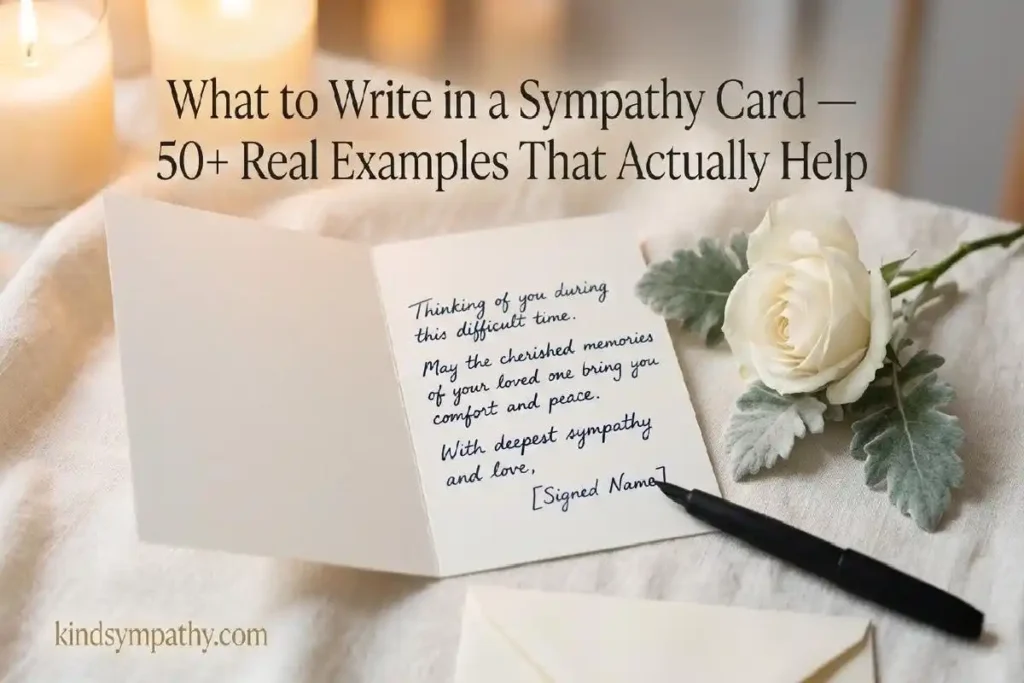
The card is in your hands. The pen is ready. The inside is completely blank.
And your mind has gone, suddenly and completely, empty.
You know what you feel. You know this person is going through something terrible. You know you want to say the right thing — something that actually helps, something that doesn’t sound hollow, something that lands the way it should. And yet here you are, staring at a small rectangle of white space that somehow feels enormous.
Knowing what to write in a sympathy card is harder than it looks. Not because the feeling isn’t there — it is — but because grief is the topic that makes language feel most inadequate. So people write “thinking of you” and sign their name and hope it’s enough. Sometimes it is. But it doesn’t have to stop there.
This guide walks you through exactly what to write in a sympathy card — the structure, the phrases that help, the ones to avoid, and over 50 ready-to-use examples for every type of loss. By the end of this, that blank inside won’t feel so empty.
Our full collection of sympathy messages for every type of loss has even more when you need them.
What is the best thing to write in a sympathy card? The best what to write in a sympathy card approach combines three things: acknowledging the loss directly, offering genuine presence, and keeping the message specific to the relationship. You don’t need to say much — but what you say should feel personal, not printed. Aim for honest over polished.
💬 Best Sympathy Card Wording Example: “I don’t have words that are equal to this loss. I just have this: I loved [name] too. And I love you. And I’m not going anywhere while this is hard.” This works because it names the inadequacy of words honestly, keeps the person who died real, and offers specific commitment rather than vague comfort. It says the three things a sympathy card most needs to say — I see the loss, I remember the person, I’m here.
The Anatomy of a Good Sympathy Card (Before You Write a Word)
Before we get to the examples, let’s talk structure. A good sympathy card doesn’t need to be long. It needs to do three things — and in this order:
1. Acknowledge the loss. Say it plainly. Don’t dance around it. “I’m so sorry for the loss of your [mum/dad/husband/friend]” is better than “I heard what happened.” Name the person if you can. Name the relationship. Don’t make them do the work of knowing what you’re referring to.
2. Say something true about the person who died or about your relationship. This is the part most people skip — and it’s the most important. “She was one of the kindest people I’ve ever known” or “I still hear his laugh when I think of him” makes the card feel personal rather than generic. It tells the recipient: I knew them too. I’m not just observing from the outside.
3. Offer something real. Not “let me know if you need anything” — something more specific. “I’ll be checking in” or “I’m here for whatever this looks like” or even just “I love you and I’m not going anywhere” tells them they have a specific person in their corner.
That’s the whole formula. Acknowledge, remember, offer. Everything else is detail.
What to Write in a Sympathy Card — Examples Organised by Loss
The relationship to the person who died shapes everything. Here are sympathy card examples tailored to each.
Sympathy Card Wording After the Loss of a Parent
The loss of a parent changes the shape of everything. These words acknowledge that.
- I’m so sorry about the loss of your [mum/dad]. They were [a remarkable person / someone who clearly loved you deeply / someone I was glad to know]. I’m thinking of you through every hard day of this.
- Losing a parent leaves a particular kind of hollow that nothing quite fills. I’m not going to pretend otherwise. I just want you to know I’m here for whatever this looks like.
- [Name] raised someone remarkable. That’s their legacy, and it lives in you. I’m so sorry they’re gone.
- I’ll always remember [name] for [specific memory or quality]. That’s a gift they left behind. I’m so sorry for your loss, and I’m here whenever you need me.
- Parents aren’t supposed to leave before us. When they do, it reorders everything. I’m thinking of you as you find your footing in this new landscape.
Sympathy Card Wording After the Loss of a Partner or Spouse
- Losing your partner means losing the person who knew you most completely. I can’t imagine the shape of the days ahead. I just know I’ll be here for them.
- [Name] was loved by so many. But the love you two had — that was its own particular thing. I’m so sorry. I’m here.
- There’s no adequate word for what you’re going through. I’ll settle for this: I’m thinking of you every day, and I’m not going anywhere.
- I know this changes everything. I’m not going to pretend it doesn’t. I just want you to know you don’t have to face any of it alone.
Sympathy Card Wording After the Loss of a Child
- There are no words for this. I know that. I just couldn’t let the card stay blank — that felt worse than an imperfect message. [Name] was [loved/wanted/so very real], and so are you. I’m here.
- I lit a candle for [name] today. I want them to be remembered. And I want you to know you’re not carrying this grief alone.
- I’m so deeply sorry. I hold you both in my heart — the child you lost and the parent you are. I’m here for all of it.
After the Loss of a Friend
- Losing a close friend is losing a whole private world — the jokes only you got, the shorthand, the specific comfort of them. I’m so sorry. That loss is real and enormous.
- I know not everyone understands that friend grief is grief. I do. And I’m thinking of you and of [name] with real love.
- [Name] was one of the good ones. The world is smaller without them. I’m so sorry.

Short Sympathy Card Wording — When Less Is More
Sometimes the blank inside is small, or you’re not sure what to say beyond the basics. These short sympathy card examples do the job without overreaching.
- I’m so sorry. I love you. I’m here.
- Words feel inadequate. Love doesn’t. I’m sending you both.
- Thinking of you and of [name]. With everything I have.
- No adequate words. Just this: I’m sorry, and I’m here.
- You’re in my heart. So is [name].
- I’m so sorry for your loss. I’m here whenever you need me.
- Thinking of you today, tomorrow, and through all of this.
- There are no right words. I’m sending love and presence instead.
- [Name] is missed. You are loved. I’m not going anywhere.
- I don’t know what to say except: I care about you deeply.
Heartfelt Sympathy Card Messages — When You Want to Say More
For the relationships that deserve the full message. These longer sympathy card messages are written to be read slowly, on a quiet evening when the card is found again.
- I’ve been trying to write this card for three days and keep not finding the right words. So I’m going to say the true thing instead: I love you. I loved [name]. And this is a real and terrible loss that I’m not going to dress up in comfort I can’t actually offer. What I can offer is this — steady, unglamorous, as-long-as-you-need showing up. That’s what I’m here for.
- [Name] was someone who made every room better. I know that’s true because I felt it — in the way they [specific quality], in the way you talked about them, in the way I always left their company feeling like something good had happened. The world is genuinely different now. I’m so sorry. And I’m here.
- I know you’re surrounded by people right now. But grief has a way of becoming very quiet and very solitary after the first wave. I want to be the person still here in week four. In month three. On the hard random Tuesdays. That’s my commitment to you. Right here, in this card.
- Losing [name] isn’t just your loss. It’s felt by everyone who knew them — and I know it ripples furthest and deepest for you. I want you to know that you’re not alone in missing them. I miss them too, in my smaller way. And I’m here for your larger way.
What to Write in a Sympathy Card for Different Relationships to the Sender
How you knew the bereaved person also shapes what’s right to say.
From a Close Friend
- I know you’re probably surrounded by kind people right now. I want to be specific about what I’m offering: not “let me know if you need anything” — but actually here. Whatever that looks like. Call me at 2am. Ask me to come over and say nothing. I’m in.
- You’ve always shown up for me. This is me showing up for you. No conditions, no timeline, no version of this where I’m not completely in your corner.
From a Colleague or Acquaintance
- I didn’t know [name] personally, but I know how much they meant to you — and that’s enough to make this a genuine loss. Please accept my deepest sympathies.
- We may not know each other well, but I wanted you to know: I’m thinking about what you’re going through. I hope the days ahead bring some comfort alongside the grief.
From a Distance — What to Write in a Sympathy Card When You Can’t Be There
- I wish I could be there. Since I can’t, please know that I’m thinking of you from wherever I am — not in a vague “I hope things are okay” way, but in a specific, daily, “you’re genuinely in my thoughts” way.
- Miles between us right now, but this card carries everything I’d say in person. I’m so sorry. I love you. [Name] is remembered here too.
“For mother loss cards, our sympathy messages for loss of mother has card-ready options. For friend condolence cards, our sympathy messages for a friend covers that tone.”
Bereavement Card Messages — What to Write for Specific Circumstances
For a Sudden or Unexpected Loss
- A sudden loss is its own particular shock — the grief lands before there’s been any time to prepare for it. I’m so sorry this happened so fast and without warning. I’m here for the whole of what comes after.
- There are no words for the shock of this. I just want you to know I’m thinking of you in it — through the initial disbelief, through whatever comes after. For as long as it takes.
For a Long-Expected Loss After Illness
- I know you’ve been preparing for this for a long time. I also know that preparation doesn’t make the loss smaller. I’m so sorry. I’m here for the grief that exists even when the goodbye wasn’t a surprise.
- You cared for [name] with so much love through their illness. Now the time for caregiving is over and the time for grieving is here. Let people look after you for a while. I’ll be one of them.
For a Pet Loss
- Losing a pet is losing a member of the family — someone who loved you unconditionally and whom you loved back just as completely. I’m so sorry. [Name] was clearly deeply loved.
- I know not everyone understands that the loss of a pet is real grief. I do. And I want you to know: I’m thinking of you, and of [name], with genuine care.
Copy & Paste Sympathy Card Messages — Ready to Write Right Now 📋
Just copy this and write it in the card 👇
For any loss (close friend): “I don’t have words that do this justice. I have love, and presence, and the commitment to still be here in month three when most people have moved on. That’s what this card carries.”
For loss of a parent: “I’m so sorry about [mum/dad]. They raised someone extraordinary. That’s their legacy — and it lives in you. I’m here for however long this takes.”
For loss of a partner: “Loving someone so completely and then losing them is one of the hardest things a person can experience. I’m not going to minimize that. I’m just going to be here.”
For a colleague: “I know we don’t always say these things at work — but I wanted you to know I’m thinking of you and I’m sorry for what you’re going through.”
For loss of a child: “There are no words for this. Just this: I love you, I remember [name], and I’m here for every single part of what comes after.”
For a sudden loss: “The shock of this kind of loss is its own thing. I’m not going to rush you to any version of okay. I’m just here.”
For a pet: “[Name] was family. The missing of them is completely real. I’m so sorry.”
For when you didn’t know the deceased: “I didn’t know [name], but I know you — and I know how much they meant to you. That’s enough to make this a real loss. I’m so sorry.”
What NOT to Write in a Sympathy Card
Knowing what to avoid is just as important as knowing what to say.
❌ “Everything happens for a reason.” Why it fails: Implies the death was purposeful or deserved. Even with the best intentions, this lands as dismissal. ✅ Write instead: “I don’t know why this happened. I just know I’m here.”
❌ “They’re in a better place.” Why it fails: Assumes beliefs you might not share — and even if you do, it can feel like it minimises the present loss. ✅ Write instead: “I hope they’re at peace. And I hope you find some peace too, in time.”
❌ “I know how you feel.” Why it fails: You don’t. Every grief is different. This inadvertently centres your experience over theirs. ✅ Write instead: “I can’t know exactly what this feels like. I just know I care about you deeply.”
❌ “Let me know if you need anything.” Why it fails: Places the burden on a grieving person to identify and request help. They rarely will. ✅ Write instead: “I’ll be in touch to check on you. And I mean it when I say I’m here for whatever helps.”
❌ “At least they had a long life.” Why it fails: “At least” is always minimising. A long life doesn’t make a loss smaller. ✅ Write instead: “I know the time they had was precious. And I know how much you’ll miss them.”
❌ Just signing your name with no message. Why it fails: A card with only a signature says: I felt obligated to send this but not moved to say anything. ✅ Write instead: Even one genuine sentence. “I’m so sorry. I love you. I’m here.” That’s enough.
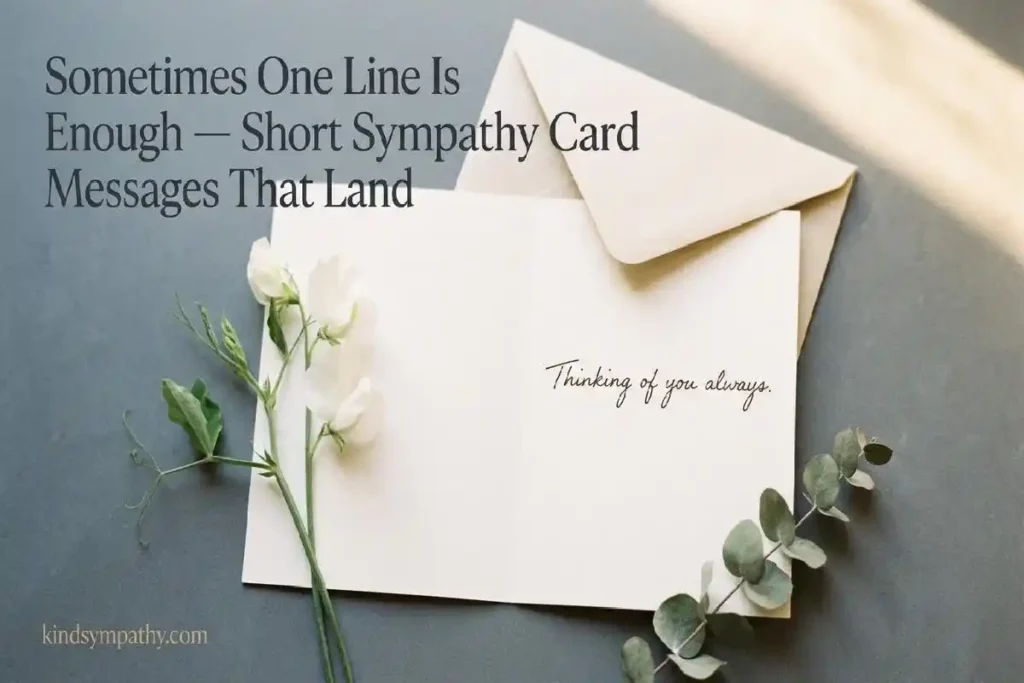
One-Line Sympathy Card Messages ✨
When the card is small or the relationship is at some distance — sometimes one perfectly chosen line is enough.
- I’m so sorry. I’m here.
- You are loved. You are not alone in this.
- No words. Just love. Just presence.
- [Name] is missed — by you, and by me.
- Grief takes the time it takes. I’ll be here all of it.
- This loss is real. So is my care for you.
- You don’t have to be okay. Not yet. Not for me.
- I’m thinking of you in the quiet moments especially.
- Still here. Still thinking of you. Still not going anywhere.
Short or Long — What Does This Particular Card Call For?
The length of what you write should match the depth of the relationship — not how much you’re feeling, which is always enormous.
Write shorter when you’re not close to the bereaved person, when the card is a smaller size, or when you genuinely don’t know what to say beyond the basics. One or two honest lines is always better than three cautious paragraphs. Short sympathy card wording that lands is infinitely better than a long message that doesn’t.
Write longer when this is one of the most important people in your life, when you knew the person who died well, or when you have something specific and true to say that couldn’t fit in a line. Longer messages have staying power — they’re the ones people read again and again on hard nights.
One rule applies to both: personalise it. Something that references the specific person who died, or the specific relationship you have with the bereaved, transforms an okay card into a meaningful one. Our guide to what to say to someone who is grieving goes deeper on making every word count.
💡 5 Practical Tips for Writing a Sympathy Card That Actually Helps
Tip 1: Name the person who died — by name. “I’m so sorry for the loss of your mother” is okay. “I’m so sorry about [name]” is better. Names keep people real. They tell the recipient: I know who you’re missing. I see the specific absence.
Tip 2: Say one specific, true thing about who they were. One sentence about the person who died transforms a sympathy card from generic to meaningful. “She always made everyone feel welcome” or “He had the best laugh I’ve ever heard” — something real that only someone who knew them could say.
Tip 3: Don’t make promises you won’t keep. “I’ll be there whenever you need me” sounds beautiful but creates an obligation you might not meet. Better: “I’m going to check in on you next week.” Specific and true beats generous and vague.
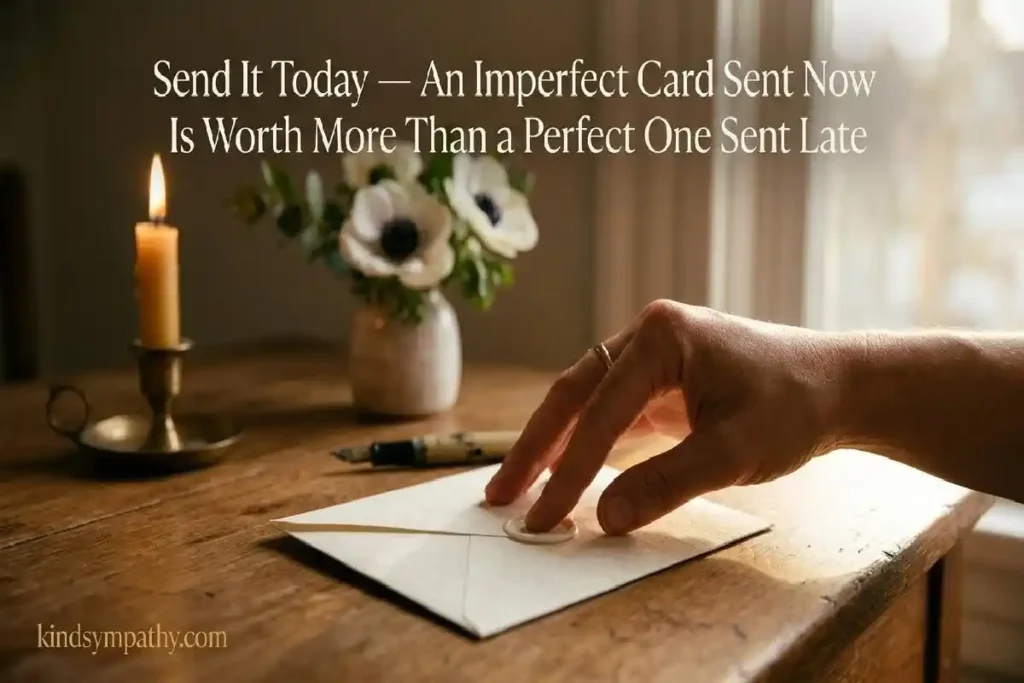
Tip 4: Send it now — don’t wait until you have the right words. The right words don’t exist. Research on the psychology of grief and human connection consistently shows that the act of reaching out — more than the quality of the words — is what matters to bereaved people. And Harvard Health’s work on grief and emotional support confirms this: the presence of caring contact is measurably meaningful. An imperfect card sent today is worth more than a perfect one sent next week.
Tip 5: Sign it the way you’d say it. “With love” or “With all my love” for people you’re close to. “With sympathy” for more distant relationships. Don’t end a heartfelt personal message with “Regards” — it undercuts everything that came before it. End the way you’d end a conversation with this person.
❓ FAQ — What to Write in a Sympathy Card
What is the best thing to write in a sympathy card?
The best what to write in a sympathy card approach combines three things: acknowledge the loss by name, say something true about the person who died or your relationship, and offer specific presence. Even a two-line card that does all three is more meaningful than a full page that’s generic. Start with “I’m so sorry about [name]” and let it build from there.
What are some short sympathy card message examples I can use right now?
Short sympathy card wording works perfectly for smaller cards or more distant relationships. Try: “I’m so sorry. I love you. I’m here.” Or: “No adequate words — just love and presence.” Or: “[Name] is remembered here. So are you.” These are short, specific, and carry genuine weight. Write one now.
What do you write in a sympathy card for the loss of a parent?
For a parent loss, acknowledge both the person and the relationship: “I’m so sorry about [name]. They raised someone remarkable — and that’s a legacy that lives in you.” Then offer something real: “I’m here for all of it, for as long as you need.” That’s what to write in a sympathy card for loss of a parent that goes beyond the standard.
Should I send a sympathy card or a sympathy text?
Send both if you can — they serve different needs. A text reaches them immediately, in real time. A card is lasting — something they can find again on a hard night months later. If you can only do one, send the card. It has a permanence and physical presence that a text can’t replicate. But don’t let choosing between them delay you — send something today.
Is it okay to say “I don’t know what to write” in a sympathy card?
Completely — and often it’s the most honest and connecting thing to say. “I’ve been trying to find the right words and I keep not finding them. So I’ll say the simple thing: I love you. I’m here.” That honesty is itself a form of care. Research on the psychology of grief and human support shows that genuine presence — even imperfectly expressed — is profoundly meaningful. And Harvard Health confirms that the emotional support of human connection is one of the most significant factors in how people navigate loss. Say the imperfect true thing. It’s always the right choice.



Pingback: What to Say to Someone Who Lost a Loved One {2026}
Pingback: How to Write a Condolence Letter — 10 Heartfelt Examples
Pingback: Sympathy Text Messages — 50+ Heartfelt Examples
Pingback: What to Write on Sympathy Flowers — 50 Messages