
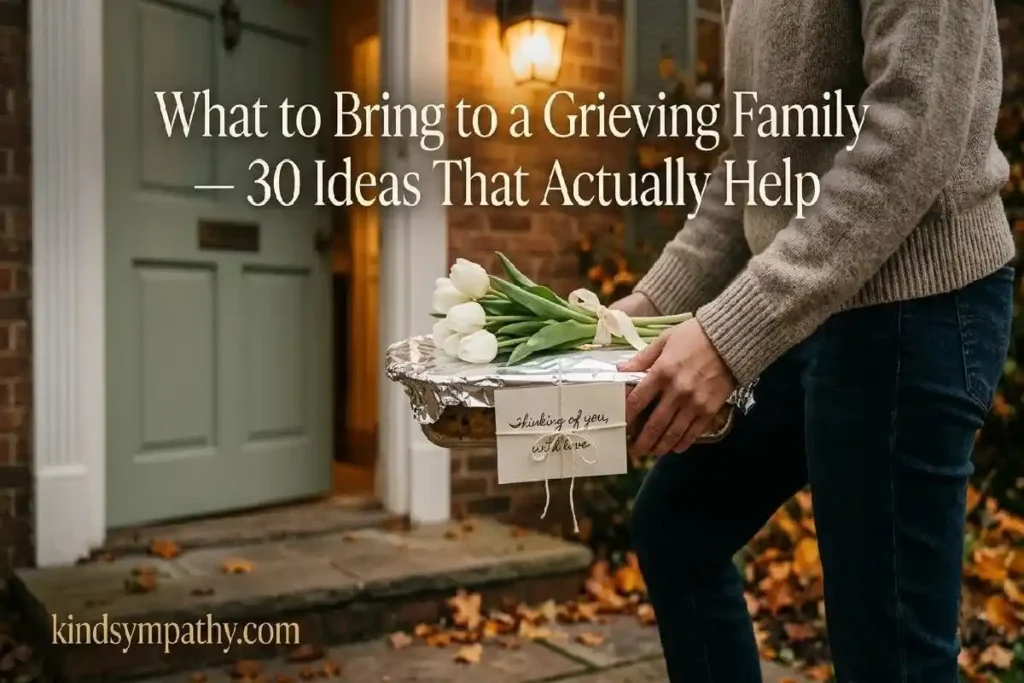
You’re standing outside their door.
Maybe you’ve been there before — this house, this street — but it feels different today. There’s a casserole dish in your hands you weren’t sure about. Or a bunch of flowers you picked up and then second-guessed. Or nothing, because you couldn’t figure out what to bring, and now you’re here anyway, which is the most important thing.
Knowing what to bring to a grieving family when you visit is something nobody teaches you. You learn as you go, often by getting it slightly wrong and noticing. The good news is: showing up is ninety percent of it. What you bring is secondary. But bringing the right thing — something useful, something that won’t create more work, something that says I thought about what you actually need — does make a difference.
This guide covers 30 practical bereavement visit gift ideas across every category — what to bring, what to say when you arrive, how long to stay, and what actually helps a grieving family in the days and weeks after a loss.
For the written words to pair with anything you bring, our guide to what to write in a sympathy card covers every format.
What should you bring to a grieving family? Knowing what to bring to a grieving family means thinking practically about what they actually need, not what feels symbolically right. The best visits bring something that reduces daily burden — food that doesn’t require cooking, practical items that are in short supply, or simply your presence and the willingness to stay.
💬 Best Thing to Bring to a Grieving Family: A home-cooked meal in a disposable container — with a note saying which night it’s for — plus a small handwritten card. This works because it feeds people without creating washing up, removes one daily decision from a depleted family, and the note means they don’t have to plan around it.
“For gifts beyond in-person visits, our sympathy gift ideas has 60 options. For gift baskets to send remotely, our sympathy basket ideas covers that too.”

Before You Go — What a Grieving Family Actually Needs (That Nobody Says Out Loud)
Here’s the thing about visiting a grieving family: the visit is the gift. The thing in your hands is secondary. Showing up — physically, at the door, in the week after a loss — is the irreplaceable thing.
But what you bring signals something too. It signals whether you thought about their actual life right now, or whether you grabbed something because you needed to arrive with something. The best condolence visit gifts are practical, low-effort for the receiver, and genuinely useful in the specific circumstances of fresh grief.
Those circumstances are:
- The kitchen is full of people and nobody knows what to cook
- There’s food everywhere but nobody’s making sure anyone actually eats
- Small practical things are running out because nobody’s had time to shop
- The house is full of visitors and nobody’s thought about toilet paper
- Everyone is exhausted and the children still need entertaining
- There are a hundred small things to manage and nobody has capacity for any of them
Keep that list in mind as you read this. The best thing you can bring is whatever meets one of those needs.

What to Bring to a Grieving Family — Food and Nourishment
Food is the oldest language of grief support. These are the items that actually help — not just what sounds good in theory.
- A home-cooked meal in a disposable container. The gold standard. A lasagne, a soup, a casserole — something substantial, made with care, in a container they don’t need to return. Leave a note saying which night it’s for: “This is for Tuesday. Put it in the oven at 180 for 40 minutes.” That specificity is everything.
- Quality bread, butter, and something to go on it. Simple, immediate, no cooking required. Good sourdough, real butter, a good cheese or quality ham. Food for people to graze on during the long days of visitors.
- A box of quality biscuits or pastries. For the tea and coffee that flows constantly in a grieving house. Quality matters — this is not the moment for the value pack.
- A fruit bowl, properly assembled. Not a bag of mixed fruit — actual ripe, ready-to-eat fruit arranged in a bowl they can put on the kitchen table. Low effort, immediate, something healthy when everything else is cake.
- Ready-made sandwiches or a deli selection. For a family managing funeral arrangements — the people who need to eat between appointments and can’t stop to cook. A good deli selection, packaged and ready.
- Tea and coffee supplies. A grieving house runs on tea and coffee. A large tin of good quality coffee, several boxes of good tea — black, herbal, decaf. The house will run out. You can prevent that.
- Paper plates, cups, and napkins. Nobody’s washing up. This practical contribution means a lot more than it looks like.
- Alcohol — if they drink and you know they’d welcome it. A bottle of good wine or whisky, chosen for them specifically. Only if you know the family well and this is appropriate. Leave it with a note: “For when the house gets quiet.”
“For what to SAY when visiting, our how to comfort someone who lost a loved one and what to say to someone who lost a loved one prepare you for the conversation.”

Practical Things to Bring to a Grieving Home (That Nobody Thinks Of)
These funeral family visit gifts are the unglamorous ones — the ones that get used immediately and matter enormously.
- Toilet paper and paper towels. Nobody’s thinking about this. The house has more people in it than usual. This will run out. Buy a large pack and leave it discreetly.
- Washing up liquid, dishwasher tablets, bin bags. The practical essentials. Nobody’s doing the shopping. These things run out. Leaving a bag of household supplies is one of the most genuinely useful things you can do.
- A box of tissues. Multiple boxes. The nice kind. Leave them in every room.
- Batteries. Sounds strange. But remote controls, children’s toys, smoke alarms — they always need batteries. A multi-pack of AA and AAA will be used.
- Milk. A big carton. The house is drinking a lot of tea. They’ll run out of milk before anything else.
- A bag of washing powder or capsules. There’s a lot of laundry happening in a grieving house. This is genuinely useful and genuinely invisible — which is the ideal practical gift.
- Children’s snacks. If there are children in the house — fruit pouches, crackers, snack bars, small treats. Children still need feeding on a schedule regardless of what’s happened to the adults’ sense of time.
Things to Bring to a Grieving Family — Comfort Items
Beyond the practical, some things bring warmth and signal care in a way that a bin bag of household supplies can’t.
- A beautiful candle. Not a generic one — something quality, something chosen. To be lit in the evenings. A small ritual.
- Fresh flowers, arranged simply. Not a huge, elaborate arrangement — something simple, already in water if possible. Lilies are traditional but can be polarising; white roses, tulips, or seasonal flowers in a simple vase are universally lovely.
- A planted succulent or small plant. Something longer-lasting than cut flowers. Something to tend, gently, when they’re ready.
- A quality blanket or throw. For the sofa. For the person who needs to be on the sofa. Something soft and warm.
- A sleep kit. Particularly meaningful to leave at a bereaved household: lavender pillow spray, herbal sleep tea, a sleep mask. Grief devastates sleep. This practical and thoughtful item will be used.
What to Bring for a Grieving Family With Children
Children in a grieving household have specific needs that often go unmet when the adults are overwhelmed. These gifts to bring after death specifically support children.
- A children’s book about grief. There are excellent, gentle books for different age groups about loss. Leave one with a note for the parents: “In case this helps when you’re ready.”
- A small activity set. A colouring book and pencils, a puzzle, a simple board game. Something that keeps children occupied during the long hours of adult sadness.
- A comfort toy or soft animal. For a younger child — something soft to hold.
- Snacks specifically chosen for the children. Ask or already know what they like. Children’s favourites, brought specifically for them, signals that someone remembered they exist.
- An offer to take the children for an afternoon. Not a purchased gift — but the most valuable thing you can offer a grieving parent. “Can I take [child’s name] to the park Saturday morning? You don’t have to worry about anything.” Specific, practical, genuinely useful.
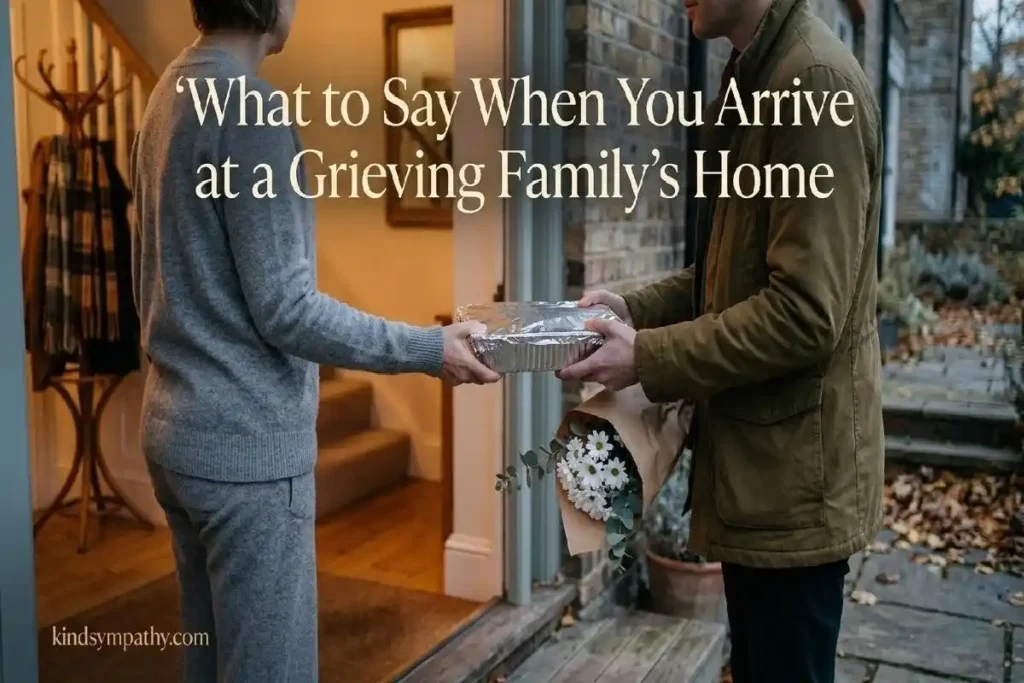
What to Say When You Arrive (Not Just What to Bring)
The thing in your hands matters less than how you are when you walk through the door. Here’s what to actually say and do when you arrive for a condolence visit.
- Keep the visit short unless they ask you to stay. Twenty to thirty minutes is usually right. You’re not there for a long social event — you’re there to show up. If they want more, they’ll ask.
- Don’t wait to be told what to do. Ask: “Can I make tea? Can I do some washing up? Is there anything that needs doing while I’m here?” Then do the thing without making it a production.
- Say their name — the person who died. Don’t dance around it. “I was thinking about [name] on the way here.” Saying the name tells the family: I’m not afraid of this. You don’t have to protect me.
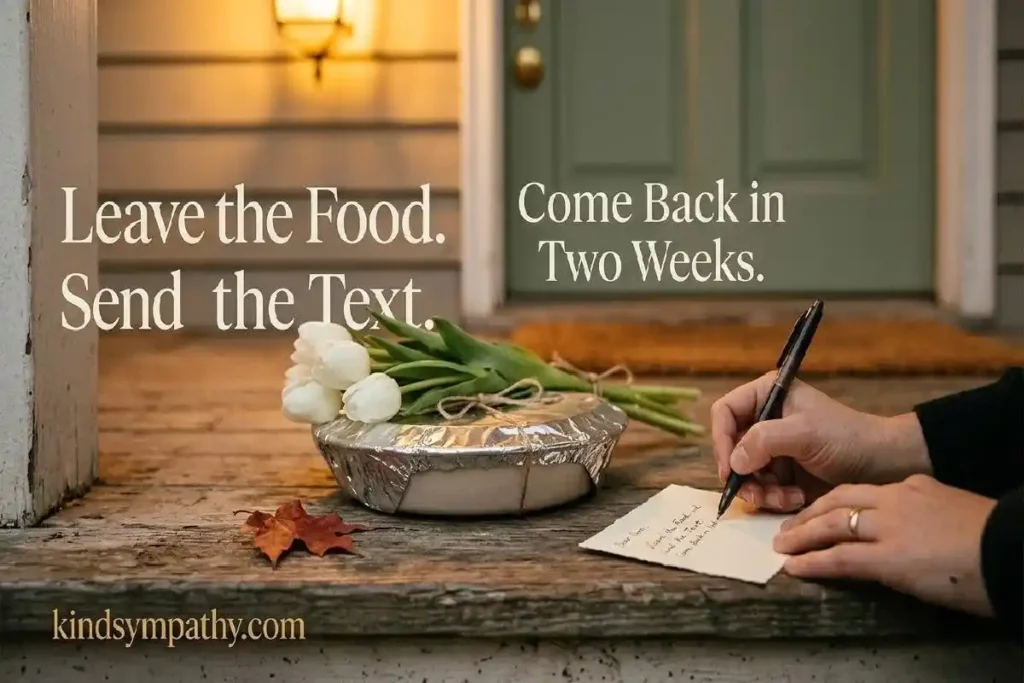
- Bring the thing and leave. Sometimes the best visit is leaving the food at the door with a note and not requiring anything from the family. “I’ve left this outside — you don’t have to come to the door. Just wanted you to have it.” A text sent before you arrive gives them the option.
- Follow up. The first visit matters. The one three weeks later matters more. Make a plan, before you leave, to come back. “I’ll bring dinner again Thursday — is that okay?” Specificity is care.
“Knowing what NOT to say or do matters too. Our what not to say to someone grieving and how to help a grieving friend guide you.”
What NOT to Bring to a Grieving Family
Some common choices create more work than they solve. These are worth knowing before you go.
❌ Flowers that need arranging. Why it misses: A grieving family doesn’t have the energy to find a vase, trim stems, arrange a bouquet. If you bring flowers, bring them in a vase already in water, or bring something that’s already done. ✅ Bring instead: Flowers in a simple vase, or a potted plant that requires nothing.
❌ Food in your good containers. Why it misses: Now they have to think about returning your casserole dish. Use disposable containers or ones you genuinely don’t want back. ✅ Bring instead: Foil containers, a disposable baking dish, or a container you’ve explicitly told them to keep.
❌ Perishable food without instructions. Why it misses: A grieving family can’t always manage “use within two days.” If you bring food, include a note about storage and timing. ✅ Bring instead: Labelled food with instructions: “Fridge. Thursday. 180 degrees, 40 minutes.”
❌ Alcohol for families where it might be inappropriate. Why it misses: If you don’t know the family’s relationship with alcohol — or if there’s any reason it might be unwelcome — leave it out. ✅ Bring instead: A quality sparkling water, a nice juice, a good tea.
❌ Something that needs to be opened in front of you. Why it misses: The grieving family shouldn’t have to perform gratitude. Leave things with a note, not with expectation. ✅ Bring instead: Anything with a clear, simple note that removes the need for a reaction.
❌ A very long visit when they haven’t asked for one. Why it misses: Energy is scarce. Even people they love can feel like too much. Twenty to thirty minutes, unless they clearly want more. ✅ Do instead: Arrive with the thing, stay briefly, offer to come back at a specific time.
What to Write When You Leave Something at the Door 📋
Sometimes you drop off without coming in. These notes are ready to go. Just copy this 👇
With a home-cooked meal: “Left this at the door — no need to come out. This is for [day]. Just heat at 180 for [time]. Thinking of you all.”
With practical supplies: “Just a few useful bits. No response needed. I’ll check in again [day].”
With comfort items: “This is for the evenings. Nothing to do with it except receive it. I love you and I’m here.”
With food for the children: “A few things for [child’s name]. Thinking of them, thinking of all of you.”
With flowers: “These are already in water — just find them a spot. With all my love.”
For when you can’t visit in person: “I wish I could be there. This is the next best thing I’ve got. I’m thinking about your family every day.”
💡 5 Tips for Visiting a Grieving Family
Tip 1: Come prepared to do something, not just to be there. The best visits are active, not passive. Don’t sit and wait for direction. Ask what needs doing and do it. Load the dishwasher. Put a wash on. Make tea for everyone. Being useful is being loving.
Tip 2: Bring something, even if it’s small. Empty hands feel harder — both for you and for the family. Even a packet of good biscuits and a card is something. It says: I thought about this visit on the way here. Research on the psychology of grief and human connection confirms that practical, tangible gestures of care are among the most meaningful things people receive during bereavement.
Tip 3: Keep the time short — but make a specific plan to come back. Twenty to thirty minutes is right for most visits. Then say: “I’ll come back Thursday with dinner — is that okay?” Specific plans get kept. Vague offers don’t. Harvard Health’s research on the long-term physical and emotional effects of grief confirms that the sustained presence of people who show up repeatedly matters more than any single visit.
Tip 4: Say the name of the person who died. Don’t avoid it. “I’ve been thinking about [name]” or “I miss [name] too” tells the family that you’re not afraid of the reality. That you’re not going to make them manage your discomfort. That’s a profound gift.
Tip 5: The visit three weeks later matters more than the one today. Everyone visits in the first week. The third week, when the house is empty and the grief is still entirely real — that’s when your visit means the most. Come back. Bring something again. Be the person who doesn’t disappear.
❓ FAQ — What to Bring to a Grieving Family
What is the best thing to bring to a grieving family?
The best answer to what to bring to a grieving family is something practical that reduces daily burden — a home-cooked meal in a disposable container, a bag of household essentials, or quality food that requires no preparation. Pair it with a personal note and arrive prepared to do something rather than just sit. The visit is the gift. What you bring makes the visit more useful.
What are some quick ideas for what to bring to a grieving home I can get today?
Quick bereavement visit gift options available today: a home-cooked meal (if you have time), quality bakery items, a large carton of milk plus tea and coffee supplies, a bag of household essentials (toilet paper, washing up liquid, bin bags), or a quality blanket with a candle. Our full sympathy gift ideas guide has more options if you want something more considered.
What do you say when you arrive at a grieving family’s home?
Keep it simple and human. “I just wanted to come. I’ve been thinking about you and about [name].” Don’t wait to be told what to do — offer to make tea, do some washing up, or just sit. Say the name of the person who died. Stay for twenty to thirty minutes unless they clearly want more. Our guide to what to say to someone who lost a loved one covers the verbal dimension in detail.
Should I call ahead before visiting a grieving family?
Always — unless the family has specifically said “come any time.” A short text saying “I’d love to drop something round — is there a time in the next couple of days that works?” gives them control. If they don’t respond or say they’re not up for visits, respect that. A doorstep drop-off — leaving food with a note — is a perfect alternative that requires nothing from them.
Is it okay to leave something at the door without coming in?
Completely — and for many families, especially in the first few days, it’s the most considerate option. Text ahead: “I’m leaving something at the door — you don’t need to come out.” Research on the psychology of grief and human connection confirms that practical care — even without direct contact — meaningfully reduces the isolation of bereavement. And Harvard Health confirms that sustained, thoughtful gestures over time matter more than single grand ones. Leave the food. Send the text. Come back in two weeks.