You meant well. Of course you did.
Almost every painful thing said to a grieving person was said by someone who cared, who wanted to help, who reached for the nearest available phrase and handed it over with genuine love. The problem isn’t intention. The problem is that certain phrases — ones that feel helpful from the outside — land very differently on the inside of grief.
Knowing what not to say to someone grieving isn’t about walking on eggshells. It’s about understanding something important: grief is not a problem to be solved, a timeline to be managed, or a perspective to be corrected. When we try to fix it with the wrong words, we accidentally communicate the opposite of what we intend.
This guide covers 30 of the most commonly used phrases that genuinely hurt people who are grieving — organised by the type of harm they cause, so you understand the pattern, not just the phrase. And for every one that misses the mark, there’s a better alternative that actually lands.
Save this before you go to any funeral. Share it with anyone who’s ever searched “what to say to someone who lost someone.” Our full guide to what to say to someone who lost a loved one covers the positive version in detail.
What phrases should you avoid saying to someone who is grieving? Knowing what not to say to someone grieving is just as important as knowing the right words. The phrases that hurt most are typically ones that minimise the loss, rush the grief process, impose religious beliefs, or accidentally centre the speaker’s discomfort over the griever’s pain. The antidote is almost always honesty and presence over comfort and closure.
💬 The Most Common Phrase to Avoid: “Everything happens for a reason.” This is said constantly and almost always lands wrong. There is no reason good enough for losing someone you love — and implying there is dismisses real pain with a cosmic explanation that helps no one. Replace it with: “I don’t know why this happened. I just know I’m here.”
“Knowing what not to say connects directly with our what to say to someone who lost a loved one and what to write in a sympathy card guides — read them together.”
Category 1 — The Silver Lining Trap (Phrases That Minimise the Loss)
These phrases try to make the loss feel smaller. They don’t. They just make the grieving person feel like they’re not allowed to feel how big it actually is.
1. “At least they lived a long life.”
Why it hurts: Length of life doesn’t reduce the pain of losing someone. A parent who dies at 94 is still gone. “At least” is always minimising — it suggests the loss should feel better for some qualifying reason.
Say instead: “I know how much you loved them. The length of time doesn’t make them easier to miss.”
2. “At least they’re not suffering anymore.”
Why it hurts: Even when true, this rushes past the loss to a silver lining the grieving person didn’t ask for. It also implies they should feel relieved when what they feel is bereaved.
Say instead: “I hope they’re at peace. And I know that doesn’t make the missing any easier.”
3. “You should be grateful for the time you had.”
Why it hurts: Gratitude and grief can coexist — but being told to feel gratitude when you’re in acute loss feels like a deflection. It implies grief is disproportionate.
Say instead: “The time you had together was precious. And I know that’s exactly why this is so hard.”
4. “At least you can have more children.”
Why it hurts: This is one of the most devastating things you can say after a pregnancy loss or the death of a child. The person who was lost cannot be replaced. Full stop.
Say instead: Nothing — for some losses, there is no silver lining and you shouldn’t look for one. Just: “I’m so deeply sorry. I’m here.”
5. “It could be worse.”
Why it hurts: Pain is not a competition. Comparative suffering never comforts. It just makes people feel their grief is being graded against something.
Say instead: “What you’re going through is genuinely, legitimately hard. I’m not going to minimise it.”
Category 2 — Rushing the Grief (Phrases With an Invisible Timeline)
These phrases come from a good place but carry an implicit message: you should be further along than this. Grief doesn’t have a deadline.
6. “Time heals all wounds.”
Why it hurts: It’s simply not true for everyone — and even when time does change grief, hearing “just wait it out” isn’t helpful when you’re in it right now.
Say instead: “I know grief doesn’t follow anyone else’s schedule. I’m not going anywhere while you find your way through this.”
7. “You need to start moving forward.”
Why it hurts: Nobody gets to decide when someone else should move forward. This is often said with kind intent but heard as a judgement.
Say instead: “Take whatever time you need. I’ll be here whether that’s a week or a year.”
8. “You should be feeling better by now.”
Why it hurts: This is a timeline placed on grief that has no business being there. It also makes the person feel like they’re failing at grieving.
Say instead: “There’s no deadline on this. Grief takes as long as it takes.”
9. “Life goes on.”
Why it hurts: True, technically. Also completely beside the point when someone is in the middle of acute loss. It feels dismissive.
Say instead: “The world keeps going, I know. You don’t have to keep pace with it right now.”
10. “They wouldn’t want you to be sad.”
Why it hurts: Uses the deceased to manage the griever’s emotions. The person who died isn’t here to confirm this — and being sad is a natural, appropriate response to love and loss.
Say instead: “Missing them is one of the most human things about you. I’m not going to argue with it.”
“For the right things to say instead, our sympathy messages and short sympathy messages collections have tested, human-approved words.”
Category 3 — The Explanation Problem (Phrases That Try to Give Grief a Reason)
Grief doesn’t need an explanation. These phrases try to provide one and almost always make things worse.
11. “Everything happens for a reason.”
Why it hurts: There is no reason good enough for the death of someone you loved. This phrase implies there is — and shuts down genuine grief with a cosmic narrative.
Say instead: “I don’t know why this happened. I just know I’m here.”
12. “God needed another angel.”
Why it hurts: Even for religious people, this can feel hollow. For non-religious people or those in a different faith, it’s tone-deaf. And for parents who’ve lost a child, it can feel actively cruel.
Say instead: If you want to express faith, try: “I’m holding you in my prayers.” Leave theology out of it.
13. “It was their time.”
Why it hurts: Implies a predetermination that dismisses grief. It also suggests the griever should accept rather than mourn.
Say instead: “I’m so sorry. This loss is real and it hurts — and you don’t have to explain that to me.”
14. “This is part of God’s plan.”
Why it hurts: Like #12, this imposes a belief system and implies the loss should feel purposeful. It doesn’t. And hearing this when you’re bereft can feel like a door being closed.
Say instead: “I believe there’s something beyond this pain, even when it’s hard to see. And I’m here while you’re in the hard part.”
Category 4 — The Centring Problem (Phrases That Make It About You)
These phrases shift attention — however briefly — from the grieving person to the speaker. In a moment of loss, that shift matters more than you might think.
15. “I know how you feel.”
Why it hurts: You don’t. Every grief is different. Every relationship is different. Even two people grieving the same person feel it differently. This phrase implies a commonality that isn’t there and centres your experience.
Say instead: “I can’t know exactly what this is like for you. I just want to understand if you’ll let me.”
16. “I was just talking to them last week / they seemed so healthy.”
Why it hurts: This centres your shock rather than their grief. It can also imply a kind of disbelief that makes the grieving person feel like they need to convince you.
Say instead: “This came as such a shock. I’m so sorry.”
17. “I’ve been so worried about how to reach out.”
Why it hurts: Now the griever has to reassure you. Your discomfort with grief just became their problem.
Say instead: Just reach out. No preamble. “I’m so sorry. I love you. I’m here.”
18. “I don’t know how you’re managing to hold it together.”
Why it hurts: Assigns the performance of strength when they might be falling apart privately. Also implies they should be less together than they are — or more.
Say instead: “You don’t have to hold it together. Not with me.”
Category 5 — Replacement and Future-Framing (Phrases That Skip the Present)
These phrases look ahead when the grieving person is very much in the present. They’re well-intentioned but land as dismissals.
19. “You’ll find someone else.”
Why it hurts: No one replaces the person who was lost. Ever. This is especially harmful after the loss of a partner or spouse.
Say instead: Nothing about the future. “Right now, I’m just here for this loss.”
20. “You’re so young — you have so much ahead of you.”
Why it hurts: Implies they should be comforted by their future when their present is unbearable. Age doesn’t make grief smaller.
Say instead: “I know it doesn’t feel like it right now. I’m just here with you in this moment.”
21. “At least you have other children.”
Why it hurts: Children are not interchangeable. The loss of one is not offset by the presence of others. This is one of the most hurtful things you can say to a bereaved parent.
Say instead: “[Name] was irreplaceable. I’m so sorry.”
22. “Focus on the good memories.”
Why it hurts: Good memories and grief coexist — but being told where to direct your emotional attention is controlling, however gently meant.
Say instead: “Tell me a memory of them if you want to. I want to hear about them.”
Category 6 — The Advice Problem (Phrases That Add Tasks to Grief)
Grief is exhausting. These phrases add tasks — things to do, perspectives to adopt, changes to make — when what someone needs is simply to be held in their grief, not given homework.
23. “You should try therapy.”
Why it hurts: If said in place of actual connection, this feels like being passed off. “I can’t handle this, go talk to a professional.”
Say instead: “I’m here, and I’ll stay here. If you ever want help finding other support too, I’ll help you find it. But right now — I’m here.”
24. “Have you tried journaling? / Getting outside? / Exercising?”
Why it hurts: Lifestyle tips during acute grief feel like lectures. Also implies the grief is a problem to be managed rather than an experience to be held.
Say instead: “Is there anything that’s been helping you get through the days? I want to support what actually works for you.”
25. “You have to be strong for the kids / family.”
Why it hurts: Assigns the performance of strength as a duty. It denies them permission to grieve and adds a burden.
Say instead: “You’re allowed to fall apart. The people around you will be okay. Let someone look after you for once.”
26. “Try to look on the bright side.”
Why it hurts: There is no bright side to someone dying. If there were, they’d have found it. This dismisses real pain in favour of forced positivity.
Say instead: “I’m not going to look for a bright side. I’m just going to be here with you in the hard part.”
Category 7 — The Comparison and Minimisation Group
27. “I know how you feel — when my cat died I was devastated.”
Why it hurts: Even if the intent is to connect through shared loss, comparing losses is tricky. The equivalence can feel dismissive.
Say instead: “I’ve had my own experience of loss and it wrecked me. I think I understand something about grief, though I know yours is its own thing.”
28. “My [relative] went through this and they got over it.”
Why it hurts: Horror stories are unhelpful; so are recovery stories when the person is in the thick of it. Other people’s outcomes aren’t comforting right now.
Say instead: “I don’t know how your path through this will look. I just know I’ll be walking it with you.”
29. “At least they went quickly / peacefully / without pain.”
Why it hurts: Even when true, the circumstances of a death don’t necessarily reduce the grief of the loss. And sometimes a sudden death brings its own specific trauma.
Say instead: “I hope it was peaceful for them. I know it’s not peaceful for you right now.”
30. “You seemed so close — at least you have that.”
Why it hurts: Being close to someone makes their loss more painful, not less. “At least” again. Always minimising.
Say instead: “I know how much you loved each other. That’s exactly why this hurts so much. I’m so sorry.”
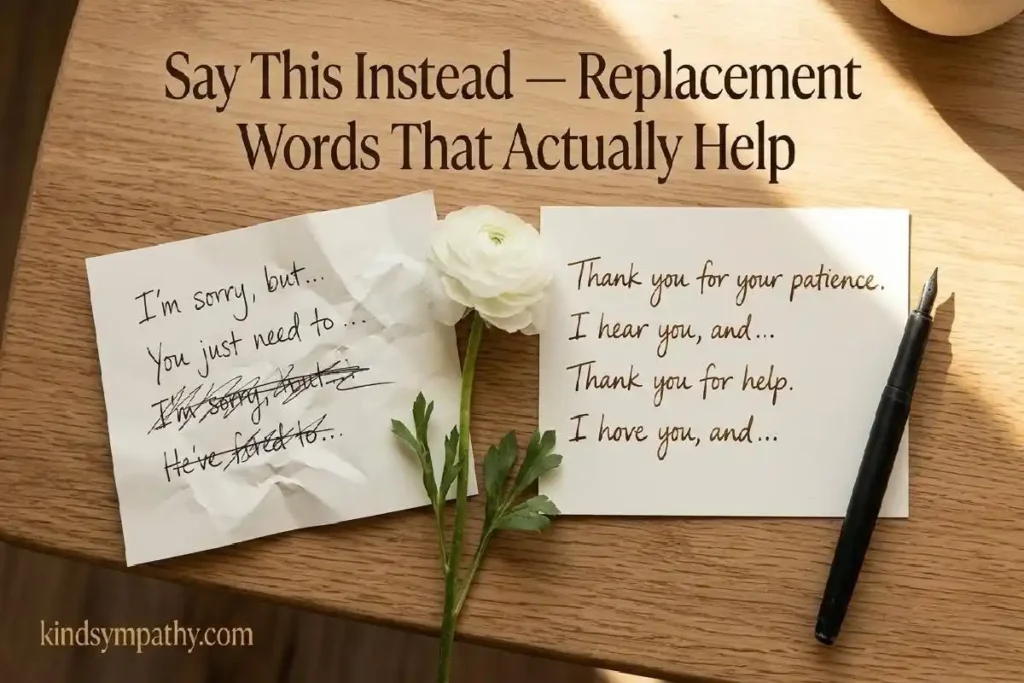
What to Say Instead — The Master Replacement List
If you need something to reach for quickly, these always work:
- “I’m so sorry.” — Always appropriate. Never wrong.
- “I don’t have the right words, but I’m here.” — Honest and connecting.
- “Tell me about them.” — Opens the door for the grieving person to speak.
- “I love you. I’m not going anywhere.” — Simple, specific, true.
- “There’s no timeline on this. I’ll be here.” — Removes the invisible deadline.
- “What do you need right now? I can handle whatever the answer is.” — Offers real help without deciding what it looks like.
- “Grief takes as long as it takes — and I’m not going anywhere.” — No pressure, just presence.
Our guide to what to write in a sympathy card and words of encouragement for someone grieving have more ready-to-use alternatives for every context.
The One Thing All These Phrases Have in Common
Look back through all 30 phrases on this list. Each one does at least one of the following:
- Explains the loss (gives it a reason)
- Minimises the loss (makes it feel smaller or more manageable)
- Rushes the grief (implies a timeline)
- Centres the speaker (shifts the focus to their own discomfort)
- Assigns tasks (gives the grieving person something to do)
Good what not to say to someone grieving awareness comes from understanding why these phrases fail — not just memorising a list. Once you see the pattern, you start to sense when a phrase you’re about to say might be falling into one of these traps. And then you stop, take a breath, and say the simpler, truer thing instead.
💡 5 Things to Remember When Supporting Someone Grieving
Tip 1: Your discomfort is not the priority. The impulse to say something comforting often comes partly from wanting to alleviate your own discomfort with grief. Notice that impulse. Then set it aside and focus entirely on what the person in front of you actually needs.
Tip 2: “I don’t know what to say” is often the right answer. Saying “I don’t know what to say — so I’m just going to say I love you and I’m here” is more connecting than any polished phrase. It names the truth of the moment: words are inadequate. What isn’t inadequate is presence.
Tip 3: Ask rather than tell. “Tell me about them” is infinitely better than “They were such a wonderful person.” Questions return agency to the grieving person. They get to decide what to share, how to share it, and what they want to bring into the conversation.
Tip 4: Show up more than once. The first visit matters. The call in month three matters more. Research on the psychology of grief and long-term support consistently shows that sustained presence — not just initial gestures — is what grieving people most need and least receive. The phrases that hurt most are often said in the first few days; the ones that help most arrive weeks and months later.
Tip 5: If you said something on this list, you can repair it. If you’ve said one of these phrases to someone who is grieving — go back. Say: “I’ve been thinking about what I said and I don’t think it was what you needed to hear. What I really mean is: I love you and I’m here.” That repair matters. Research on the emotional impact of grief on the body and mind from Harvard Health shows that the quality of support people receive has measurable impact on grief outcomes. It’s never too late to be the person who shows up differently.
❓ FAQ — What Not to Say to Someone Grieving
What is the most harmful thing you can say to someone who is grieving?
Knowing what not to say to someone grieving starts with the most common offenders: “Everything happens for a reason” and “They’re in a better place” consistently rank as the most painful for grieving people to receive. Both dismiss the present loss with explanations or comfort that wasn’t asked for. Replace them with: “I don’t know why this happened. I just know I’m here.”
What phrases should you avoid saying after someone dies?
The top harmful condolence phrases to avoid are: “Everything happens for a reason,” “At least they lived a long life,” “You should be feeling better by now,” “I know how you feel,” and “You’ll find someone else.” Each one minimises, rushes, explains away, or centres the speaker rather than the grieving person. Our full list of 30 covers all the patterns.
What do grieving people actually want to hear after a loss?
Grieving people most want to hear that their loss is real, that the person who died is remembered, and that support isn’t conditional on them recovering quickly. Simple grief messages like “I’m so sorry. I love you. I’m here.” or “Tell me about them — I want to hear.” work because they don’t try to fix anything. They just offer love and presence.
What are some things NOT to write in a sympathy card?
In a sympathy card, avoid: “They’re in a better place,” “Everything happens for a reason,” “At least they had a long life,” and “Time heals all wounds.” These are the wrong condolence words that feel hollow even when written with care. Our guide to what to write in a sympathy card shows you what works instead.
Is it okay to say “I don’t know what to say” to someone who is grieving?
Not just okay — it’s often the most honest and connecting phrase available. Grieving people don’t need you to have the right words. They need you to be there. Research on the psychology of grief and human connection shows that genuine presence — even imperfect, stumbling presence — is far more meaningful than polished condolences. And Harvard Health confirms that the sustained availability of caring people is one of the most significant factors in how people navigate loss. Say the honest thing. Then stay.