
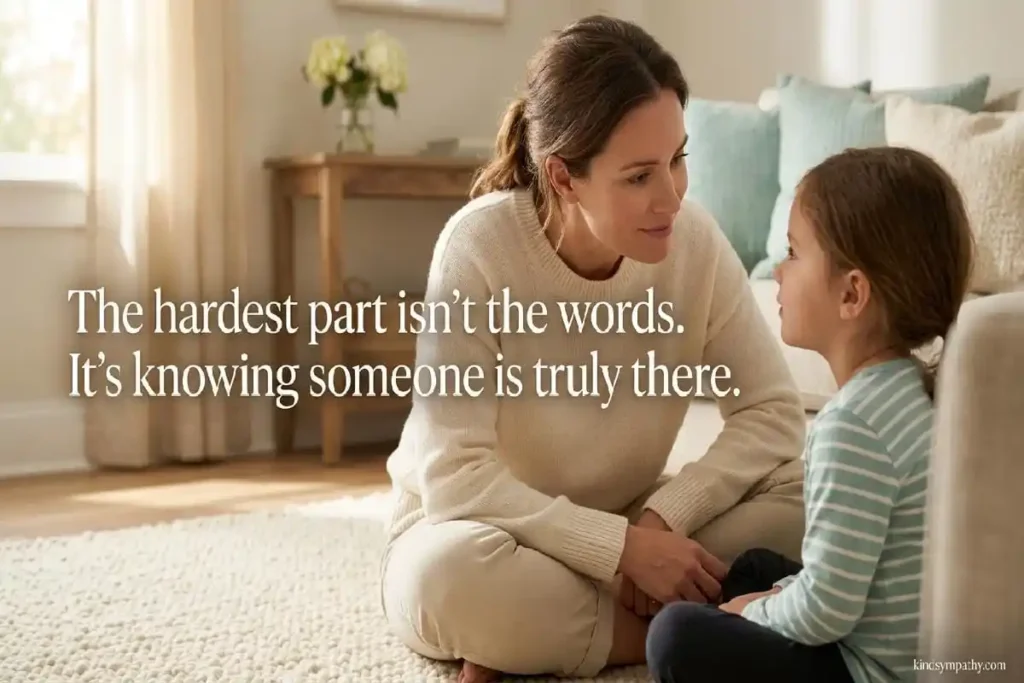
You crouch down to their level.
And everything you know about grief — all the things you’d say to an adult, all the careful language you’ve been rehearsing — falls away. Because they’re looking at you with eyes that are waiting for something. Something true. Something they can actually hold onto. And adult grief words don’t fit in small hands.
Knowing what to say to a child who lost a parent might be the single most difficult thing in the landscape of condolence. Too much and it overwhelms them. Too little and they feel invisible. Too clinical and they shut down. Too emotional and they feel like they have to take care of you.
These sympathy messages for a child who lost a parent are here for all of it — for the things you say directly to a grieving child, for the words you write to the surviving parent who’s watching their child navigate grief, and for the people around them who want to help and don’t know how to start.
What are sympathy messages for a child who lost a parent? Sympathy messages for a child who lost a parent are words of comfort offered to a grieving child directly, or to the adults supporting them. The best ones use age-appropriate language, validate whatever the child is feeling without trying to explain the loss away, and make it clear that the child is not alone and does not need to be brave.
💬 Best Sympathy Message for a Child Who Lost a Parent Example: “I know something very sad happened. Your mum/dad loved you so, so much. And all the people who love you are right here with you. You don’t have to feel okay. You can feel whatever you feel — and we’ll be right here.” This works because it names the loss simply and directly, affirms the parent’s love, and explicitly gives the child permission to feel without pressure. The “we’ll be right here” is the most important part — presence and consistency are what grieving children need most.
“For messages about the parent who passed, our sympathy messages for loss of mother and sympathy messages for loss of father offer adult-focused condolences.”
What to Say Directly to a Young Child (Ages 4–8) Who Lost a Parent
Talking to a very young child about the death of a parent is one of the most tender things a person can do. The language needs to be simple, honest, and free of euphemisms like “passed on” or “gone to sleep” — which can genuinely confuse small children and create new fears. These messages are written for the kneel-down, eye-level conversation.
For more guidance on grief messages across all relationships and ages, our complete sympathy messages guide has everything organized by situation.
- “Something very sad happened. Your mummy/daddy died. That means we won’t see them anymore, but we will always love them and remember them.”
- “It’s okay to cry. It’s okay to be sad. It’s okay to feel whatever you feel.”
- “You didn’t do anything wrong. This isn’t your fault. Not even a little bit.”
- “Your mummy/daddy loved you so, so much. That love will always be yours.”
- “I love you. I’m going to be right here with you.”
- “You can ask me anything you want to know. I’ll always try to tell you the truth.”
- “You might feel sad sometimes and okay other times. Both of those are fine.”
- “Your mummy/daddy will always be in your heart. Always.”
- “Lots of people love you very much. And none of them are going anywhere.”
- “It’s okay to still have fun sometimes. That doesn’t mean you love them any less.”
What to Say to an Older Child (Ages 9–13) Who Lost a Parent
Children in this age group often understand death more fully — but they’re also navigating the awareness of what it means, the long-term implications, and the social complexity of grief around peers. These messages acknowledge that depth while still being warm, honest, and without any pressure to perform bravery.
- “I’m so sorry about your mum/dad. This is one of the hardest things anyone goes through. And you don’t have to go through it alone.”
- “There’s no right way to feel. Whatever you’re feeling right now — anger, sadness, numbness, weirdly okay — all of it is completely normal.”
- “You might feel like you need to be strong for everyone else. You don’t. Not with me.”
- “I’m not going to tell you it’ll all be okay, because right now it doesn’t feel that way. What I will tell you is that I’m here.”
- “If you ever want to talk — about them, or about anything — I’m here. No pressure. Just here.”
- “You’re allowed to be sad at school. You’re allowed to need breaks. Anyone who’s going through what you’re going through is allowed to need things.”
- “Your mum/dad was so proud of you. I want you to know that.”
- “You can still laugh. You can still have good days. That doesn’t make you a bad person. It makes you human.”
- “Grief is weird — it doesn’t follow rules. Some days will be hard and some won’t be, and neither tells you how much you loved them.”
- “I’m going to keep checking in. Not to pry — just because you matter to me.”
What to Say to a Teenager Who Lost a Parent (Ages 14–18)
Teenagers who lose a parent often carry their grief with a particular intensity and complexity. They may feel pressure to step up, to take care of surviving siblings or the other parent, or to seem okay in front of their peers. These messages address that directly — and give them full, unconditional permission to just be a person in grief.
- “Losing a parent at your age is one of the most unfair things. I’m not going to pretend otherwise.”
- “You don’t have to step up. You don’t have to hold anything together. You’re allowed to just be devastated.”
- “I know you might feel like you need to be okay in front of everyone. You don’t have to be okay in front of me.”
- “If there’s anything I can do — drive you somewhere, sit with you, help you with something practical — please just say.”
- “Your grief doesn’t have to look like anyone else’s. However it comes out is how it’s supposed to come out.”
- “Your mum/dad loved you. I’m going to keep saying that to you for as long as you need to hear it.”
- “You’re carrying something enormous. I see that. And I’m proud of you for just getting through each day.”
- “You don’t have to have it together. Not now. Maybe not for a while. That’s okay.”
- “If you want to talk about them — or not talk about them — I’ll follow your lead entirely.”
- “I’m here. Not just today. I mean that.”
Heartfelt Bereavement Messages for the Surviving Parent (Supporting the Adult Who Is Also Grieving)
The surviving parent is trying to hold their own grief and their child’s grief simultaneously — which is one of the most exhausting things any person can do. These bereavement messages are for the parent who needs to know that someone sees both losses and is here for both people.
- “I can’t imagine carrying your own grief while also trying to hold your child’s. I see you doing it. I’m here for both of you.”
- “Please let me take something off your plate. Not the big things — the small ones. Dinner. School pickup. Whatever I can carry, I will.”
- “You’re doing an extraordinary thing, watching over a grieving child while grieving yourself. I want you to know you don’t have to do it alone.”
- “How are you, separate from being a parent right now? I want to know. Your grief matters too.”
- “I’m not just here for [child’s name]. I’m here for you. Both of you, at the same time, for as long as this takes.”
Messages to Write in a Card for a Child Who Lost a Parent (What to Write When You’re Stuck)
A card for a grieving child — whether you’re writing to the child directly or to their family — is a quiet, important gesture. These condolence messages are calibrated for warmth without being overwhelming, and for language that a child can actually understand and hold onto.
For guidance on card format and writing, our sympathy card wording guide covers every age and relationship type.
- “We are thinking about you and sending you lots of love. You are not alone.”
- “Your mummy/daddy loved you so much. We will always remember them with you.”
- “We love you. We are here. Nothing about that is changing.”
- “It’s okay to feel sad. And it’s okay to feel okay sometimes too. We’re here for all of it.”
- “You have people around you who love you so much. We’re not going anywhere.”
- “Your mum/dad was so proud of you. We want you to know that.”
- “You are brave just by getting through each day. We see that.”
- “For [child’s name] — with so much love from all of us.”
- “We’re thinking of your whole family. With all our love.”
- “Whatever you need, whenever you need it — we’re here.”

Messages for Teachers and School Staff (Supporting a Grieving Child in an Educational Setting)
Teachers and school staff are often on the front line of a child’s grief — seeing them every day, navigating classroom dynamics, and trying to strike the right balance between normalcy and sensitivity. These kids bereavement messages are for the classroom context.
- “I just wanted to let you know — [child’s name] might have harder days. Please just let them be however they need to be.”
- “If they need to step out, or sit quietly, or not participate today — that’s okay. Please just give them space.”
- “They’re going through something enormous. Your kindness and patience right now will matter to them for years.”
- “We just want them to feel safe at school. That’s the whole ask.”
- “Thank you for looking out for them. It means more than you know.”
Faith-Based Sympathy Messages for a Grieving Child (Spiritual Comfort in Simple Language)
For families whose faith offers comfort, these messages use spiritual language in terms a child can understand — without overclaiming or creating confusion.
- “Your mummy/daddy is loved by God and they are at peace. And you are loved here, by all of us.”
- “We believe love never truly ends. And your mum/dad’s love for you is forever.”
- “God holds your mummy/daddy close. And we hold you close. Always.”
- “You will be together again one day. Until then, we’re right here with you.”
- “Your parent loved you with all their heart. That love is a gift from God that you carry forever.”
For When the Child Needs Permission (Messages That Give Kids Space to Feel Whatever They Feel)
One of the most important things a grieving child needs is permission — to feel whatever they’re feeling, to not be okay, to still have fun without guilt. These messages give that permission directly.
- “You’re allowed to be sad. You’re allowed to be angry. You’re allowed to be fine and then not fine again.”
- “There’s no wrong way to miss someone you love.”
- “You don’t have to be brave. Not today. Not ever, if you don’t want to.”
- “It’s okay to laugh at something funny. Your mum/dad would want you to laugh.”
- “You’re doing so well just by being here. That’s enough.”
Grief Messages on the Hard Days — Birthdays, School Events, Milestones
Anniversaries and milestones are particularly hard for grieving children — the first birthday without their parent, the school play where there’s an empty seat, the graduation they won’t be at. These grief messages are for reaching out on those specific, painful days.
- “I know today is harder than usual. I’m thinking of you and your whole family.”
- “First [birthday/Christmas/school event] without them — I know. I haven’t forgotten. I love you.”
- “I wish they could be there to see what an amazing person you’re becoming.”
- “They would have been so proud. I want you to know that.”
- “Today is hard. I’m right here.”
What NOT to Say to a Grieving Child (The Mistakes That Cause Lasting Harm)
Children’s grief is uniquely vulnerable to well-meaning but harmful language. Here’s what to avoid — and why each one matters more with children than with adults.
❌ “They’re in a better place now.” Why it harms: Young children may interpret this literally — wondering why their parent chose to go somewhere better. It can create confusion and even feelings of rejection. Say instead: “Your mummy/daddy loved you so much. That love doesn’t go away.”
❌ “They’ve gone to sleep.” Why it harms: This genuinely causes bedtime anxiety in children. Euphemisms for death confuse children who are still developing their understanding of permanence. Say instead: Use the word “died” gently, clearly, and without drama. It’s kinder than the alternative.
❌ “You need to be strong for your mum/dad now.” Why it harms: This forces a role on a grieving child that they cannot and should not carry. It suppresses their grief and builds resentment. Say instead: “You don’t have to be strong. You’re allowed to feel whatever you feel.”
❌ “You’ll see them again one day.” Why it misses: Even if spiritually sincere, this can raise more questions than it answers for children, and doesn’t address the present loss. Say instead: “They will always be in your heart. And we will always remember them with you.”
❌ “I know how you feel.” Why it stings: You don’t. And children in grief often feel uniquely alone. Claiming shared experience can dismiss their particular pain. Say instead: “I can’t know exactly how you feel. But I care about you, and I’m right here.”
❌ “Try not to cry — you’ll upset your mum/the other children.” Why it harms: Suppressing a child’s tears in grief causes real, lasting psychological harm. Tears are the right response. Let them come. Say instead: “Crying is completely okay. It means you love them. I’ll sit with you.”
❌ “They lived a good long life” (to the child). Why it misses: Children don’t process loss through the lens of a life’s length. To a child, their parent is simply gone. That’s what matters. Say instead: “They loved you so, so much. And everyone who loves you is right here.”
One-Line Sympathy Messages for a Child Who Lost a Parent (For Cards, Notes, Quiet Moments)
Each of these is complete — gentle, age-inclusive, and true enough to stand alone.
- “You are loved. You are not alone. That’s not changing.”
- “It’s okay to cry. It’s okay to not cry. Both are fine.”
- “Your mum/dad loved you more than anything.”
- “You don’t have to be brave today.”
- “Everyone who loves you is right here.”
- “You can ask any question you have. We’ll answer honestly.”
- “Sadness shows how much you love them. That’s not a bad thing.”
- “There’s no wrong way to miss someone.”
- “We’re going to be here for a very long time.”
- “Their love for you doesn’t go away just because they’re gone.”
- “You’re doing so well just by being here.”
- “We will always, always remember them with you.”
Copy & Paste Messages — Use These Right Now 👇
Every message is ready to use. Adjust “mum/dad” for the specific parent.
To say directly to a young child: “Your mummy/daddy loved you so, so much. And we all love you too. It’s okay to feel sad. I’m going to be right here with you.”
To say to an older child: “I’m so sorry about your mum/dad. What you’re going through is really hard and it’s okay to not be okay. I’m here whenever you want to talk — or not talk. I just want you to know I’m not going anywhere.”
To write in a sympathy card for a child: “We are thinking of you and sending you so much love. Your mummy/daddy is always in your heart — and we’re always right here. You are never, ever alone.”
To the surviving parent: “I can’t imagine carrying all of this — your own grief and watching your child grieve at the same time. I see you. Please let me do something practical. I mean it — whatever I can take off your plate, I will.”
For a teacher or school: “[Child’s name] is going through something enormous right now. We wanted to make sure you knew, so you can give them whatever grace and space they need. Thank you for looking out for them.”
For a friend of the family: “I know words don’t reach the size of what your family is going through. I’m just here — for whatever you need, for as long as you need it.”
On the child’s first birthday after the loss: “I know today is a hard one — the first birthday without their mum/dad. I’ve been thinking about your whole family. Please let me know if I can do anything at all.”
When the child is struggling at school: “It makes complete sense that they’re struggling right now. They’re doing something incredibly hard every single day. Please just let them know they’re loved and not in trouble.”
For a child returning to school after the loss: “You are so brave for coming back. You don’t have to feel okay. And if you need a minute, just say so — we’re all on your side.”
For the child’s first holiday after the loss: “The holidays are going to feel different this year. I’m thinking of you and your family so much. I love you all, and I’m here.”
5 Tips for Writing Your Own Sympathy Message for a Child Who Lost a Parent
Tip 1: Use honest, simple language — not euphemisms. Children need truth, delivered gently. “Your daddy died” is kinder in the long run than “went to sleep” or “passed on,” which can create confusion and new fears. Age-appropriate honesty is the most loving thing.
Tip 2: Give permission, not instruction. The most important thing a grieving child needs to hear is that whatever they’re feeling is okay. Don’t tell them to be brave, or not to cry, or to take care of their surviving parent. Tell them: you can feel whatever you feel. We’re here.
Tip 3: Reach out quickly, and keep reaching. Research on the psychology of grief and human connection shows that consistent, sustained presence is what helps grieving children most — not any single message. Reach out to the family today. Check in again next week. Mark the hard dates.
Tip 4: Use their parent’s name if you know it. For an older child especially, hearing their parent’s name spoken — “I’ve been thinking about [name]” — tells them that person still exists in the world, in people’s thoughts. That’s deeply comforting. Use the name.
Tip 5: Support the surviving parent too — that’s the most practical thing you can do for the child. Harvard Health’s research on the emotional impact of grief on the body shows that a child’s grief recovery is closely tied to the wellbeing of the surviving parent. Supporting the adult in the house — with food, logistics, presence, practical help — is one of the most direct ways to support the child.
Short or Long: What Works for a Grieving Child?
Short works best when talking directly to a child — especially a young one. Simple, warm, repeated. Young children need to hear the same reassurances many times, not a long explanation. For direct-to-child messages, brief is always better.
Long works better when writing to the surviving parent or family, when the situation calls for something more comprehensive, or when writing to a teenager who may benefit from feeling fully seen and heard.
Whatever the format — keep language simple, honest, and free of clichés. Our complete bereavement messages guide covers grief support across all ages and relationships. And when you want to do something beyond words, our sympathy gift guide for families has thoughtful options that can help support both parent and child.

❓ FAQ: Sympathy Messages for a Child Who Lost a Parent
What is the best sympathy message to send for a child who lost a parent?
The best sympathy message for a child who lost a parent is simple, honest, and gives the child explicit permission to feel whatever they feel. For young children: “Your mummy/daddy loved you so much. And all the people who love you are right here.” For older children and teenagers: “I’m so sorry about your mum/dad. You don’t have to be okay right now — I’m just here.” The key is presence and permission, not explanation.
What are some short sympathy message examples I can say to a grieving child right now?
A few ready to use: “You are loved. You are not alone. That’s not changing.” / “It’s okay to cry. It’s okay to not cry.” / “Your mum/dad loved you more than anything in the world.” Short kids bereavement messages — repeated often — are far more comforting to young children than longer explanations. Say the simple things. Say them again.
What do you write in a sympathy card for a child who lost a parent?
Use language a child can actually understand and hold onto. Name the love. Give permission to feel. Offer presence. A strong card for a young child: “We love you so much. Your mummy/daddy loved you so much. You are never, ever alone — and we’re right here.” Our sympathy card wording guide has guidance on tone and language for different ages.
Should I send a sympathy card or speak in person to a child who lost a parent?
Both matter — in different ways. Speaking directly to a grieving child, at their level, with simple honest language, is one of the most comforting things an adult can do. A card is something they can hold, return to, and re-read. For younger children especially, a physical card with their name on it can be meaningful. For older children and teenagers, a card alongside a genuine in-person check-in is ideal.
Is it okay to say “I don’t know what to say” to a child who lost a parent?
With older children and teenagers — yes. It’s honest, and it models that adults don’t always have all the answers, which can be genuinely comforting. With very young children, it’s better to focus on simple, warm, reassuring statements rather than admitting uncertainty. Research on the psychology of grief and human connection shows that what grieving children need most is consistent, warm presence — not perfect words. And Harvard Health’s findings on the emotional impact of grief on the body confirm that the adults around a grieving child, and how they show up, shape the child’s entire grief experience. Be honest. Be present. Come back.