
There are some losses where the right words don’t exist.
This is one of them.
No parent should outlive their child. That’s not just a saying — it’s a deep, visceral truth that every human being carries somewhere inside them, even before they become a parent themselves. When a child dies, the order of things feels broken. The future that was supposed to exist — the one full of birthdays and milestones and ordinary Tuesdays — simply doesn’t anymore. And the parents left behind carry a grief that has no comparison, no clean edges, no predictable end.
If you’re searching for sympathy messages for loss of child, you’re probably feeling exactly what most people feel in this moment: utterly at a loss. Nothing feels adequate. Nothing is adequate — and that’s important to understand before you write a single word.
The goal of condolences for loss of child is not to comfort away the grief. It’s to make bereaved parents feel that their child was real, their love was witnessed, and they are not alone in the unbearable weight of this.
That’s what these messages reach for.
What are sympathy messages for loss of child? Sympathy messages for loss of child are words of condolence offered to parents who have lost a son or daughter at any age. They differ from all other condolence messages in one essential way: they must never minimize or explain the loss. A child’s death is incomparable. The only right response is to stand beside that truth — not soften it.
💬 Best Sympathy Message for Loss of Child Example: “There are no words for this. I know that. I’m not here to find them — I’m just here. Your child was real, your love was everything, and your grief is the most valid thing in the world. I’m not going anywhere.” This works because it begins by releasing the pressure to say the right thing — which is itself comforting. It validates the child’s existence, the parent’s love, and the grief itself, without trying to resolve any of it. Presence over polish. Always.
“This is part of our complete sympathy messages collection. For thoughtful gifts for bereaved parents, our sympathy gift ideas for bereaved parents offers gentle options.”

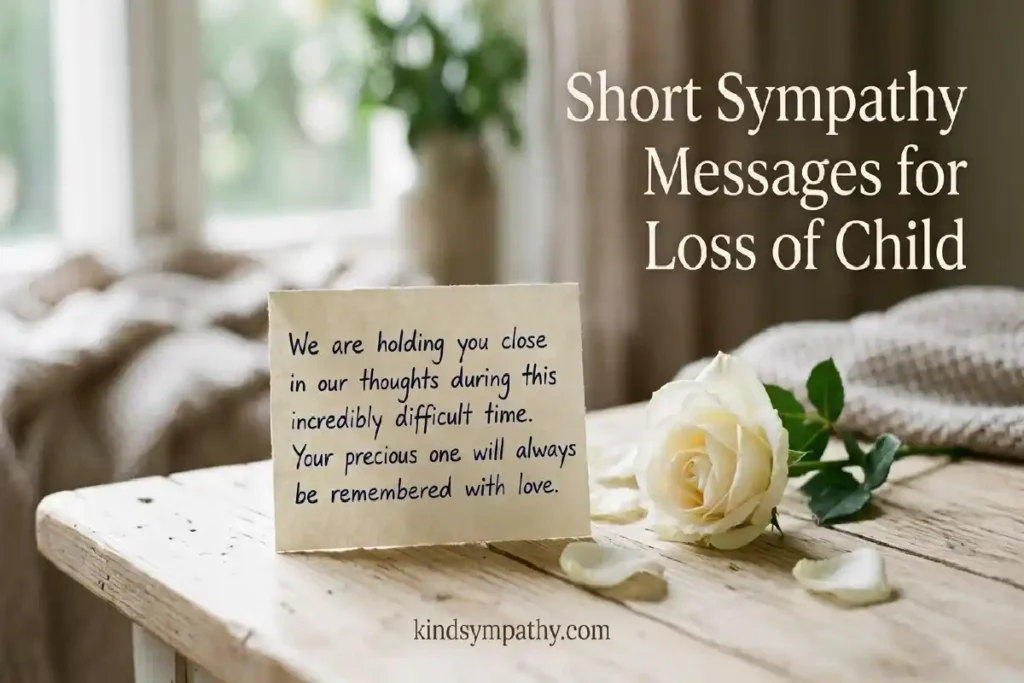
When Words Fail — Short Sympathy Messages for Loss of Child
There is no “right” short message for this loss. But there are honest ones. These short sympathy messages for loss of child don’t try to hold the whole weight of what’s happened — they just make sure the parents know someone sees it. Sometimes that’s the only thing that’s possible. And it matters more than people realize.
- “I’m so deeply, heartbreakingly sorry for the loss of your child.”
- “No words reach this. But I’m here, and I mean that completely.”
- “Your child was loved. Their life mattered. And so does your grief.”
- “There is nothing I can say. Please know I’m not going anywhere.”
- “You should never have had to face this. I’m so sorry.”
- “Holding your whole family in my heart right now.”
- “Your child was real and loved and will not be forgotten.”
- “I can’t fix this. I can only show up. And I will.”
- “This is the most devastating loss there is. Please don’t carry it alone.”
- “Their name deserves to be spoken. I’ll never stop saying it.”
- “I’m thinking of you every single day — and of your child.”
- “You were the best possible parents. This is not your fault. None of it.”
- “The love you gave them was extraordinary. That never disappears.”
- “I don’t have words. I have presence. It’s yours, for as long as you need it.”
- “You are allowed to grieve this forever. No one will rush you. Not me.”
Heartfelt Condolences for Loss of Child (For When You Need to Say Something Real)
These longer condolences for loss of child are for the people in your life who are walking through the most devastating thing a human being can experience. They don’t try to explain or comfort in any conventional sense. They simply stand beside the grief — which is the only honest place to stand.
If you need more sympathy messages for different types of loss, our complete sympathy messages collection covers every situation with care.
- “I don’t have the right words. I’ve been sitting here for days knowing that nothing I say will touch this, and I couldn’t bear to stay silent any longer. Your child was real. Their life was precious. And what you’re carrying right now is the heaviest thing any human being can carry. I’m here — not to fix anything, just to be near you in this.”
- “The world had your child in it for [however long], and it was better for it. Whatever time you had — the laughter, the ordinary moments, the love that filled the whole room — none of that was wasted. None of it disappears. I’m so deeply sorry they’re gone.”
- “There’s no grief like a parent’s grief for a child. I won’t pretend to understand the full weight of what you’re carrying. What I will do is stay close — today, next month, on the hard anniversaries, on the days that sneak up on you. I’m not going anywhere.”
- “I keep thinking about your child and finding myself unable to find words that feel worthy. So let me just say this: they were loved. By you, by everyone who knew them, by everyone who’s heard their name. That love is still here. It doesn’t end.”
- “You became a parent, and that doesn’t change. You will always be [child’s name]’s parent. Nothing about that is past tense. I want you to know I see that — and I honor it.”
- “There is no timeline on this grief. No milestone at which you’re supposed to be okay. The people who love you will be here at every stage — through the unbearable first weeks, through the quiet months, through the years that follow. Please believe that. I’m one of those people.”
- “I’ve been thinking about how to reach out since I heard, and I keep coming back to the same thing: I just want you to know you’re not alone. Not now. Not ever. Your child’s life will always matter — to you and to the people who love you.”
- “What you’re going through defies description. So I won’t try to describe it. I’ll just say: I love you. I love the memory of your child. And I will be here for every single day that follows this one.”
- “A child’s loss leaves a shape in the world that never fills. I know that. And I know there are no words that reach that empty space. But I want you to know someone is standing at the edge of it with you, refusing to look away.”
- “The courage it takes to keep going after this is something most people will never understand. I see it. And I want you to know: you don’t have to do this alone. Not today, not any day.”
Child Died Sympathy Card Messages (Written With Both Hands)
A sympathy card sent to bereaved parents is not like any other card. It will be kept. Re-read. Carried. Set down and picked up again on birthdays, on the anniversary, on the morning that starts like any other and suddenly isn’t. These messages are written knowing all of that — words that must hold up under the weight of years, not just days.
For help with card structure and format, our sympathy card wording guide walks through what to write and how to write it.
- “With the deepest, most sincere sympathy. Your child was loved — and that love outlasts everything.”
- “There are not enough words in this card. Please know it carries more than it can say.”
- “Their life was a gift to the world. Your love for them was extraordinary. We are so devastated alongside you.”
- “May you feel held, even in the moments when nothing else reaches you.”
- “Your child mattered. To you, to everyone who knew them, to the world. That never changes.”
- “Wishing you moments of peace — not the kind that erases the grief, but the kind that makes it breathable for a little while.”
- “You were their parent. You always will be. Nothing about that is past tense.”
- “We are standing beside you in this — for as long as you need, in whatever way helps.”
- “Their name deserves to be spoken. We will keep saying it.”
- “With love that does not know how to be adequate — and with the promise that we are here.”
Bereaved Parents Message to Send as a Text (Because Silence Is the Hardest Thing)
Reaching out to parents who’ve lost a child can feel paralyzing. You don’t want to say the wrong thing. You don’t want to intrude on their grief. And so people often say nothing — which leaves bereaved parents in a silence that can feel like abandonment. These bereaved parents messages are for cutting through that fear with something simple and real.
Send one. Today. It doesn’t have to be perfect — it has to arrive.
- “I heard and I have no words. I just want you to know I love you and I’m here.”
- “Please don’t feel like you need to respond. I just couldn’t be quiet.”
- “Thinking of you and [child’s name] every single day.”
- “You are not alone. I mean that. Call me any time — day or night.”
- “I’m so deeply sorry. There’s nothing else that’s true enough to say.”
- “Can I come by? I don’t need you to talk. I just want to be near you.”
- “I’ve been thinking about [child’s name] constantly. What a person they were.”
- “Please don’t disappear. Let me be there however I can.”
- “I love you. I love the memory of your child. I’m here.”
- “Whatever the next hour looks like — I’m one text away. Always.”
Sympathy Messages for Loss of Child From a Friend (When You Were There Too)
When you knew the child — when you watched them grow, held them, laughed with them, loved them — the message comes from a different place. These are for the friend who was part of the child’s life, not just the parent’s. Grief shared this way is its own act of love.
- “I loved [child’s name] too. Not the way you did — nothing compares to that. But they were in my life and in my heart. And I’m grieving too. And I’m here.”
- “I keep thinking about that time [specific memory] — the way they laughed, the way the whole room changed when they walked in. That doesn’t go away. They don’t go away.”
- “You were the most incredible parents. They knew it. Everyone could see it.”
- “I’m not going to pretend I know how to do this alongside you. I just know I’m not walking away.”
- “Whatever today looks like — I’m with you in it. No conditions, no timeline.”
- “I’ll say their name whenever you need to hear it. And even when you don’t.”
- “You don’t have to perform anything for me. Not strength, not okayness, not recovery. Just be whatever you are.”
- “I’ve been crying since I heard. I can’t imagine what you’re feeling. I just love you so much.”
- “I’ll be there on the hard days that come later — the birthdays, the milestones, the random Tuesdays. I’ll be there.”
- “Nothing I say is enough. But silence feels like a betrayal. So here I am.”
Professional Condolence Messages for Loss of Child (Warm, Careful, Human)
When a colleague loses a child, the professional context requires particular care — but it doesn’t excuse coldness. These messages are warm without overstepping, and they make one thing unmistakably clear: this is not a situation where work matters.
- “Please accept my deepest condolences on the devastating loss of your child. There is nothing here that needs your attention. Please take all the time you need.”
- “On behalf of everyone here — we are heartbroken alongside you. Please focus only on your family.”
- “There are no words for this kind of loss. Please know the entire team is thinking of you.”
- “Your child’s life mattered. Please take every day you need — we have everything covered.”
- “With the most sincere sympathy. Please do not give work a single thought right now.”
- “We are so deeply sorry. Please lean on whoever you need — we will be here when you’re ready.”
- “You have our complete support. Nothing here is more important than you and your family.”
- “I was heartbroken to hear your news. Please reach out if there is anything I can do — anything at all.”
- “Wishing you the space, the time, and the care you need. We are thinking of you every day.”
- “With profound sympathy — from all of us, with all we have.”
Faith-Based Sympathy Messages for Loss of Child (For Parents Whose Faith Is Their Ground)
For parents who find — or seek — spiritual footing in the most devastating grief, these messages offer something that reaches past what ordinary language can hold.
- “May God hold your child in eternal love — and may that same love hold you through what no parent should ever face.”
- “I’m praying for you every day — for rest, for peace, for moments of grace in the places you least expect to find them.”
- “Your child is known and loved by something far greater than any of us can comprehend. And so are you.”
- “May your faith be a shelter when nothing else can reach the pain.”
- “I trust that love this strong — the love you had for your child — is something that doesn’t simply end.”
- “Lifting your whole family up in prayer. May grace find you in the quiet moments.”
- “May the Lord be near to your broken hearts. You are not forgotten. Not by the people who love you. Not by God.”
- “I believe in a love that outlasts everything — even this. And I’m praying that belief finds its way to you.”
- “Their life was a gift. Your love for them was extraordinary. May something greater than words comfort you now.”
- “Praying for you today, tomorrow, and on every hard day that follows.”
Messages for Bereaved Parents on the Days That Return (Anniversaries, Birthdays, Milestones)
The grief of losing a child doesn’t have a finish line. It returns on birthdays — the ones that happen and the ones that don’t. On the day they would have started school, graduated, gotten married. These grief messages are for those returning days — the ones most people forget to mark.
Show up on those days. It means more than you know.
- “I know today would have been their birthday. I haven’t forgotten. I’m thinking of you and of them.”
- “This date is on my calendar. It always will be. I love you.”
- “The milestones that don’t happen hurt in a way that’s hard to explain. I see that. I’m here.”
- “It’s been a year. I know grief doesn’t follow a schedule. How are you — really, today?”
- “I was thinking about [child’s name] today and wanted you to know their memory is alive in me too.”
- “The holidays are harder without them. I’ve been thinking about your family so much this season.”
- “Another year. Another birthday that’s also a grief day. I’m with you in it.”
- “You’re allowed to celebrate their life and grieve their absence at the same time. Both things are true.”
- “I’ll keep saying their name. I never want you to feel like the world has forgotten.”
- “Today I’m remembering your child — and sending all my love to you.”
RIP Messages for a Child (Short Tributes That Honor a Brief, Precious Life)
These RIP messages are for social media tributes, captions, or quiet moments of tribute — short enough to stand alone, weighty enough to mean something.
- “A life too short, a love that lasts forever. Rest in peace, sweet one.”
- “Gone far too soon. Loved beyond measure. Rest easy.”
- “The world was better for having you in it. Rest in perfect peace.”
- “Your light was brief and it was brilliant. Rest now.”
- “Loved completely, missed forever. Rest in peace.”
- “Some lives touch everything they brush against. Yours did. Rest easy.”
- “The love that surrounded you never ends. Rest in peace.”
- “A child who was everything to the people who loved them. Rest.”
- “Too young, too precious, too deeply loved. Rest in peace.”
- “You were here. You were real. You were loved. Rest now.”

Choosing sympathy messages for loss of child with the greatest care
What NOT to Say to Bereaved Parents — And Why It Matters More Here Than Anywhere
Nowhere in the landscape of grief is careless language more damaging than when it reaches parents who have lost a child. These are the phrases most likely to land like wounds — with better alternatives for each.
❌ “Everything happens for a reason.” Why it wounds: There is no reason that justifies a child’s death. Saying this implies one exists — which can feel like a profound betrayal to a grieving parent. Say instead: “This should never have happened. I’m so deeply sorry it did.”
❌ “God needed another angel.” Why it wounds: Even for deeply faithful parents, this can imply their need for their child mattered less than God’s. It removes the senselessness — which is part of what needs to be honored. Say instead: “I’m praying for you. And I’m holding your child’s memory with so much love.”
❌ “At least they’re not suffering anymore.” Why it wounds: Any “at least” statement minimizes. And it shifts focus away from the parent’s grief to a silver lining that doesn’t feel like one. Say instead: “I’m so glad they were so loved while they were here.”
❌ “You can have another child.” Why it wounds: No other child replaces this one. This sentence can feel like a denial of the specific, irreplaceable person who was lost. Say instead: “Nothing replaces [their name]. This loss is its own.”
❌ “I know how you feel — I lost my dog/parent/friend.” Why it wounds: Comparing any other loss to the death of a child is the one comparison that almost always causes harm. This grief stands alone. Say instead: “I can’t know what this is like. I just want to be here.”
❌ “You need to be strong for your other children.” Why it wounds: It assigns a performance role to someone who has just experienced the most devastating loss of their life. They are also a grieving person who deserves support. Say instead: “You’re allowed to fall apart too. Everyone around you can hold things for a while.”
❌ “Have you thought about seeing a therapist?” Why it wounds: Even well-meant, unsolicited mental health advice in the acute phase of grief can feel like deflection — like you’re handing the problem to someone else. Say instead: “I’m here to listen. And I’m here for the long haul. Tell me about them.”
One-Line Sympathy Messages for Loss of Child (For Cards, Pins and Quiet Moments)
Each of these stands alone — complete enough for a card, powerful enough for a quote graphic, true enough to last.
- “A parent’s love for a child is the fiercest love there is. Honor every bit of that grief.”
- “Their life was short. The love was not.”
- “You will always be their parent. That is permanent.”
- “Some absences are so large they change the shape of everything.”
- “They were here. They mattered. They are not forgotten.”
- “Grief this enormous is love this real.”
- “The world had them in it. That was a gift — even now.”
- “Their name deserves to be spoken. Say it as often as you need.”
- “There is no timeline on a parent’s grief. There shouldn’t be.”
- “You loved them as well as any child has ever been loved.”
- “Some losses make language feel small. This is one of them.”
- “You are allowed to carry this for as long as it takes.”
Copy & Paste Messages for Loss of Child — Use These Right Now 👇
Every one of these is ready to send as-is. Pick the situation. Add their child’s name if you know it.
Quick text: “I don’t have the right words. I just couldn’t stay silent. I love you, I’m thinking about [child’s name] constantly, and I’m here — for today and for every hard day that comes after.”
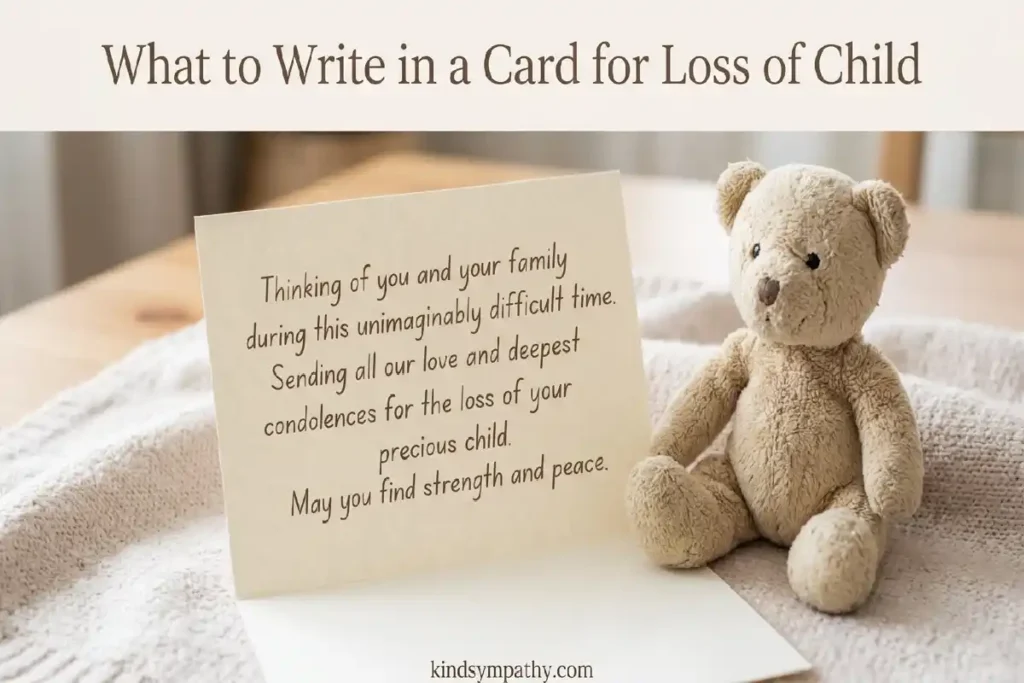
Sympathy card: “There is nothing adequate to write here. So let this card carry more than words: love, sorrow, and the absolute refusal to forget your child or disappear from your life. We are here.”
Close friend: “I’ve been sitting with this since I heard and I keep coming back to the same place — I love you, I loved [child’s name], and I’m not going anywhere. Tell me what you need, or tell me nothing. I’ll keep showing up either way.”
For sudden or unexpected child loss: “I’m in complete shock. I can’t imagine what you’re going through. Please know I’m here — fully, unconditionally, for whatever you need. No questions, no timeline, no pressure.”
For loss of an infant or newborn: “Your baby was real. Your love for them was real. Your grief is real and it deserves every bit of space it needs. I’m so deeply sorry. And I’m here.”
For loss after illness: “You showed up for them through everything — every appointment, every hard day, every quiet night. The love you gave them was extraordinary. I’m so sorry it’s over. And I’m so proud of the parents you were.”
For a colleague: “Please accept my deepest condolences on the loss of your child. There is nothing here that matters right now except you and your family. Please take all the time you need. We are thinking of you every day.”
For someone far away: “I wish I could be there. I’m so sorry I can’t. Please know the distance doesn’t change how much I love you — or how much I’m thinking about [child’s name]. I’m a call away, any hour.”
On their child’s birthday: “Today is [child’s name]’s birthday. I haven’t forgotten. I’m thinking of both of you — and of the celebration that should have been. Sending all my love.”
Months later, checking in: “It’s been a while and I just wanted to reach out. I haven’t moved on. I’m still thinking about you and about [child’s name] — and I’ll keep showing up, for as long as you need someone to.”
5 Tips for Writing Your Own Sympathy Message for Loss of Child
Tip 1: Use their child’s name — every time. The single most comforting thing you can do for bereaved parents is say their child’s name. Not “your child” or “your loss” — their name. “I keep thinking about [Name]” tells a parent that their child existed, was noticed, and will not be forgotten. This is the most important tip on this list.
Tip 2: Validate the grief without comparing it. Never say “I know how you feel” or compare this loss to anything else. The loss of a child is in a category of its own. The most comforting acknowledgment is the simplest: “This is the most devastating thing. I know no words reach it. I’m here anyway.”
Tip 3: Send something today — however imperfect. Bereaved parents notice the silence of people who say nothing because they don’t know what to say. Research on the psychology of grief and human connection confirms that reaching out — imperfectly, honestly — is what matters. Don’t wait for the right words. Send the honest ones.
Tip 4: Never suggest a timeline. There is no “moving on” from the loss of a child. Never imply one — not with “I hope you’re feeling better” or “I know it gets easier.” Instead: “I’m here for as long as this takes — and then longer.” That open-endedness is a profound act of love.
Tip 5: Keep showing up on the invisible days. The birthdays. The “would have been” milestones. The first day of school that doesn’t happen. These are the days that break parents open, long after the world has moved on. Harvard Health’s research on the emotional impact of grief on the body is clear that sustained support has measurable healing effects. Put their child’s birthday in your calendar. Send something. Every year. That single act — remembered and honored — means more than almost anything else you can do.
Short or Long: How to Choose
Short works best when the loss is raw, when words feel impossible even to the sender, or when you’re reaching out in the first terrible hours and days. A brief, true message that asks nothing and offers presence is exactly right.
Long works best for close friends and family, for cards, for when you knew the child personally and have something real to say about them, or for messages sent on anniversaries and birthdays when you want parents to know their child is still being remembered.
The rule here, above everything: say their child’s name. Whatever length, whatever situation, however simple — use the name. It’s the most powerful word in any message you send.
For more on supporting bereaved parents through long-term grief, our full bereavement messages guide covers every stage and relationship. And when you want to do something beyond words, our sympathy gift guide for bereaved parents has thoughtful options that honor a child’s memory in lasting ways.

Sympathy messages for loss of child, sent today, mean more than perfect words later
❓ FAQ: Sympathy Messages for Loss of Child
What is the best sympathy message to send for the loss of a child?
The best sympathy message for loss of child does three things: it names the child, it validates the size of the grief without trying to reduce it, and it offers presence without a timeline. Something like: “There are no words for this. But your child was real, they were loved, and I’m not going anywhere.” No silver linings. No reasons. Just presence and the child’s name.
What are some short sympathy messages for loss of child I can send right now?
A few ready to send: “Your child was real and loved and will never be forgotten.” / “No words exist for this. Just know I’m here.” / “I’m thinking of you and [child’s name] every single day.” Short condolences for loss of child are especially important to send quickly — bereaved parents feel every hour of silence, and a brief, true message sent today is worth more than a perfect one that never arrives.
What do you write in a sympathy card for the loss of a child?
Name the child. Acknowledge that this loss is unlike any other. Do not offer silver linings or timelines. Signal that your support is long-term, not just for this week. A strong card message: “[Child’s name] was real and loved and will be spoken of with love for as long as we are here. We are so devastated alongside you — and we are not going anywhere.” For more detailed guidance, our sympathy card wording guide covers structure and format.
Should I send a sympathy card or a text when someone’s child dies?
Both, and as soon as possible. A sympathy text message for loss of child matters because it arrives immediately — it breaks the silence that bereaved parents feel in the first hours and days. A card matters because it’s physical, lasting, and can be held on the hard days that come months later. Don’t let the question of which one delay you from sending either. The most important thing is that something arrives.
Is it okay to say “I don’t know what to say” in a sympathy message for loss of child?
Not only is it okay — for this particular loss, it may be the most honest and honoring thing you can say. It acknowledges that this grief is beyond the reach of ordinary language. It removes the performance of having answers. And it tells the parents: I know what you’ve lost is incomparable. Studies on the psychology of grief and human connection show that genuine presence and honesty reach grieving people far more deeply than polished phrases. And Harvard Health’s research on the emotional impact of grief on the body confirms that sustained, honest human connection is what supports healing over time. You don’t need the right words. You need to say their child’s name, stay close, and never stop showing up.





Pingback: 70+ Heartfelt Sympathy Messages for Loss of Son