

One in four pregnancies ends in miscarriage.
One in four. And yet, somehow, we’ve collectively decided that this grief doesn’t quite count. That “it was early” is a comfort. That “at least you know you can get pregnant” is the right response. That the appropriate amount of time to grieve a baby you were already naming in your head is — what, a week? Two?
The truth is, miscarriage grief is real, complex, and almost entirely invisible. People grieve alone because they never announced the pregnancy. They grieve in silence because the world doesn’t have a funeral for this loss. They grieve the baby, yes — but also the future they had already started imagining, the due date that now passes without acknowledgment, the physical experience of loss that their body went through while everyone else carried on as normal.
If you’re looking for sympathy messages for miscarriage — to send to a friend, a sister, a colleague you suspect is struggling — you’re already doing something most people don’t. You’re deciding this loss deserves to be acknowledged.
It does. These messages are built for exactly that.
What are sympathy messages for miscarriage? Sympathy messages for miscarriage are words of support and condolence offered to someone who has experienced pregnancy loss. The best ones share a single defining quality: they validate the grief without qualification — no “at leasts,” no silver linings, no timeline. They simply say: your loss was real, your baby was real, and you don’t have to minimize this for anyone.
💬 Best Sympathy Message for Miscarriage Example: “Your grief is real. It doesn’t matter how early it was or what anyone else thinks you should feel. You were already a parent in every way that counted. I’m so sorry for your loss — and I’m here, without condition, for as long as you need.” This works because it preemptively dismantles every minimizing phrase someone might have already heard, and replaces them all with a single, unconditional validation. For someone carrying miscarriage grief, that kind of directness is exactly what cuts through.
“Related losses include sympathy messages for loss of baby and sympathy messages for stillbirth — different in timing, but equally real in grief.”

Short Sympathy Messages for Miscarriage (Simple, True, No Qualifiers)
The best short sympathy messages for miscarriage don’t try to explain or reframe anything. They just land beside the person and say: I see this. I’m not calling it small. These work for texts, for the inside of a card, for the moment when you know you need to say something and you don’t have the words for more.
- “Your grief is real. I’m so sorry for your loss.”
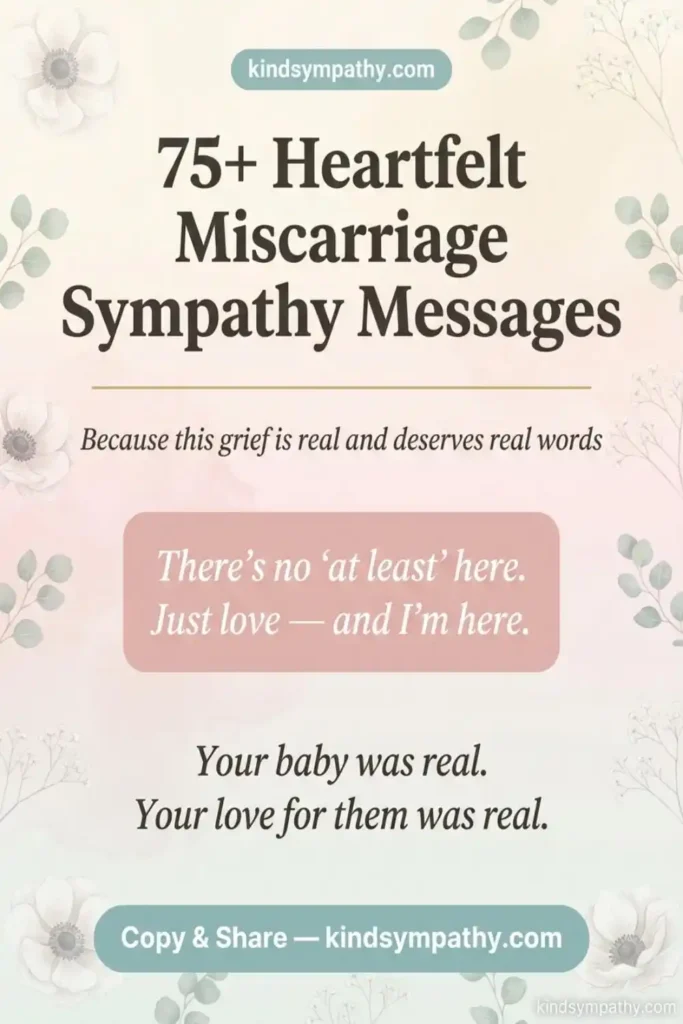
- “There’s no ‘at least’ here. Just love, and I’m here.”
- “You were already their parent. That matters.”
- “I’m so sorry. This is a real loss and it deserves real grief.”
- “Please don’t minimize this for anyone. Not even yourself.”
- “I’m here — no conditions, no timeline.”
- “Your baby was real. Your love for them was real.”
- “This is one of those losses the world doesn’t always acknowledge. I do.”
- “I’m thinking of you — and of the baby you lost.”
- “Sending you so much love. You don’t have to be okay.”
- “Whatever you’re feeling right now — it’s valid. Every bit of it.”
- “I’m so sorry. Please let me be here for you.”
- “You deserved that baby. I’m so sorry you didn’t get to keep them.”
- “Grief doesn’t have a size requirement. Yours is the right size.”
- “I love you. I’m here. That’s not changing.”
Heartfelt Pregnancy Loss Sympathy Messages (For the People Who Need You to Really Show Up)
Pregnancy loss can be one of the loneliest griefs there is — partly because it was often secret, partly because the world moves on before the person can. These longer messages are for the close relationships where showing up in full is the only right response.
For more messages across all types of devastating pregnancy and infant loss, our complete sympathy messages collection covers every situation with depth.
- “I know the world might not have known about this pregnancy — which makes the grief even more isolating, in a way that isn’t fair. You were carrying something real. You were already imagining a future. And losing that is a loss that deserves to be named, not quietly moved past. I’m here. Tell me as much or as little as you want.”
- “The thing about miscarriage grief that people don’t talk about enough is that it’s not just one loss — it’s the loss of a baby, yes, but also a due date, a future, a version of your life that no longer exists. I see all of that. And I’m not going to pretend any of it is small.”
- “You don’t have to downplay this because it was early, or because other people have been through worse, or because the world doesn’t have a framework for this kind of grief. You’re allowed to grieve this fully. I’m giving you permission, for whatever that’s worth. And I’m staying close.”
- “I’ve been thinking about you since I heard and I keep wanting to say something useful and coming up empty. So here’s what I’ve got: I’m devastated alongside you, I think your grief is entirely valid, and I’m going to keep checking in — not because I expect anything from you, but because you deserve to know someone’s paying attention.”
- “The physical experience of miscarriage is its own thing, separate from the emotional one. Your body went through something real and hard on top of the grief. I just want to say: I see the whole of it. Not just the loss but the experience — and I’m here for all of it.”
- “There’s no right way to grieve this. Some people are devastated immediately. Some people don’t feel it for weeks. Some are a strange combination of relieved and heartbroken that doesn’t make sense even to them. Whatever it looks like for you — that’s how it’s supposed to look. I’ll be here for the version you actually experience.”
- “I know some people might say things that don’t help. ‘At least you know you can conceive.’ ‘It wasn’t meant to be.’ ‘You can try again.’ I want you to know: I’m not one of those people. I’m the one who’s just going to say I’m sorry, and I love you, and I’m here.”
- “Grief after miscarriage is allowed to be as big as it is. You don’t have to earn the right to fall apart by how far along you were. The love was there. The hope was there. The baby was real. The loss is real. All of that is true — and all of it deserves space.”
- “I want you to know that I’m thinking about what you were hoping for, not just what happened. The future you were already building. The name you might have been turning over in your mind. All of that was real. And all of that is worth grieving.”
- “Please reach out whenever you need to — not just in the next few days, but in the weeks after, when the world has moved on and you haven’t. I’ll still be here. The due date, the hard days, the moments it hits when you don’t expect it. I’m in for all of it.”
What to Write in a Miscarriage Sympathy Card (Words That Actually Land)
Sending a card after a miscarriage is an act of recognition — it tells someone: your loss is real enough to deserve a physical piece of paper that acknowledges it. That alone means something. These miscarriage condolence messages for cards are written to be kept, re-read, and felt on the harder days ahead.
For guidance on card structure and format, our sympathy card wording guide covers everything you need.
- “Your loss is real. Your grief is real. And you are so loved — now and through all of it.”
- “There are no words that reach this fully. Please know this card carries more than it can say.”
- “You were already their parent. That’s permanent. And so is the love we have for you.”
- “Wishing you gentleness — with yourself, with the days ahead, with however this grief unfolds.”
- “This wasn’t nothing. It was everything you were hoping for. I’m so sorry.”
- “May you feel held in the coming days, and may the people who love you actually show up for you.”
- “Your baby was real. Your love for them was real. And your grief is exactly the right size.”
- “We’re here — not just right now, but on the due date, on the hard ordinary days, whenever you need us.”
- “With all the love we have, and none of the ‘at leasts.'”
- “Please don’t minimize this for anyone. It was a loss. It deserves every tear.”
Miscarriage Sympathy Text Messages to Send Right Now (Because Silence Is Its Own Kind of Harm)
Here’s the thing about miscarriage grief that’s different from most other losses: many people are grieving it alone, because the pregnancy wasn’t public yet. Which means the text you send might be one of the only acknowledgments they receive. Don’t underestimate what that means. These miscarriage sympathy text messages are written to land like a hand reaching through the screen.
- “I heard and I’m so sorry. I love you. Please don’t feel like you have to reply.”
- “I know this probably isn’t something you’ve been telling many people. But I’m telling you: I’m here.”
- “You’re allowed to grieve this as big as it feels. I’ll be here for all of it.”
- “I was thinking about you today. How are you, really?”
- “Can I bring food over this week? I want to do something. Just say when.”
- “I’m not going to say ‘at least.’ I’m just going to say: I’m so sorry. I love you.”
- “Please don’t disappear into this alone. Let me be here.”
- “I haven’t moved on from thinking about you. I hope you know that.”
- “Whatever today looks like — I’m one message away. No pressure, no expectations.”
- “I love you and I’m here. That’s the whole text.”
Messages From a Close Friend After Miscarriage (Raw, Real, No Distance)
When it’s your person — your closest friend, your sister, someone who confided in you before they told anyone else — the message doesn’t need to be careful. It needs to be present. These are for the friendships where showing up beats saying the right thing every time.
- “I don’t know what to say. I just know I love you and I’m not going anywhere.”
- “You can tell me everything. Or nothing. Or the same things on repeat. I’m here for all of it.”
- “I know this is one of those griefs the world doesn’t always know how to hold. I do. Bring it.”
- “I’m going to keep checking on you — not just this week, but when the due date comes, and on all the hard days in between.”
- “You were already thinking about that baby. I know. That matters.”
- “I’m so angry on your behalf. You deserved to keep them.”
- “The world moved on pretty fast, didn’t it. I haven’t.”
- “Come over, or let me come to you. We don’t have to talk about it. I just don’t want you to be alone.”
- “You’re allowed to be devastated. You’re allowed to be numb. You’re allowed to be whatever this actually is for you.”
- “I love you. Full stop. Everything else we’ll figure out.”
Professional Miscarriage Support Messages (Warm, Careful, Human)
When a colleague experiences pregnancy loss, the professional context requires slightly more care — but not less warmth. These messages honor the loss without overstepping.
- “I was so sorry to hear about your loss. Please take all the time you need — there’s nothing here that can’t wait.”
- “Please accept my sincerest sympathies. Your loss is real and it matters.”
- “On behalf of everyone here — we’re so sorry. Please focus entirely on yourself right now.”
- “There is nothing you need to do or respond to here. Just take care of yourself.”
- “Wishing you the space and gentleness you need right now. We’re thinking of you.”
- “Please don’t give work a second thought. We have everything covered.”
- “I’m so sorry for your loss. Please reach out if there’s anything at all I can do.”
- “With sincere sympathy and full support. Take whatever time you need.”
- “Your wellbeing is the only priority right now. We’ll be here when you’re ready.”
- “With heartfelt condolences — please be gentle with yourself.”
Faith-Based Miscarriage Sympathy Messages (Spiritual Support for Those Who Need It)
For people whose faith is the ground they stand on, these messages offer spiritual comfort alongside genuine human presence.
- “May God hold your baby in eternal love, and may that same love carry you through this.”
- “I’m praying for you — for peace, for healing, for grace in the moments you least expect it.”
- “Your baby was known and loved by something far greater than any of us. And so are you.”
- “May your faith be a shelter right now, when everything else feels so uncertain.”
- “I trust that love this real doesn’t simply end — and I’m praying for you every single day.”
- “Lifting you up in prayer today and every hard day that follows.”
- “May the Lord be close to your heart right now. You are not walking this alone.”
- “I believe that the baby you lost is held in something eternal. And I believe you will be held through this too.”
- “Praying for peace — not the kind that asks you to be okay too soon, but the real kind.”
- “God sees this loss. And so do I. You are not invisible in your grief.”

What NOT to Say After a Miscarriage (The Phrases That Hurt Most)
Miscarriage is the loss most likely to receive minimizing responses — not out of cruelty, but out of discomfort and a cultural habit of making this grief smaller than it is. These are the phrases to avoid, and what to reach for instead.
❌ “At least it was early.” Why it wounds: The gestational age doesn’t determine the size of the grief. A parent who lost a pregnancy at six weeks may have been imagining that baby’s whole life. “Early” doesn’t mean less real. Say instead: “There’s no ‘at least’ here. I’m just sorry.”
❌ “At least you know you can get pregnant.” Why it wounds: It reframes a devastating loss as a biological proof of concept. It asks someone to be grateful while they’re grieving. Say instead: “I’m so sorry. This isn’t the outcome you deserved.”
❌ “It wasn’t meant to be.” Why it wounds: It implies the loss was somehow correct or fated — removing the legitimate anger and grief at something that shouldn’t have happened. Say instead: “This is a real loss and you’re allowed to grieve it completely.”
❌ “You can try again.” Why it wounds: A future pregnancy doesn’t replace this one. This baby was already real to the parents. “Try again” erases that specific person. Say instead: “This baby was real. This loss is real. Nothing about that changes.”
❌ “I know someone who had three miscarriages and now has two healthy kids.” Why it wounds: However well-intentioned, comparisons and future-focused stories ask someone to skip ahead past a grief they’re still standing inside. Say instead: “Right now I just want to be here with you in this.”
❌ “Have you thought about what might have caused it?” Why it wounds: In the absence of a clear medical explanation, this kind of question can feel like an accusation — something the parent did or didn’t do. Say instead: “This wasn’t your fault. Not even close.”
❌ “At least you weren’t further along.” Why it wounds: Yet another form of minimizing by comparison. Grief doesn’t scale linearly with gestational age. It scales with love and hope — which can be enormous from the very first positive test. Say instead: “Your love for that baby was real from the moment you found out. I’m so sorry for your loss.”
One-Line Sympathy Messages for Miscarriage (For Cards, Pins and Quiet Moments)
Each of these is complete on its own — a single true sentence that doesn’t need anything else around it.
- “Miscarriage is a real loss. Your grief is a real grief.”
- “You were already their parent.”
- “The love was there before anything else.”
- “There is no ‘at least’ in this kind of loss.”
- “Grief doesn’t ask how many weeks it was before it shows up.”
- “You deserved to keep that baby.”
- “Your feelings don’t need to be justified to anyone.”
- “A pregnancy loss is a baby lost. Full stop.”
- “The world might have moved on. I haven’t.”
- “Your love for that baby was real from the very first moment.”
- “This wasn’t nothing. This was everything you were hoping for.”
- “You don’t have to minimize this for anyone’s comfort.”
Copy & Paste Miscarriage Sympathy Messages — Use These Right Now 👇
Every message is ready to send as-is. Pick the one that fits. Add their name if it feels right.
Quick text: “I heard what happened and I’m so sorry. You don’t have to respond — I just didn’t want to be one of the people who says nothing. I love you and I’m here.”
Sympathy card: “Your loss is real. Your grief is valid — however big it is, however long it lasts. Please know this card carries love, not ‘at leasts.’ We’re here.”
Close friend: “I’m not going to say any of the things people say. I’m just going to say: I love you, you deserved to keep that baby, and I’m going to keep checking on you long after the world has moved on.”
For a partner sending to their own partner: “We lost something real. Something we were already hoping for and imagining and loving. Your grief and mine are both valid — and we don’t have to carry this alone. I’m here, for both of us.”
For a colleague: “Please accept my sincere sympathies on your loss. There’s nothing here that needs your attention right now. Take all the time you need — we’re thinking of you.”
When you found out privately (before announcement): “I know you hadn’t told everyone yet, which makes this even harder to carry. But I’m here — and I want you to know your grief is completely valid, however quietly you’re holding it.”
For a recurring loss (multiple miscarriages): “I know this isn’t the first time. And I know that doesn’t make it any easier — maybe it makes some parts of it harder. I’m so sorry. I’m here. And I’m not going to ask you to have perspective about this.”
On what would have been the due date: “I know today was supposed to be the due date. I hadn’t forgotten. I’m thinking of you and of the baby you lost. Sending you all the love I have today.”
Months later, checking in: “I’ve been thinking about you and wanted to reach out. I know it’s been a while — but grief doesn’t follow a calendar. I hope you’re being gentle with yourself. I’m still here.”
For someone who lost a much-wanted pregnancy after fertility treatment: “I know how hard the road was to get here — and I know that makes this loss carry even more weight. I’m so sorry. What you went through to get pregnant, and what you’re going through now, are both things that deserve to be acknowledged. I’m here.”
5 Tips for Writing Your Own Miscarriage Sympathy Message
Tip 1: Lead with validation — every time. The most important thing a miscarriage support message can do is validate the loss without qualification. Before anything else: “Your grief is real. This was a real loss.” That baseline validation is what makes everything else land. Without it, the message risks feeling like it’s performing support rather than offering it.
Tip 2: Never use the word “at least.” No form of “at least” belongs in a miscarriage message. Not once, not ever, not even when it feels positive. “At least you know you can conceive” sounds kind and lands like a dismissal. Every time you’re tempted to write “at least,” replace it with “I’m sorry” and nothing else.
Tip 3: Reach out today — especially if the pregnancy was private. When a pregnancy wasn’t announced yet, the person may be grieving in near-total silence. Research on the psychology of grief and human connection confirms that isolation amplifies grief significantly. Reaching out — even imperfectly, even just “I heard and I’m here” — breaks that isolation. Don’t wait for the right words. Send the honest ones.
Tip 4: Mark the invisible dates. The due date is the hardest. It arrives months later, when everyone else has forgotten — and the person is suddenly very aware of who they were supposed to be holding by now. Harvard Health’s research on the emotional impact of grief on the body makes clear that sustained support shapes recovery. Put the due date in your calendar. Send a simple message that day. That one act, months later, will mean more than almost anything you did right after the loss.
Tip 5: Acknowledge what was already real. The name they were turning over. The nursery they were picturing. The due date they’d already calculated. The future version of their life they were starting to imagine. The best pregnancy loss condolence words acknowledge all of it — not just the medical event, but the whole emotional reality that preceded it. “I know you were already imagining that baby’s life” is one of the most comforting sentences you can write.
Short or Long: What Works After a Miscarriage
Short is often the right call in the immediate days after the loss — especially if the pregnancy was private and the person is still processing who knows and how much to share. A brief, validating message that asks nothing back is exactly right.
Long works well for close friends and family writing cards or letters, when you want to acknowledge the full scope of what was lost (not just the baby, but the future, the hope, the due date), or when you’re reaching out on the due date or a hard anniversary and want to show you’ve been paying attention.
Whatever the length, one thing never changes: never minimize. A short message that validates fully will always reach further than a long message that reaches for silver linings. For more on supporting someone through pregnancy and infant loss, our complete bereavement messages guide covers every stage with care. And for thoughtful ways to show up beyond words, our sympathy gift guide for pregnancy loss has ideas that honor the loss in lasting ways.

❓ FAQ: Sympathy Messages for Miscarriage
What is the best sympathy message to send after a miscarriage?
The best sympathy message for miscarriage leads with unconditional validation — no silver linings, no comparisons, no future-focus. Something like: “Your grief is real. It doesn’t matter how early it was — you were already their parent. I’m so sorry, and I’m here.” Short, direct, and completely free of the minimizing language most people reach for. That’s what actually helps.
What are some short sympathy messages for miscarriage I can send right now?
A few ready to use: “There’s no ‘at least’ here. I’m just sorry.” / “Your love for that baby was real from the very first moment.” / “Grief doesn’t have a size requirement. Yours is the right size.” Short miscarriage condolence messages sent today matter more than perfectly crafted ones sent later. When the pregnancy was private, the text you send might be one of the only acknowledgments the person receives — don’t underestimate that.
What do you write in a miscarriage sympathy card?
Validate first. Name the loss directly — this was a baby, not “a pregnancy.” Offer presence without a timeline. Avoid anything that starts with “at least” or “at least you.” A strong card message: “This wasn’t nothing. It was everything you were hoping for. Your grief is exactly the right size. We’re here — not just now, but on the due date, and all the hard days in between.” For more detailed help on format and wording, our sympathy card wording guide covers it all.
Should I send a miscarriage sympathy card or a text?
Both if you can, and as soon as possible. A sympathy text message for miscarriage breaks the silence immediately — and for miscarriage specifically, where the pregnancy was often private, that immediate acknowledgment can be the only one the person receives. A card is lasting — something they can return to on the due date or a hard anniversary. Don’t let the question of which one delay you from sending either.
Is it okay to say “I don’t know what to say” after a miscarriage?
Not only okay — often it’s the most honest and comforting thing you can offer. It tells the person: your loss is too big and too real for easy language. It signals that you’re not going to reach for platitudes. And it gives them permission to respond however they need to. Research on the psychology of grief and human connection consistently shows that honest presence matters far more than polished condolences. And Harvard Health’s research on the emotional impact of grief on the body confirms that sustained connection is what actually supports recovery — especially when someone is grieving quietly. Say you don’t have the words. Show up anyway. And come back on the due date.



Pingback: 70+ Heartfelt Sympathy Messages for Stillbirth
Pingback: Support Messages for Miscarriage — 60+ Words