The date appears on the calendar and something shifts.
Not dramatically. Not with fanfare. Just a quiet weight that settles in — a particular heaviness the day carries that no other day quite replicates. One year. Two years. Five. However many it’s been, the anniversary of a death arrives differently from every other day on the calendar. It arrives with memory. With counting. With the strange simultaneous feeling of it was so long ago and it feels like yesterday.
And here’s what makes it hard in a specific way: almost no one else remembers. The world doesn’t mark it. The condolence cards stopped coming a long time ago. Life moved on for everyone except the person living in the gravity of this particular date.
Thinking of you on a death anniversary is one of the most powerful things you can do for someone who is grieving. Not because the words fix anything. But because they answer the question every grief anniversary quietly asks: does anyone else remember? Does this date mean anything to anyone else?
It should. These messages make sure it does. Our guide to words of encouragement for someone grieving has more for the wider journey.
What are thinking of you on death anniversary messages? Thinking of you on death anniversary messages are words of compassionate remembrance sent on the yearly anniversary of a death — to acknowledge the date, honour the person who was lost, and remind the grieving person that they are not carrying this day alone. The best thinking of you on death anniversary messages name the date, name the person who died, and offer presence without pressure.
“For thinking of you during grief generally, our thinking of you messages for grief and thinking of you messages after loss speak to long-term grief check-ins.”
💬 Best Thinking of You on Death Anniversary Example: “I know what today is. I didn’t want it to pass without you hearing from someone who marked it too — someone who remembered [name] today, who thought about you today, and who wanted you to know: this date matters. They matter. You are not remembering alone.” This works because it does three essential things: it names the date (proving it was remembered), it names the person who died (keeping them real), and it refuses to let the day pass in silence. All three matter enormously to someone holding a grief anniversary.

The Message That Marks the Day — Short Death Anniversary Thinking of You Texts
A short message arriving on the right date is worth more than a long message sent any other day. These short thinking of you death anniversary text messages are for the moment the calendar turns — direct, warm, arriving exactly when needed.
- I know what today is. I’m thinking of you and of [name].
- This date doesn’t pass for me without thinking of you. It never will.
- Thinking of you today especially. I remember.
- One year. [Or: two years / five years.] Still thinking of you. Still thinking of them.
- The date is here and so am I. Thinking of you with so much love.
- I haven’t forgotten what today is. I haven’t forgotten them.
- Today is one of the hard ones. I’m here.
- [Name] is remembered today — by you, and by me.
- This date carries weight. I didn’t want it to carry it alone for you.
- I’m thinking of you today. The whole day. All of it.
Anniversary of Loss Thinking of You — Messages That Name the Day and the Person
The most powerful anniversary messages do two things: they acknowledge the specific date and they keep the person who died real. These anniversary of loss messages do both without flinching.
- I’ve been thinking about today all week — not with dread, but with a kind of intentional remembering. I wanted you to know that I hold this date with you. I hold [name] with you.
- A year ago [or: two years ago, five years ago] the world changed for you in a way it doesn’t change back from. I know that. I’m not going to pretend the anniversary is just another day. It isn’t. And I’m here for it.
- There’s something about the anniversary of a death that hits differently from even the weeks right after. It has its own texture — the counting of time, the measuring of how long it’s been. I’ve been thinking about you in that texture today.
- I know this date lands heavy. I know the grief today might feel closer to the surface than usual, or further away than you expected, or both at once. Whatever it is — I’m here for it. With you.
- The date on the calendar today is one I thought about as it approached. I wanted to be the person who said something rather than let it pass in silence. So: I see this day. I remember [name]. I’m thinking of you.
- [Name] has been in my thoughts especially today. Not because I need a date to remember them — I don’t — but because today is your day of remembering, and I wanted to be in it with you.
- Grief anniversaries are their own particular kind of hard — not always loudly, sometimes very quietly. Whatever this one is for you, I didn’t want you to be alone in it. I’m here. I remember.
- I know the people around you might not mark this date the way you do. I wanted to be someone who marked it. With you. Thinking of you and of [name] with everything I have.
Death Anniversary Thinking of You — Organised by Relationship
Who you’re sending to shapes what you say. These messages are calibrated to the specific relationship.
For Someone Who Lost a Parent
- One year [or: however many] without your [mum/dad]. I can’t imagine what the counting feels like from the inside. I just want you to know I’m thinking of you on this one, and every one.
- [Name] was someone who shaped you — in ways you’ll spend your whole life discovering. I think about that on this day especially. And I think about you, carrying them forward.
- I’ve been holding you in my thoughts today. The anniversary of losing a parent is its own kind of weight that doesn’t get lighter — it just becomes more familiar. I’m here for you in it.
For Someone Who Lost a Partner or Spouse
- Today marks [one year / however long] since you lost [name]. I don’t know how to name what that anniversary feels like. I just know I’m thinking of you through every hour of it.
- Loving someone and losing them and then having to live through the anniversary of that loss — that’s an enormous thing. I see you in it. I’m not going to look away.
For Someone Who Lost a Child
- There are no words for a day like this. I know that. I just didn’t want it to pass without you knowing: I remember [name] today. I think of you every day, but especially today.
- I lit a candle for [name] today. I wanted them to be remembered somewhere, somehow, on this day. I hope that means something.
For Someone Who Lost a Friend
- Losing a close friend is losing someone who knew you in a specific and irreplaceable way. I think about that on this anniversary. I think about you. I think about [name].
- Friend grief doesn’t always get marked the way other grief does. I want to mark it. Today, especially. I’m thinking of you.
Death Anniversary Card Messages (What to Write When the Date Deserves Something More)
A card arriving on or just before a death anniversary is one of the most meaningful things you can send. Here’s what to write in a death anniversary thinking of you card that genuinely holds the day.
- I marked this date in my calendar the day I found out when it was. I didn’t want it to come and go without me doing something, saying something, being something more than another person who forgot. This card is that something. I’m thinking of you. I remember [name].
- Cards usually come at the beginning. This one comes every year — or it will, as long as you need it. This date matters. You matter. And [name] is remembered here.
- I picked this card because I wanted you to have something physical to hold on what might be a hard day. Something that says: the people who love you haven’t forgotten what today is. I haven’t.
- Keep this for the anniversaries that feel harder than others. It says: you are remembered, they are remembered, and someone out here marks this date with intention and with love.
- This card arrives on [name]’s anniversary because I wanted to make sure this day didn’t pass in silence for you. Grief anniversaries deserve acknowledgment. So does the person you’re missing. So do you.
Remembrance Message — Honouring the Person Who Was Lost
The most meaningful death anniversary messages often keep the person who died at the centre — not just checking in on the griever, but actually remembering the one who is gone. These remembrance messages do that.
- [Name] was — and I’ve been thinking about that today. About who they were, what they meant to you, what the world is like in the specific ways it’s different without them in it.
- I think about [name] sometimes when I [specific thing — hear a song, drive past somewhere, see something they would have loved]. Today I thought about them for obvious reasons. And about you.
- The loss of [name] left a real space in the world. Not an abstract one — a specific, felt absence that you navigate every day. I want you to know I feel it too, even from the outside. Even today, especially today.
- [Name] deserves to be remembered on this day. Not with sadness only — with everything they were. I hope you find moments today where the memory is warm rather than only painful.
- The anniversaries of a death are also the anniversaries of a life. I want to hold both today — the loss and the love, the absence and the memory. [Name] was worth all of it.
Copy & Paste Death Anniversary Thinking of You Messages 📋
Ready to use exactly as they are. Just copy this 👇
For a text on the anniversary date: “I know what today is. I wanted you to know I’ve been thinking about you — and about [name] — with so much care. This date doesn’t pass without meaning to me. I hope today has some gentle moments in it.”
For when you’re far away: “I’m far away today but thinking of you closely. I know what this date is. I didn’t want it to pass without you knowing: [name] is remembered here, from wherever I am, and so are you.”
For the first anniversary: “The first anniversary is its own particular thing. I’ve been thinking about you all week as this date approached. I’m thinking about you today especially. You don’t have to carry this one alone.”
For a later anniversary (multiple years): “[X] years. I know the world doesn’t always mark these later anniversaries — but I do. [Name] is remembered. You are thought of. The date means what it’s always meant. I’m here.”
For a card: “I marked this date in my calendar because I didn’t want it to pass without something from me. This card is that something. It says: I remember [name]. I’m thinking of you. This date matters and so do you.”
For a close friend: “I know today is the anniversary. I’ve been thinking about you and about [name] all morning. I don’t know if there’s anything I can do to make this easier — I just didn’t want you to be alone in it. I’m here.”
For someone who lost a parent: “I’ve been thinking about you as this date arrived. Losing a parent changes so much and the anniversary is its own kind of weight. I’m here. [Name] is remembered. And so is everything they meant to you.”
For the anniversary of a sudden or unexpected death: “The anniversaries of sudden losses carry their own particular texture. I’ve been holding you in my thoughts as this one arrived. [Name] is remembered today, by me and by so many others. You are not alone in this date.”
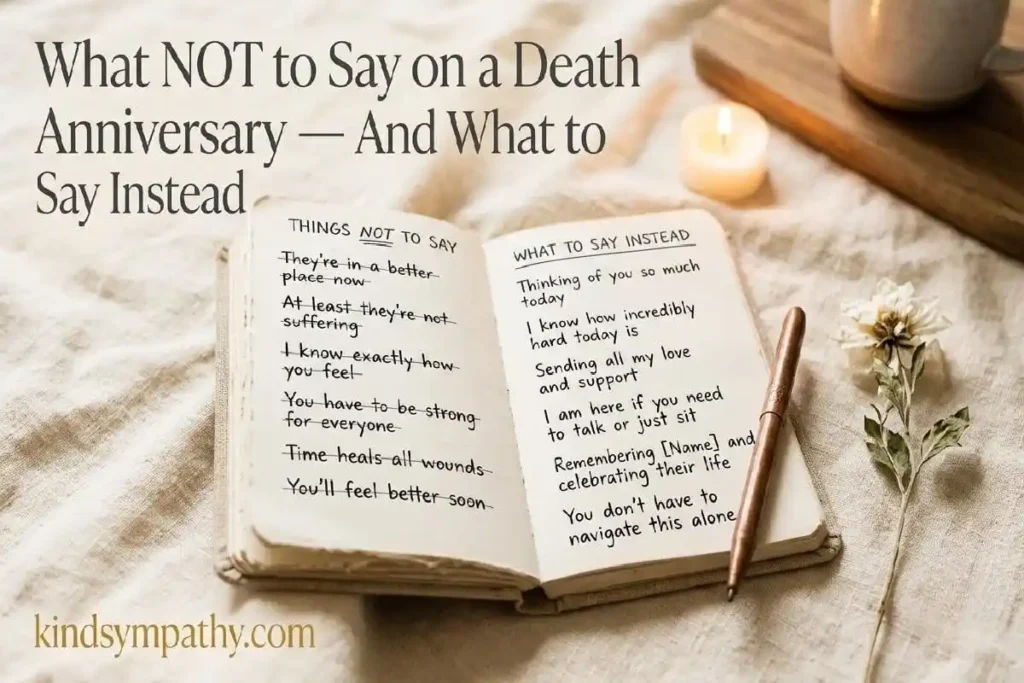
What NOT to Say on a Death Anniversary
Some phrases — even well-meant — miss the mark on this specific day.
❌ “I can’t believe it’s already been [X] years.” Why it stings: Centers your own perception of time rather than the griever’s experience of it. It can feel dismissive of how long and hard that time has actually been. ✅ Say instead: “I know [X] years have passed. I also know time doesn’t always work the way people think when you’re grieving. I’m thinking of you today.”
❌ “They would want you to be happy today.” Why it stings: Uses the deceased to manage the griever’s emotions on a day when those emotions are completely valid. ✅ Say instead: “However today feels is the right way for it to feel. I’m here for whatever version of today this is.”
❌ “At least you have so many good memories.” Why it stings: Memories and grief coexist — one doesn’t cancel the other. “At least” always minimises. ✅ Say instead: “I hope there are moments today where the memories feel warm. And I’m here for the ones that don’t.”
❌ “You’re so strong — they’d be proud of how far you’ve come.” Why it stings: Assigns performance of strength and progress on a day when the person might simply be grieving. The implication that they should have “come far” by now can add pressure. ✅ Say instead: “You don’t have to be anywhere in particular in your grief today. I’m here for wherever you are.”
❌ Saying nothing at all. Why it stings: Silence on a death anniversary tells the grieving person: this day is invisible to everyone but me. ✅ Say instead: Any of the messages in this post — even the shortest one. Something is always better than nothing.
❌ “I didn’t know whether to bring it up.” Why it stings: If sent on the day, this opens with your uncertainty rather than their need. The day is already there. Just say something. ✅ Say instead: Just say it. Lead with the acknowledgment. “I know what today is” is the best possible opening.
One-Line Thinking of You Death Anniversary Messages ✨
Each of these works alone — as a text, a card note, or a Pinterest graphic.
- I know what today is. I’m here.
- This date is marked in my heart, not just my calendar.
- [Name] is remembered today. So are you.
- The anniversary arrives and so do I.
- Grief anniversaries deserve acknowledgment. This is mine to you.
- One year. Two. However many. I remember.
- Today the world moves as normal. I don’t.
- I’m holding this date with you.
- The people we love don’t stop being loved on their anniversaries.
- Not forgotten. Not by me. Not today.
- This date was always going to be hard. I’m here for it.
- Whatever today brings — I’m thinking of you through all of it.
- Some dates are louder than others. I hear this one.
- Marked. Remembered. Held. That’s what this day is, from this end.
- The world kept going. You kept going. They are still remembered.
Text or Card — What Does a Death Anniversary Need?
This is one situation where the timing is more important than the format.
Send something on the day itself — not a day before, not a week after. The date is the message. A death anniversary thinking of you text that arrives on the actual anniversary says: I tracked this date. I came on purpose. You are not carrying this alone today. That precision matters.
A card sent to arrive on or just before the date is even more meaningful — because it shows preparation, intention, and the kind of care that involves sitting down and writing something ahead of time. Our guide to grief anniversary messages and what to write has more options for different situations and milestone years.
For later anniversaries (years two, three, five, ten), a card that arrives when most people have long since stopped marking the date is one of the most profound gifts you can offer a grieving person. Our collection of long-term bereavement support messages covers the ongoing grief journey if you need it.
The one thing that’s always wrong: letting the date pass in silence when you know what day it is.
💡 5 Tips for Getting a Death Anniversary Message Right
Tip 1: Put the date in your calendar and treat it like a commitment. A death anniversary thinking of you message only works if it arrives on the day. Put the date in your calendar with a reminder. Not the week after. Not when you remember. The day. That’s the whole job.
Tip 2: Name the person who died. “I’m thinking of you and of [name] today” is completely different from “I’m thinking of you on this anniversary.” Naming the person keeps them real. It tells the grieving person: I know who you’re missing. I’m missing them too. That specificity is one of the most healing things a message can offer.
Tip 3: Acknowledge the number. “One year” or “three years” is worth saying. Not to measure how long the grief has gone on, but to honour the specific milestone. Each anniversary year carries its own weight — the third is different from the first. Naming the number says: I know exactly where you are in this.
Tip 4: Don’t make it about your own feelings. Anniversary messages are easy to accidentally centre on yourself — your shock at how much time has passed, your own memories of the person. Keep the focus where it belongs: on the person you’re writing to, and on the person they’re missing.
Tip 5: Mark every year, not just the first. Research on the psychology of grief and long-term bereavement consistently shows that death anniversaries continue to carry significant emotional weight for years — often intensifying at certain milestone years (one, five, ten). Harvard Health’s work on grief’s long-term emotional impact confirms that regular acknowledgment from others — especially on significant dates — is one of the most meaningful forms of sustained support a grieving person can receive. Set the recurring calendar reminder. Show up every year. That consistency is irreplaceable.
❓ FAQ — Thinking of You on Death Anniversary
What is the best thinking of you message to send on a death anniversary?
The best thinking of you on death anniversary messages name the date, name the person, and offer presence. Try: “I know what today is. I didn’t want it to pass without you hearing from someone who remembered — and who wanted you to know: [name] is remembered, this date matters, and you are not alone in it.” That combination is what a grief anniversary most needs: proof that the day was marked and the person was kept real.
What are some short thinking of you death anniversary text examples I can send right now?
Short death anniversary thinking of you text messages work perfectly when sent on the actual date. Try: “I know what today is. Thinking of you and of [name].” Or: “This date is marked for me too. I’m here.” Or: “One year [or however many]. Still thinking of you. Still thinking of them.” Brief, on-time, and naming both the griever and the person they lost.
What do you write in a card for a death anniversary?
Write something that proves you prepared for this date. Try: “I marked this in my calendar because I didn’t want it to pass without something from me. This card says: I remember [name]. I’m thinking of you. This date matters and so do you.” That’s what to write in a death anniversary card that actually does what anniversary cards are supposed to do.
Should I send a death anniversary message by card or text?
Both if you can — but the card should be timed to arrive on or just before the date. A text works for an immediate, on-the-day acknowledgment. A card shows preparation and care. For later anniversaries especially (year two, three, five), a card that arrives when nobody else is sending anything is one of the most meaningful things you can offer.
Is it okay to bring up the death anniversary even if time has passed?
Always. Bringing it up does not remind the grieving person of something they’ve forgotten — they haven’t forgotten, not for a single day. What it does is tell them: I remembered. I’m marking this with you. Research on the psychology of grief and human connection shows that having others acknowledge loss anniversaries is one of the most meaningful forms of ongoing grief support. And Harvard Health confirms that grief anniversaries carry genuine emotional weight across many years, and that acknowledgment from others significantly reduces the isolation of that experience. Say something. Name the day. Name the person. Always.