
The Slack message landed at 9:47am.
A colleague’s father passed away. Or a client’s wife. Or your manager’s sister. And now you’re sitting in front of a blank compose window, professional obligation colliding with genuine sympathy, wondering how to write something that sounds like a human being and not like a form letter from HR.
Condolence email templates solve a real problem: the workplace requires you to respond to grief, and most people have never been taught how. It’s an oddly specific skill — more personal than a business email, more formal than a text to a friend, and somehow more fraught than either.
The emails in this guide are ready to send. Not in a “swap out a few words” way — in a genuinely copy-paste, add-a-name-and-go way. They’re professional without being cold, human without overstepping, and exactly what someone opening a condolence email at a difficult time actually needs to receive.
For personal (non-workplace) condolence messages, our guides to sympathy messages for loss and what to write in a sympathy card have you covered.
What is a condolence email template? A condolence email template is a professionally structured sympathy message sent via email to a colleague, client, or professional contact following a bereavement. The best condolence email templates balance warmth with professionalism — acknowledging the loss genuinely without overstepping workplace boundaries or making the recipient feel like they’ve received a form response.
💬 Best Condolence Email Template Example: Subject: Thinking of you — so sorry for your loss
“I just heard the news about your [mother/father/partner], and I wanted to reach out right away. Please accept my sincere condolences. [Name] clearly meant so much to you, and I’m truly sorry for what you’re going through. Please don’t worry about anything on this end — we have everything covered. Take all the time you need.”
This works because it’s immediate, names the practical reassurance about work coverage (which is what most bereaved people are anxious about), and keeps the focus on the person rather than the logistics.
“For email to a boss specifically, our sympathy email to boss covers that professional hierarchy. For written letters, our how to write a condolence letter is the print/mail alternative.”
The Anatomy of a Professional Condolence Email
Before the templates, a quick note on structure. Every effective bereavement email template does three things in this order:
1. Acknowledge the loss directly. Don’t ease in with small talk. Open with the purpose of the email.
2. Say something human. One line that shows this is a person writing, not a form. A specific name. A genuine expression of care.
3. Remove the work anxiety. Grieving people worry about their email pile, their deadlines, what’s been left undone. One clear sentence that says “everything is covered” is often more comforting than any amount of sympathy language.
That’s the formula. Every template below follows it.
Condolence Email Templates — From Manager to Employee
When someone who reports to you experiences a loss, the email needs to balance managerial authority with genuine human care. These work condolence email templates strike that balance.
Template 1 — Loss of a Parent
Subject: My condolences — please take all the time you need
Dear [Name],
I was so sorry to hear about the death of your [mother/father]. Please accept my deepest condolences.
[Name] clearly meant a great deal to you, and losing a parent is one of the hardest things any of us go through. Please don’t give work a second thought right now. We have [colleague/your team] covering your responsibilities, and everything will be here when you’re ready to return — without any pressure on timing.
If there’s anything at all I can help with from this end, please reach out. Take good care of yourself.
With sincere sympathy, [Your name]
Template 2 — Loss of a Partner or Spouse
Subject: So sorry for your loss
Dear [Name],
I was deeply saddened to learn of the loss of your [partner/husband/wife]. Please know that my thoughts are with you during this incredibly difficult time.
I want you to know that work is completely taken care of. Please focus entirely on yourself and your family. There is no expectation of any communication from your end while you’re dealing with this loss.
Please reach out when you feel ready, and please let me know if there is anything I or the team can do to support you.
With deepest sympathy, [Your name]
Template 3 — Sudden or Unexpected Loss
Subject: Thinking of you
Dear [Name],
I’ve just heard the news, and I wanted to reach out immediately. I’m so deeply sorry. A loss like this — sudden and without warning — is its own kind of shock, on top of everything else.
Please don’t worry about work. I will personally make sure everything is handled. Take whatever time you need — there is no pressure from this end at all.
I’m here if you need anything.
With sincere condolences, [Your name]
“For colleague condolences, our sympathy messages for a colleague and corporate condolence messages cover all workplace situations.”
Condolence Email Templates — From Employee to Manager
Sending condolences up the hierarchy is slightly different — the professional distance is greater, but the human obligation is no less real. These formal sympathy email templates navigate that gap.
Template 4 — General Bereavement (Loss of a Family Member)
Subject: My sincere condolences
Dear [Name/Mr./Ms./First name if appropriate],
I was very sorry to hear about the death of your [family member]. Please accept my sincere condolences.
Losing someone you love is one of life’s most difficult experiences, and I want you to know that the whole team is thinking of you. Please focus entirely on your family and yourself right now — everything here is covered and there’s no need for you to worry about any of it.
I hope you find comfort and support in the time ahead.
With warm regards and deepest sympathy, [Your name]
Template 5 — Loss of a Parent (More Personal Working Relationship)
Subject: Thinking of you
Dear [Name],
I heard about your mother/father and I’m so sorry. I know how much [he/she/they] meant to you, and I can only imagine how difficult this must be.
Please take all the time you need. Everything on the work side is well in hand, and no one is expecting anything from you right now. When you’re ready to return, we’ll all be glad to have you back — but only when the time feels right for you.
Wishing you strength and peace in the days ahead.
With sincere sympathy, [Your name]
Condolence Email Templates — Between Colleagues (Same Level)
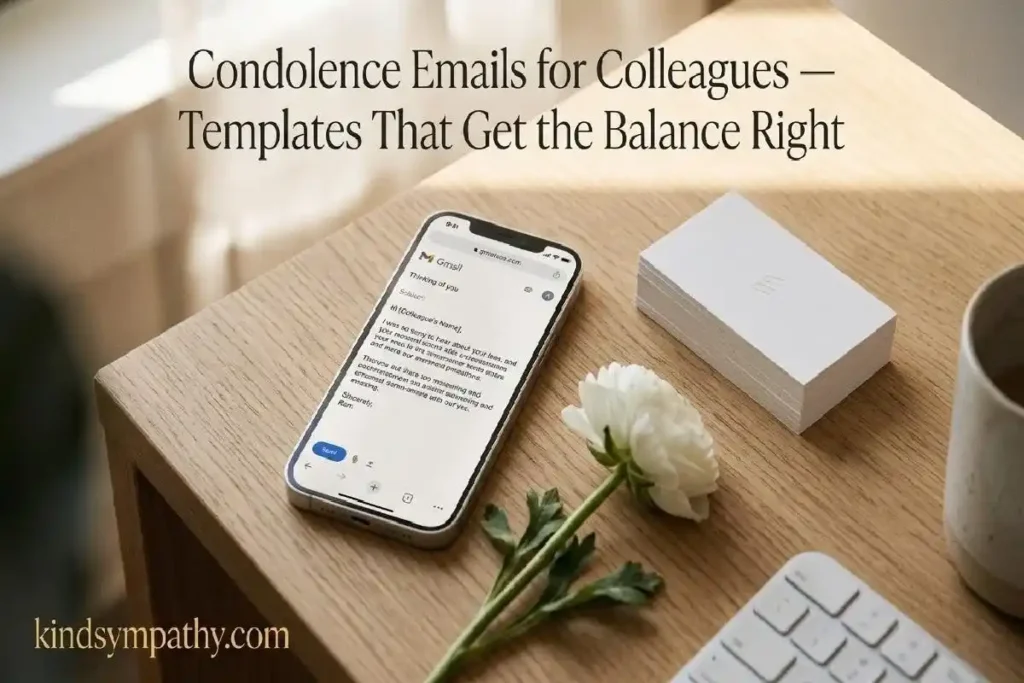
Between peers, the email can be slightly warmer and more personal. These sympathy email templates are for the colleague you work alongside — not above or below.
Template 6 — Close Colleague
Subject: I’m so sorry — thinking of you
Hi [Name],
I just heard and wanted to reach out straight away. I’m so sorry about [name/your mum/your partner/etc.]. That’s a real loss, and I’m thinking about you.
Please don’t worry about anything over here. I’ve got [tasks/clients/meetings] covered and I’ll make sure everything runs smoothly while you’re away. Just focus on yourself and your family.
I’m here if you need anything at all — whether that’s work stuff or just someone to talk to.
Take care, [Your name]
Template 7 — Colleague You Know Less Well
Subject: My condolences
Hi [Name],
I heard about your loss and just wanted to extend my condolences. I’m sorry for what you’re going through.
Please don’t worry about anything work-related while you’re away. If there’s anything I can help cover in the meantime, please don’t hesitate to ask.
Take all the time you need.
Warm regards, [Your name]
Template 8 — Colleague You’re Friendly With
Subject: So sorry to hear this
Hi [Name],
I’m so sorry. I heard what happened and I just wanted you to know I’m thinking about you.
I’ll handle [specific task] while you’re out and make sure [colleague] knows what’s going on. You don’t need to worry about a single thing from this end.
When you’re ready and want to talk — whether it’s about work or just to have a conversation — I’m here. And if there’s anything else I can do, please say.
Take care of yourself, [Your name]
Formal Condolence Email Templates — For Clients and Business Contacts
When the relationship is professional rather than personal, warmth still matters — but so does appropriate distance. These professional condolence emails for clients and business contacts are designed for that specific register.
Template 9 — To a Client on Loss of a Family Member
Subject: Our deepest condolences
Dear [Client name],
On behalf of [Company name] and myself, I wanted to extend our sincere condolences on the loss of your [family member]. Please know that our thoughts are with you and your family at this time.
We will ensure that all active projects are managed seamlessly in your absence and that nothing requires your attention until you are ready. Please focus entirely on yourself and your loved ones.
We will be in touch at a time that suits you when you’re ready to reconnect. Until then, please take good care.
With deepest sympathy, [Your name] [Company name]
Template 10 — To a Business Partner
Subject: Sincere condolences
Dear [Name],
I was very sorry to hear of your recent loss. Please accept my sincere condolences.
I want to reassure you that there is no expectation of contact or action on your part regarding our shared work at this time. Everything can wait, and we will work around whatever timeline makes sense for you.
Please take all the time you need. I’ll be in touch when the time is right.
With warm regards and sincere sympathy, [Your name]
Template 11 — To a Client You Know Personally
Subject: Thinking of you
Dear [Name],
I just heard about your loss and I wanted to reach out right away. I’m so sorry. I know how much [name/your family/this person] meant to you, and I want you to know I’m thinking about you.
Everything on our end is completely fine — please don’t give any of it a thought. When you’re ready to reconnect, I’ll be here. Until then, take care of yourself.
With warmth and sincere condolences, [Your name]
“For formal messages, our formal condolence messages has pre-written options. For team emails, our sympathy messages from a team covers group sending.”
Short Condolence Email Templates — When Time is Critical
Sometimes you need to send something immediately — brief, genuine, and right now. These short condolence email wording examples are for exactly that.
Template 12
Subject: So sorry for your loss
Dear [Name], I’m so sorry to hear of your loss. My sincere condolences to you and your family. Please don’t worry about anything here — all is covered. [Your name]
Template 13
Subject: Thinking of you
Hi [Name], I just heard and I’m so sorry. Take all the time you need — I’ve got everything covered here. Thinking of you. [Your name]
Template 14
Subject: My condolences
Dear [Name], I was very sorry to hear the news. Please accept my sincere condolences. Work is completely taken care of — please focus on yourself and your family. [Your name]
Condolence Email Subject Lines (That Get Opened)
The subject line matters. These condolence email wording options for subject lines are warm without being clinical:
- “My sincere condolences”
- “Thinking of you — so sorry for your loss”
- “I’m so sorry to hear this”
- “With deepest sympathy”
- “Thinking of you”
- “So sorry for your loss”
- “My condolences”
- “I heard the news — so very sorry”
- “Please accept my condolences”
Avoid: “RE: Bereavement” / “[Name] bereavement” / anything that reads like a filing system. The subject line is the first human contact — treat it accordingly.
What NOT to Write in a Condolence Email (Professional Version)
Even in a professional context, certain phrases land wrong.
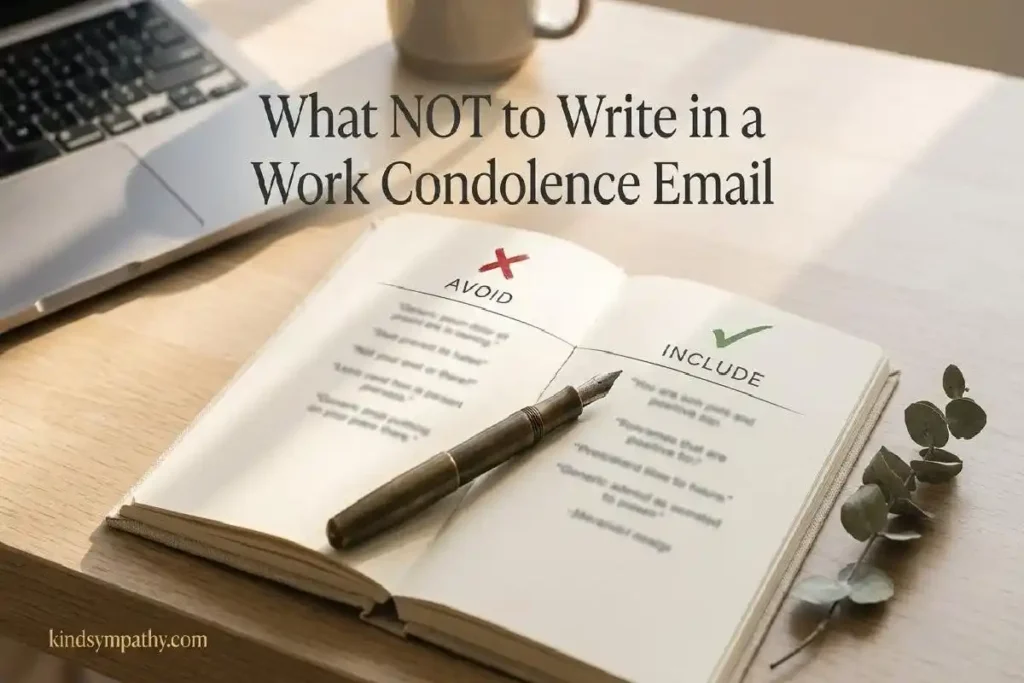
❌ “I know how you feel.” Why it fails: Centres your experience, assumes equivalence. ✅ Write instead: “I can only imagine what you’re going through.”
❌ “If there’s anything you need, just ask.” Why it fails: Places burden on the bereaved to identify and request help. ✅ Write instead: “I’ve already covered [specific thing] — please don’t give work a thought.”
❌ “He/she is in a better place.” Why it fails: Imposes beliefs in a professional context, feels hollow. ✅ Write instead: “I’m so sorry for your loss” — clean, honest, appropriate.
❌ “Let me know when you’ll be back.” Why it fails: Places timeline pressure on someone in grief. ✅ Write instead: “Take all the time you need — there’s no pressure or expectation from our end.”
❌ Copying everyone on the email. Why it fails: A condolence email should feel private, even when sent as a team communication. Send individual messages where possible. ✅ Do instead: If a team email is necessary, cc sparingly and flag that responses should go directly to the grieving person’s personal email once ready.
❌ “I’m sorry for your loss” with nothing else. Why it fails: Technically correct but hollow when sent alone with no personal content. ✅ Write instead: Add the one human sentence — a name, a specific thing covered at work, a genuine expression of care.
Copy & Paste Condolence Emails — Ready Right Now 📋
For a direct report whose parent died — just copy this 👇
Subject: My condolences — please take all the time you need
Dear [Name], I was so sorry to hear about your [mother/father]. Please accept my sincere condolences. Losing a parent is one of the hardest things, and you don’t need to give work a single thought right now. Everything is covered, and we will hold things here for as long as you need. Take good care of yourself. With sympathy, [Your name]
For a close colleague — just copy this 👇
Subject: So sorry — thinking of you
Hi [Name], I just heard and wanted to reach out right away. I’m so sorry. Please don’t worry about a thing over here — I’ve got [tasks] covered and everything else is in hand. Just focus on yourself and your family. I’m here if you need anything at all. Take care, [Your name]
For a client — just copy this 👇
Subject: Our sincere condolences
Dear [Name], On behalf of [Company] I want to extend our sincere condolences on the loss of your [family member]. Please know there is no expectation of contact or action from your end at this time. Everything is being managed, and we will reach out when you’re ready. Please take all the time you need. With warm regards, [Your name]

💡 5 Tips for Writing a Condolence Email That Gets the Balance Right
Tip 1: Send it the same day you hear the news. The professional condolence email that arrives promptly says: I prioritised you, even for fifteen minutes, even with everything else on. Delayed emails feel like afterthoughts. Research on the psychology of grief and human connection shows that immediate acknowledgment matters significantly to bereaved people.
Tip 2: Always name the person who died. “I’m so sorry to hear about your mother’s death” is more human than “I’m so sorry to hear of your loss.” If you know the name of the person who died, use it. Specificity signals genuine care.
Tip 3: Solve the work anxiety in one sentence. The most practical thing a condolence email can do is remove the anxiety about professional obligations. “Everything is covered, please don’t give work a thought” takes thirty seconds to write and removes days of background worry.
Tip 4: Keep it brief. A professional condolence email should be between three and six sentences. Anything longer risks feeling performative. Say the true thing and stop. A short email that says something real beats a long email that says something generic every time.
Tip 5: Follow up once, briefly, when they return. When someone comes back to work after a bereavement, a quick “I’m glad you’re back, please don’t hesitate to let me know what I can do to help ease you back in” matters enormously. Research from Harvard Health on grief, connection and recovery confirms that the professional environment that handles bereavement with ongoing sensitivity meaningfully affects how employees fare after loss. The return message is part of the condolence, not separate from it.
❓ FAQ — Condolence Email Templates
What is the best condolence email template to use at work?
The best condolence email template for a professional context combines three things: immediate acknowledgment of the loss, a human sentence that shows you care, and a clear statement that work is covered and there’s no pressure. Template 1 (loss of a parent, manager to employee) models this cleanly. Adapt the relationship and specifics — but keep those three elements in every version.
What are some short condolence email examples I can send right now?
Templates 12–14 in this guide are the quickest bereavement email templates available — three to four sentences, subject line included, ready to personalise and send in under two minutes. For even shorter: “Dear [Name], I was so sorry to hear the news. My sincere condolences to you and your family. Please don’t worry about anything here — all is covered. [Your name]”
What should I put in the subject line of a condolence email?
The best condolence email wording for subject lines is warm and simple: “My sincere condolences,” “Thinking of you,” or “So sorry for your loss.” Avoid anything that sounds administrative. The subject line is the first thing they see — it should feel like it came from a person.
Should a condolence email be formal or personal?
It depends on the relationship. Manager to direct report: warm and supportive, with practical reassurance. Colleague to colleague: can be more personal. Client or business contact: more formal but still genuinely human. The register should match the relationship — the formal sympathy email for a client will look different from the one you send to a work friend. The templates in this guide are organised by relationship for exactly this reason.
Is it okay to say “I don’t know what to say” in a condolence email?
It works in a personal email but can feel misplaced in a professional one where some level of composure is expected. In a professional sympathy email template, the equivalent is acknowledging the difficulty directly but briefly: “There are no adequate words for a loss like this, but I wanted to reach out immediately.” Research on the psychology of grief and human connection shows that genuine acknowledgment — even brief — matters more than the specific words used. And Harvard Health confirms that feeling supported by the professional community is a meaningful factor in how people navigate loss. Send the imperfect email. It’s still far better than silence.






Pingback: Sympathy Email to Boss — 20 Examples That Work