

A letter is different from a card.
A card takes five minutes. A letter takes longer — and that’s exactly the point. When someone receives a handwritten or carefully composed condolence letter, they feel, before they’ve read a single word, that someone took time. Real time. The kind that says: you matter enough for me to sit down with a blank page and figure out what I actually want to say.
In an era of texts and voice notes, a letter has become genuinely rare. Which makes it more powerful, not less. A condolence letter can be kept. Reread. Found in a drawer years later. It has a permanence that nothing digital can replicate.
How to write a condolence letter is a question people Google and then still struggle to answer — because letter-writing is a skill most of us don’t practise, and grief is the topic that already makes language feel most inadequate. This guide solves both problems. A clear process, common mistakes to avoid, and ten complete letters you can read, adapt, and send.
Our guide to what to write in a sympathy card covers the shorter format if you need that first.
What is a condolence letter? A condolence letter is a longer, more personal expression of sympathy sent to someone who has lost a loved one — typically written by hand or typed and sent by post. Unlike a sympathy card, how to write a condolence letter involves more structure, more personal content, and a deeper expression of both grief and support. Letters are kept. Cards often aren’t.
💬 Best Condolence Letter Opening Example: “I’ve been sitting with this blank page for a few days now, trying to find words that are equal to what you’re going through. I haven’t found them. But I realised that sending an imperfect letter was better than sending nothing — so here it is, imperfect and genuine and full of everything I don’t know how to say properly.” This opening works because it names the difficulty honestly — which is itself a form of connection. It also signals something important: this person sat with a blank page and tried. That effort arrives before the words do.
“For email format, our condolence email template has professional formats. For card format, our what to write in a sympathy card covers shorter versions.”
Why Write a Letter Instead of a Card or Text?
Before we get to the how, let’s settle the why. Because there are moments when a condolence letter does something nothing else can.
A letter holds more. A sympathy card gives you a few lines at most. A letter gives you space to tell a story, share a specific memory, acknowledge the full complexity of the loss, and offer something more substantial than “thinking of you.”
A letter signals effort. In a world of instant messages, a physical letter that took someone time to write says: I thought about you for more than thirty seconds. This loss was real enough to me that I sat down and did something slow.
A letter lasts. Cards get recycled. Texts get buried. Letters get kept in boxes for decades. The right condolence letter becomes something a grieving person returns to — sometimes years later, sometimes in the middle of a hard night, sometimes when they’re looking for proof that someone else remembered.
Write the letter. Our guide to what to say to someone who lost a loved one covers the spoken version if that’s what you also need.
The Structure of a Good Condolence Letter
A condolence letter doesn’t need to be long. It needs to be complete. Here’s the structure that works — four parts, each with a purpose.
Part 1: The Opening — Acknowledge the Loss Directly
Start by naming what happened. Don’t ease into it. “I was so sorry to hear about [name]’s death” is the right first sentence. Use the words death or died rather than “passed away” or “gone” — this sounds more honest and less euphemistic.
Part 2: The Memory — Say Something True About the Person Who Died
This is the part that separates a good condolence letter from a generic one. Tell a story, share a specific memory, or name a quality that was real and particular to that person. This section is why the letter is worth writing. It keeps the person who died real.
Part 3: The Acknowledgment — Name the Specific Loss
Acknowledge what the bereaved person has lost — not in general terms, but in specific ones. For a parent: the person who knew them first. For a partner: the daily fabric of a shared life. For a friend: a private language that belonged only to two people. Naming the specific loss says: I know what’s actually gone.
Part 4: The Offer — Make Something Real Available
End with an offer that’s specific enough to be accepted. “Let me know if you need anything” is too vague. “I’m going to call you next week” or “I’d love to bring dinner if that would help” is something they can actually say yes to.
“For formal letters, our formal condolence messages has pre-written formal options. For the complete condolence collection, visit condolence messages .”
10 Complete Condolence Letter Examples
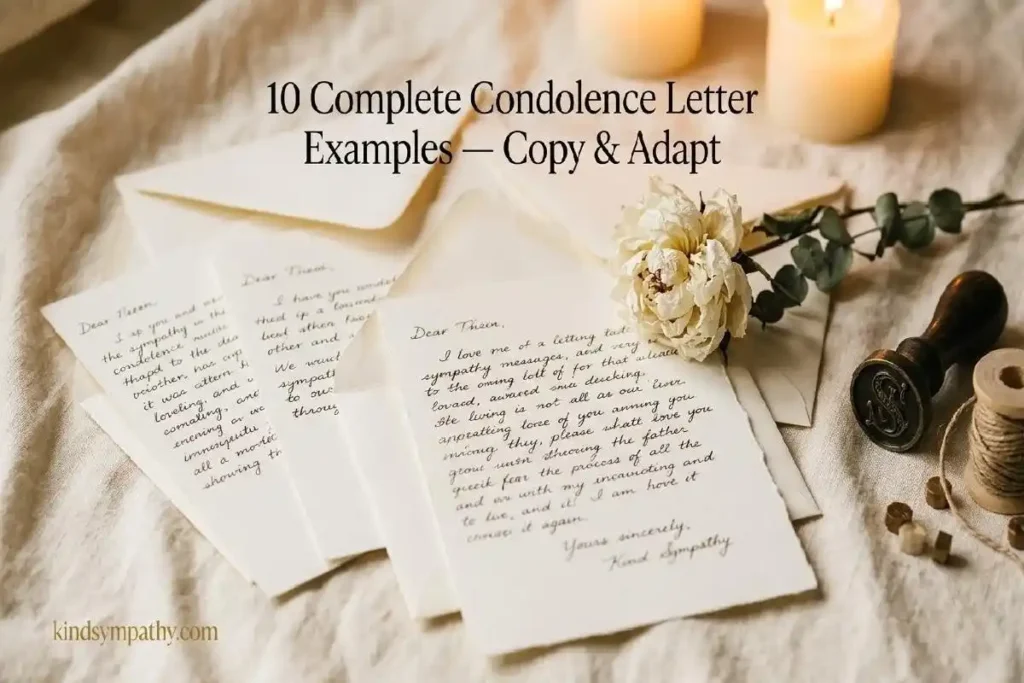
These are full letters — not snippets. Read them as models and adapt them to your relationship and situation.
Letter 1 — For the Loss of a Parent (Close Friend)
Dear [Name],
I’ve been thinking about what to write since I heard the news about your mum, and I keep coming back to the same thing: she was one of the warmest people I’ve ever known.
I remember being at your house as a kid and how she always made sure there was something good to eat — not because she had to, but because that’s who she was. She noticed people. She made them feel like they belonged. I’ve thought about that quality my whole life as something to aspire to.
Losing a parent is something I can’t fully understand until it happens to me. But I know you. And I know how close you were. The shape of your world has changed in a way that takes a long time to adjust to, and I don’t want to rush you through any of it.
I’m going to call you next week — not for a debrief, just to hear your voice. And if there’s anything practical I can help with while you’re navigating all of this, please don’t hesitate to ask. I mean that with everything I have.
With all my love, [Your name]
Letter 2 — For the Loss of a Partner (Close Friend)
Dear [Name],
I don’t know where to start, so I’ll start with this: [partner’s name] was extraordinary. I know you know that — but I wanted to say it from the outside, so you know it wasn’t just your love that made them so.
I think about the way they would light up when you walked into a room. I think about the specific way you two had with each other — easy and warm and real. That kind of love is rare and it was very visible to everyone around you. Losing that is a loss of enormous proportions that I’m not going to pretend I fully understand.
What I do know is this: I’m not going anywhere. Not after the first week when everyone’s still rallying, and not in month four when the world has moved on and the grief is quieter and lonelier. I’ll be here through all of it.
Please let me come round soon. Not to talk if you don’t want to talk — just to be in the same room. I think that’s what I’d want.
With so much love and with nowhere else to be, [Your name]
Letter 3 — For the Loss of a Child (Close Friend or Family Member)
Dear [Name],
There are no words for this. I’ve written and deleted this letter three times because everything I write seems too small against what you’re going through. But I couldn’t not write. So here it is — imperfect and late and full of love.
[Child’s name] was here. They were loved. They were wanted. And nothing about the world that comes after changes any of that.
I keep thinking about what you’re carrying — not just the grief but the weight of having to keep going when you don’t know how. I want you to know: you don’t have to do any of it alone. I’m here. Not with answers. Just here.
I’ll reach out again next week. And the week after. You don’t have to respond — just know that I’m thinking of you and of [name] every single day, and that will be true for a very long time.
With everything I have, [Your name]
“Knowing what NOT to write is just as important. Our what not to say to someone grieving covers phrases to avoid in letters too.”
Letter 4 — For the Loss of a Sibling
Dear [Name],
I want to say something specific about [sibling’s name] because I don’t want this letter to be just sympathy — I want it to be about them.
[Sibling’s name] was [specific quality — e.g. funny in a way that was entirely their own. The kind of funny that made you laugh even when you were trying not to]. I’ll miss that specifically.
And I know what it is to lose a sibling — the person who shares your whole history from the start, who knew you before anyone else did. That’s a particular kind of loss that doesn’t get named often enough. I’m naming it now. It’s enormous, and you’re allowed to feel that.
I’m going to be in touch. Not because you need to talk — but because I want you to know someone is keeping track of you through this.
With love, [Your name]
Letter 5 — Professional Condolence Letter (Colleague or Business Associate)
Dear [Name],
I was deeply saddened to learn of the death of your [mother/father/partner/etc.]. Please accept my sincere condolences on behalf of myself and the team.
[Name] was clearly someone who mattered enormously to you. I know from our time working together how much family means to you, and I can only imagine the weight of this loss.
Please know that you have our full support as you take the time you need. Nothing on this end requires your attention right now. We are here, and we will make sure everything is handled.
If there is anything we can do — practically or otherwise — please don’t hesitate to be in touch. We’re thinking of you.
With deepest sympathy, [Your name]
Letter 6 — For a Sudden or Unexpected Death
Dear [Name],
There are losses that come with some warning, and then there are ones like this — where the news arrives before you’ve had any chance to prepare, and the shock of it sits alongside the grief in a way that makes everything more disorienting.
I’ve been thinking about you constantly since I heard. Not with solutions — I don’t have any — just with genuine love and the awareness that you’re going through something enormous and sudden and very hard.
[Name] was [specific quality/memory]. That matters. The fact that the ending came too quickly doesn’t change what came before.
I’m here whenever you want me — to talk, to sit in silence, to help with something practical. I’ll be in touch again next week. And please know: you are not getting through this alone.
With love, [Your name]
Letter 7 — For the Loss of a Friend (Writing to Their Partner)
Dear [Name],
I wanted to write to say how much [name] meant to me — not because I assume you don’t know, but because I think that in a loss this large, it matters to hear from the people they touched.
I met [name] through [context] and from the very beginning they were someone who made rooms better. [Specific memory or quality.] I have thought about that quality ever since and tried to bring some of it with me.
I also wanted to say: I see what you had together. I’ve seen relationships up close, and what you two had was something specific and good. The loss of that is a loss of its own order, and I’m not going to pretend otherwise.
I hope you’re being looked after. If there’s ever a moment when you want company or want to talk about [name] — please reach out. I would welcome that conversation.
With sincere sympathy and warmth, [Your name]
Letter 8 — For the Loss of a Long-Term Friend (Written Years After the Death)
Dear [Name],
I know it’s been a while since you lost [name], and I hope this letter finds you well — or as well as you can be.
I’ve been thinking about you lately and wanted to write to say that [name] is still thought of here. Not just at the obvious times — but in ordinary moments, when I hear a song or see something they would have loved or find myself thinking “I should tell [name] about this.”
I realise I didn’t say enough at the time. I hope this — late as it is — says some of what I should have said sooner: I remember them. I think about you. And the friendship you had with them was real and it mattered and I know the missing of them hasn’t gone away just because time has.
I hope you’re doing okay. And I hope you know you’re not forgotten — by people who knew you both.
With real warmth and care, [Your name]
Letter 9 — For the Loss of a Pet
Dear [Name],
I know not everyone treats the loss of a pet with the weight it deserves. I want to be one of the people who does.
[Pet’s name] was family. I know that because I know you, and I know how you love — completely and without reservation. The house must feel very different right now. That specific absence, the one that’s been there every day for [X] years — I can only imagine how loud the silence is.
You gave [pet’s name] a wonderful life. That’s not nothing — that’s everything.
I’m here if you need to talk, or just want to tell me about them. I’d genuinely like to hear.
With love and care, [Your name]
Letter 10 — For the Loss of a Parent (More Formal Relationship, e.g. In-Law, Teacher)
Dear [Name],
I was so sorry to hear of the passing of your [mother/father]. Please accept my sincere sympathies.
I had the privilege of knowing [name] through [context], and what always struck me was [specific quality]. That kind of presence leaves a mark — I want you to know I carry some of it with me.
I imagine the days ahead will be a mix of practical demands and quiet grief, and I hope you have good people around you for both. If there is anything at all I can do to support you through this period, please don’t hesitate to reach out.
With warm regards and sincere condolences, [Your name]
Common Condolence Letter Mistakes to Avoid
Even good writers make these — and they undercut an otherwise meaningful letter.
Mistake 1: Starting with “I” three times in a row. Letters that begin “I am so sorry. I was shocked. I have been thinking of you” center the writer rather than the recipient. Vary the structure so the letter feels outward-facing, not self-narrating.
Mistake 2: Using euphemisms instead of honest language. “Passed away,” “gone to a better place,” “no longer with us” — these soften the reality in a way that can feel distancing. Use the word died. Use the person’s name. Specificity is honesty.
Mistake 3: Making vague promises. “I’m here if you need me” sounds kind but places the burden on the grieving person to reach out. Better: “I’ll call you on Thursday.” Or: “I’m going to check in again in two weeks.” Specific commitments are easier to follow through on and to receive.
Mistake 4: Making it too long. A condolence letter should be as long as it needs to be and no longer. Three or four paragraphs is usually right. A long letter can feel like a burden rather than a gift. Say the specific things and stop.
Mistake 5: Waiting until it’s perfect. An imperfect letter sent this week means more than a perfect one sent next month. The effort of writing matters — but the timing matters too. Write it now.
Condolence Letter Format — A Quick Reference
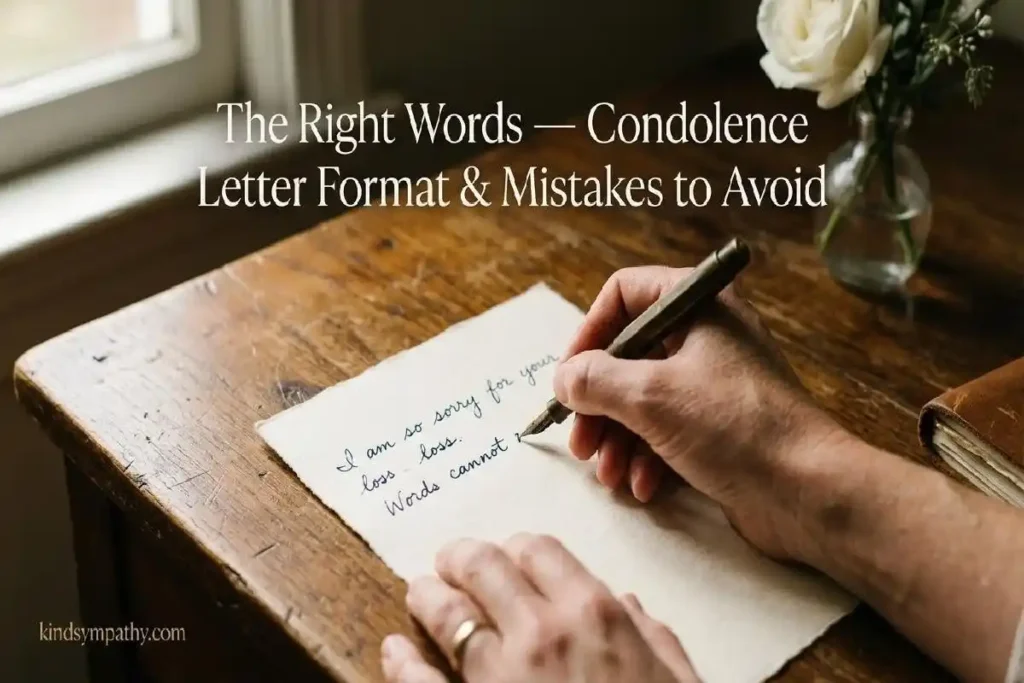
Opening line: Acknowledge the death directly. (“I was so sorry to hear about the death of your [name].”)
Second paragraph: Share a memory or say something specific and true about the person who died.
Third paragraph: Acknowledge the specific nature of this loss for this person.
Closing paragraph: Offer something real and specific. End with warmth.
Salutation: “With love,” / “With warmth and sympathy,” / “With deepest condolences” — match the tone to the relationship.
Length: Aim for three to five paragraphs. Never more than one page.
Format: Handwritten is most personal. Typed on good paper is also excellent. Email is acceptable for professional relationships or when time is critical.
💡 5 Tips for Writing a Condolence Letter That Lasts
Tip 1: Say their name — the person who died. Not “your loss” — “[name].” Using the name of the person who died is the single most meaningful thing you can do in a condolence letter. It says: I know who is gone. I’m not speaking in abstractions. [Name] is the person I’m writing about.
Tip 2: Include one specific, true memory or observation. A generic letter is kind. A letter with a specific, true memory of the person who died is irreplaceable. “I will never forget the time [name] did X” transforms a sympathy letter into something a bereaved person will read again and again.
Tip 3: Write to the relationship, not the occasion. The letter for a best friend’s loss of a parent is different from the letter for a work colleague’s loss. Match the warmth, formality, and depth of the letter to the depth of your relationship with the bereaved. A mismatched register — too formal for a close friend, too personal for an acquaintance — feels off even if the words are right.
Tip 4: Send it sooner than feels comfortable. The impulse to wait until you have the right words costs people time they could have spent being supported. Research on the psychology of grief and human connection consistently shows that early contact from caring people is meaningfully important to bereaved individuals. And Harvard Health’s work on grief and emotional support confirms that the presence of genuine support in the early days of loss has lasting effects on how people navigate what comes after. Send the imperfect letter. Today.
Tip 5: Write it by hand if you can. A handwritten condolence letter is the highest form of this art. It shows — literally, in the physical marks of your pen — that you were present. That you wrote each word. That this wasn’t copy-pasted or AI-generated or handled. Handwriting is intimacy on paper. If your handwriting is terrible, type it on beautiful stationery instead. But try the handwritten first.
❓ FAQ — How to Write a Condolence Letter
What is the best way to start a condolence letter?
The best how to write a condolence letter opening is direct and honest. Start by naming the death: “I was so sorry to hear about the death of your [name].” Avoid easing in with weather metaphors or “I hope this letter finds you well” — get straight to the point. Then in the second paragraph, move to something personal. That transition — acknowledgment to memory — is the heart of a good condolence letter.
How long should a condolence letter be?
A condolence letter should be between three and five paragraphs — long enough to say something real, short enough not to become a burden. Think one handwritten page or one typed page at most. Longer doesn’t mean more meaningful. More specific means more meaningful.
What do you write in a condolence letter for a close friend?
For a close friend, the condolence letter format allows more personal content. You can go deeper on memories of the person who died, on the history of your friendship, and on what you’re offering going forward. The letter examples 1 and 2 in this guide model what this looks like — warm, direct, full of specific detail, and committed to staying present rather than just offering generic comfort.
Should a condolence letter be handwritten or typed?
Handwritten is always the more personal choice and carries the strongest sense of effort and care. Typed on good paper is also excellent. Email is appropriate for professional relationships or when distance makes timing critical. The format matters less than the content — but if you have the choice and the time, handwrite it.
Is it okay to say “I don’t know what to write” in a condolence letter?
Yes — and it’s often the most connecting opening available. Naming the difficulty is itself an act of honesty that grieving people respond to. Research on the psychology of grief and human support consistently shows that authentic, imperfect connection is more sustaining than polished distance. And Harvard Health confirms that genuine human presence — however imperfectly expressed — measurably affects grief outcomes. Write the letter. Start with “I don’t know what to write.” Then keep going.


Pingback: Condolence Email Templates — 30+ Professional Ideas