
Grief doesn’t change based on who you are. But how you express condolences on behalf of an institution, in an official capacity, or as a senior professional — that does.
There are moments when warmth alone isn’t enough. When what’s needed is language that carries weight and composure alongside genuine sorrow. A university acknowledging the death of a beloved faculty member. A law firm expressing condolences to a client family. A CEO sending a formal message to the family of a long-serving employee. A government body releasing a statement on the passing of a public figure. These are the moments that call for formal condolence messages — not cold, never hollow, but structured and dignified in a way that personal messages aren’t required to be.
The challenge with formal condolence language is threading the needle: professional enough to maintain the appropriate register, human enough to carry genuine feeling. These 50 messages do both. They’re ready to adapt — for a letter, a statement, an email, or an announcement.
Our guide to professional condolence email templates covers the workplace-level register if that’s what you need. This post is for the more official end of the spectrum.
What are formal condolence messages? Formal condolence messages are official, professionally structured expressions of sympathy sent on behalf of an institution, organisation, or in a senior professional capacity. The best formal condolence messages maintain composure and appropriate register while still expressing genuine grief — they never sacrifice warmth entirely for formality.
💬 Best Formal Condolence Message Example: “On behalf of [Organisation Name], I wish to express our deepest condolences on the passing of [Name]. [He/She/They] made a significant and lasting contribution to [field/community/institution], and their absence will be profoundly felt. Our thoughts are with their family and all those who had the privilege of knowing them.” This works because it acknowledges the loss, honours the person’s contribution, and extends sympathy to those most affected — all in three sentences that carry genuine weight without overstepping the formal register.
“For the complete condolence collection, visit condolence messages . For email format, our condolence email template puts formal messages into professional structure.”
The Formal Condolence Register — What Makes It Different
Before the messages, let’s establish what separates formal condolence language from personal sympathy. Three principles govern every message in this guide:
Composure over intimacy. Formal messages don’t lean into emotion the way personal ones do. They express sorrow with restraint — acknowledging the depth of the loss without dwelling in it.
Dignity over directness. Where personal messages might say “I’m so sorry, I love you,” formal messages say “Please accept our deepest sympathies.” The difference isn’t coldness — it’s appropriate register for the relationship.
Collective voice. Many formal messages speak on behalf of an organisation: “We wish to express,” “On behalf of [institution].” This is correct and expected. Individual formal messages from senior professionals may use first person but remain structured.
Every message below follows these principles. And every one is still written to reach a human being who is grieving — because that’s always what a condolence message is for.
Official Condolence Messages — For Institutions and Organisations
These speak in the collective voice of an organisation. Use them for announcements, public statements, official letters, or internal communications from a leadership body.
- On behalf of [Organisation Name] and all its members, we extend our deepest and most sincere condolences to the family of [Name] on their loss. [He/She/They] will be deeply missed by all who had the privilege of working alongside them.
- It is with great sadness that [Organisation Name] acknowledges the passing of [Name]. [His/Her/Their] contributions to [field/institution] have been immeasurable, and the impact of their work will continue to be felt for many years to come. Our heartfelt condolences go to their loved ones at this time.
- [Organisation Name] wishes to express its sincere condolences to the family, friends, and colleagues of [Name]. We are deeply saddened by this loss. [He/She/They] brought extraordinary [dedication/expertise/character] to everything they did, and their legacy endures.
- On behalf of the Board and leadership of [Organisation Name], please accept our deepest sympathies on the passing of [Name]. This is a profound loss for all who knew them, and our thoughts remain with their family during this most difficult time.
- We join with the wider [community/profession/industry] in mourning the loss of [Name]. A remarkable [professional/leader/individual], their passing leaves a significant void. [Organisation Name] extends its warmest and most heartfelt condolences to all those who mourn.
Formal Condolence Messages From a CEO or Senior Executive
When senior leaders write on behalf of their company or in a personal-formal capacity, the message must balance authority with genuine humanity. These strike that balance.
- It is with deep sadness that I write to acknowledge the passing of [Name]. On behalf of [Company Name] and personally, I extend my sincerest condolences to their family. [He/She/They] served this organisation with distinction and will be greatly missed.
- I wanted to take a moment to write personally to express my condolences on the loss of your [family member/partner/colleague]. Losing someone so valued is a profound experience, and I hope you know that [Company Name] stands with you during this difficult time.
- On behalf of the leadership team and the entire [Company Name] family, I wish to extend our most heartfelt sympathies. [Name] embodied everything we value in a colleague and a human being. We honour their memory and extend our deepest condolences to all who mourn.
- Please accept my personal condolences and those of the entire organisation on the passing of [Name]. Their contributions to our work and to the people around them were exceptional. They will be remembered with great respect and warmth.
- It is my sad duty to share the news of [Name]’s passing. I know many of you worked closely with them and will feel this loss acutely. On behalf of the company, and on my own behalf, please accept our deepest condolences to [Name]’s family and to all of you.
“For corporate settings, our corporate condolence messages and sympathy messages for a boss navigate the professional hierarchy.”
Professional Bereavement Messages — For Legal, Medical, and Academic Contexts
Different professional environments have specific expectations. These professional bereavement messages are calibrated for regulated or high-stakes professional settings.
Legal and Law Firm Condolences
- On behalf of [Law Firm Name] and our partners, we wish to extend our sincerest condolences to the family of [Name]. The loss of [a valued client / a respected colleague / a distinguished member of the profession] is deeply felt, and we hope the days ahead bring some measure of comfort.
- We were deeply saddened to learn of the passing of [Name]. [He/She/They] was a client of this firm for many years, and we feel the weight of this loss personally. Please know that our thoughts are with the entire family at this time.
- [Name] was not only a respected professional but a person of remarkable integrity. On behalf of [Firm Name], please accept our most heartfelt condolences. It was a privilege to know them and to work alongside them.
Medical and Healthcare Condolences
- On behalf of the clinical team and the administration of [Hospital/Practice Name], we wish to express our deepest condolences to the family of [Name]. It was our privilege to care for them, and we are profoundly saddened by their passing.
- [Name] was a valued member of our healthcare community, known for [their compassion/expertise/dedication]. [Hospital/Organisation Name] extends its sincere condolences to their family, friends, and colleagues. Their contribution to the care of patients will be long remembered.
Academic and University Condolences
- The [University/Department] is deeply saddened to announce the passing of [Name], [Title/Role]. [His/Her/Their] contributions to [field of scholarship/the academic community/teaching] were considerable and lasting. We extend our deepest condolences to their family and to all who had the privilege of learning alongside them.
- It is with profound sadness that we mark the passing of [Name], a distinguished member of our academic community for [X] years. The knowledge they shared and the lives they touched leave an indelible mark on this institution. Our sincere condolences go to those who knew and loved them.
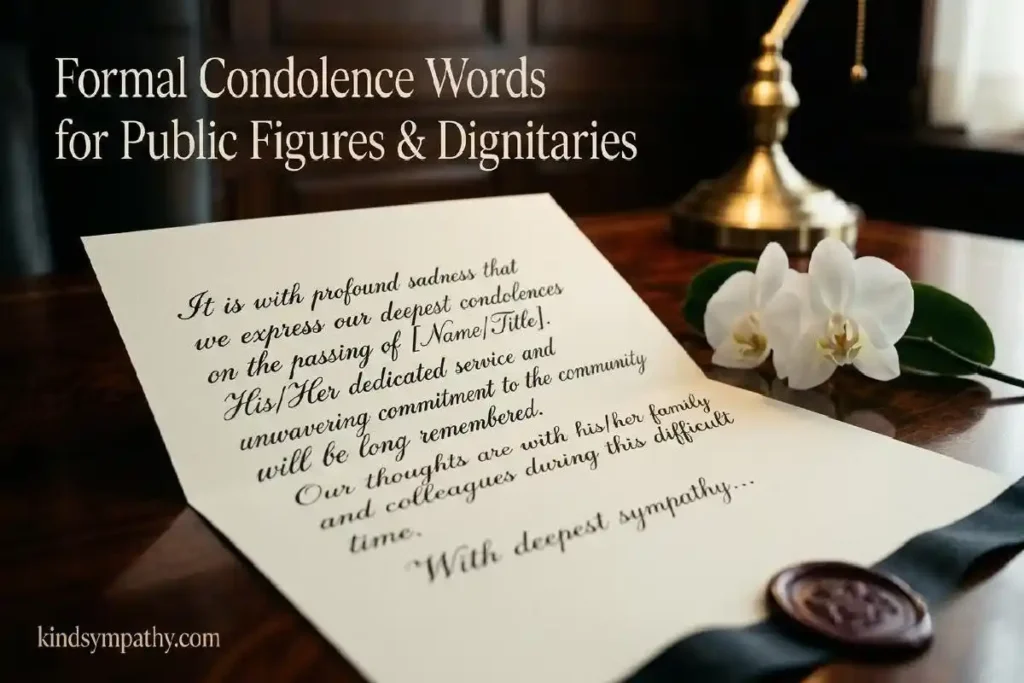
Formal Condolence Messages for Public Figures and Dignitaries
When a death is public, official statements must acknowledge the loss in a way that respects both the person and the public significance of their passing.
- It is with great sorrow that we mark the passing of [Name]. [His/Her/Their] service to [the nation/the organisation/the community] was exemplary, and the contributions they made will endure long after their passing. Our deepest condolences go to their family at this time of profound grief.
- We mourn the loss of a truly remarkable individual. [Name]’s dedication to [their cause/their profession/their country] was unparalleled, and their legacy will continue to inspire for generations to come. We extend our sincere condolences to all who grieve this loss.
- [Name] served with distinction and was respected by all who had the honour of knowing or working with them. Their passing is a significant loss to [institution/sector/community]. On behalf of [Office/Organisation], we offer our deepest condolences to their family and loved ones.
- The loss of [Name] is felt deeply across [sector/community/nation]. They were a person of great [character/integrity/vision], whose work will stand as testament to their extraordinary life. We extend our heartfelt sympathies to everyone who mourns.
- Today we pay tribute to [Name], who gave so much of [himself/herself/themselves] to [the work/the community/the nation]. Their absence will be profoundly felt. On behalf of [Organisation Name], we offer our sincerest condolences to the family and to all those who loved them.
“For a formal letter format, our how to write a condolence letter walks through the structure. For a formal boss email, our sympathy email to boss has exact formats.”
Formal Sympathy Words — For Written Letters and Official Correspondence
These work as standalone letters or as the body of formal written correspondence — structured for official documentation.
- Dear [Name/Family],
It is with great sadness that I write to convey my sincere condolences on the passing of [Deceased’s Name]. Please accept this expression of our deepest sympathies, both from myself personally and from [Organisation Name] as a whole.
[He/She/They] will be remembered with great respect, and the contributions they made will continue to be felt in the work we carry forward.
Yours sincerely, [Name, Title]
- Dear [Name],
On behalf of [Organisation], I wish to express our heartfelt condolences on the loss of your [relationship to deceased]. We understand this is an extraordinarily difficult time, and our thoughts are with you and your family.
[Name] was known to many of us as [description of their role/character], and their passing has been deeply felt across our organisation.
Please do not hesitate to reach out if there is anything we can offer.
With deepest sympathy, [Name, Title]
- To the Family of [Deceased Name],
We write with heavy hearts to express the condolences of [Institution Name] on the passing of [Name]. [His/Her/Their] contributions to [field/organisation] were significant, and the dignity and dedication with which [he/she/they] conducted [himself/herself/themselves] throughout [his/her/their] career will long be remembered.
Please accept the sincere sympathies of the entire [Institution Name] community.
With respect and sorrow, [Name, Title, Organisation]
Short Formal Condolence Message Examples (When Brevity Is Required)
Sometimes a formal context calls for something brief — a public social media post, a short note, an official caption. These short formal condolence message examples maintain dignity in few words.
- [Organisation Name] extends its deepest condolences on the passing of [Name]. Their legacy endures.
- We are deeply saddened by the loss of [Name]. Our sincerest sympathies go to their family and all who mourn.
- It is with great sadness that we mark the passing of [Name]. May their memory be a lasting tribute to an extraordinary life.
- On behalf of [Organisation], our deepest condolences to the family of [Name]. Profoundly missed by all who knew them.
- [Name] served with distinction and will be greatly missed. Our heartfelt condolences to their loved ones.
Formal Condolence Messages for Specific Losses
For the Passing of a Colleague
- The entire [organisation/department/team] is saddened by the loss of [Name], who was not only a respected professional but a genuinely valued colleague. We extend our deepest condolences to [his/her/their] family and to those who worked alongside them.
- [Name] brought [expertise/dedication/warmth] to every aspect of [his/her/their] work. The space they leave behind cannot easily be filled. Our deepest sympathies go to all who loved them.
- Losing a colleague of [Name’s] calibre and character is a significant loss — not only professionally, but personally, for everyone who had the privilege of working with them. Please accept our sincere condolences.
For the Passing of a Client or Long-Term Partner
- Our association with [Name] spanned [many years / significant milestones], and we have valued every aspect of our relationship. We are deeply saddened by their passing and extend our most sincere condolences to the family.
- [Name] was far more than a client to this firm. They were a trusted and respected presence, and their passing leaves a genuine void. Our warmest condolences go to their family.
For the Passing of a Founder or Visionary
- We mourn the loss of our founder, [Name], whose vision gave this organisation its purpose and whose dedication gave it its character. [His/Her/Their] legacy is alive in everything we do, and we dedicate our continued work to their memory.
- [Name] built something that will outlast any of us — a vision, a community, a body of work that speaks for itself. We are heartbroken by their loss and extend our deepest condolences to all who loved them.
Copy & Paste Formal Condolence Messages — Ready to Adapt 📋
For an institutional announcement — just copy this 👇 “It is with deep sadness that [Organisation Name] acknowledges the passing of [Name]. [He/She/They] made an enduring contribution to [field/community], and their loss will be profoundly felt. Our deepest condolences go to their family and to all who mourn.”
For a CEO email to the company — just copy this 👇 “I write with heavy heart to share news of [Name]’s passing. They were valued beyond what words can adequately express — a colleague of distinction, and a person of great character. On behalf of [Company Name] and personally, I extend our deepest sympathies to their family.”
For a formal letter — just copy this 👇 “Dear [Family Name], On behalf of [Organisation], I wish to convey our sincere condolences on the passing of [Name]. Their service to [institution/community] was distinguished in every respect. We honour their memory and offer our warmest sympathies to your family. Yours sincerely, [Name, Title]”
For a short public statement — just copy this 👇 “[Organisation] is deeply saddened by the passing of [Name]. A person of remarkable [character/contribution/vision], they will be long remembered. Our deepest condolences to all who grieve this loss.”
For a professional bereavement card — just copy this 👇 “Please accept our sincere condolences on the loss of [Name]. [His/Her/Their] contributions to [field] were exceptional, and [he/she/they] will be greatly missed. With deepest sympathy — [Organisation/Name].”
What to Avoid in a Formal Condolence Message
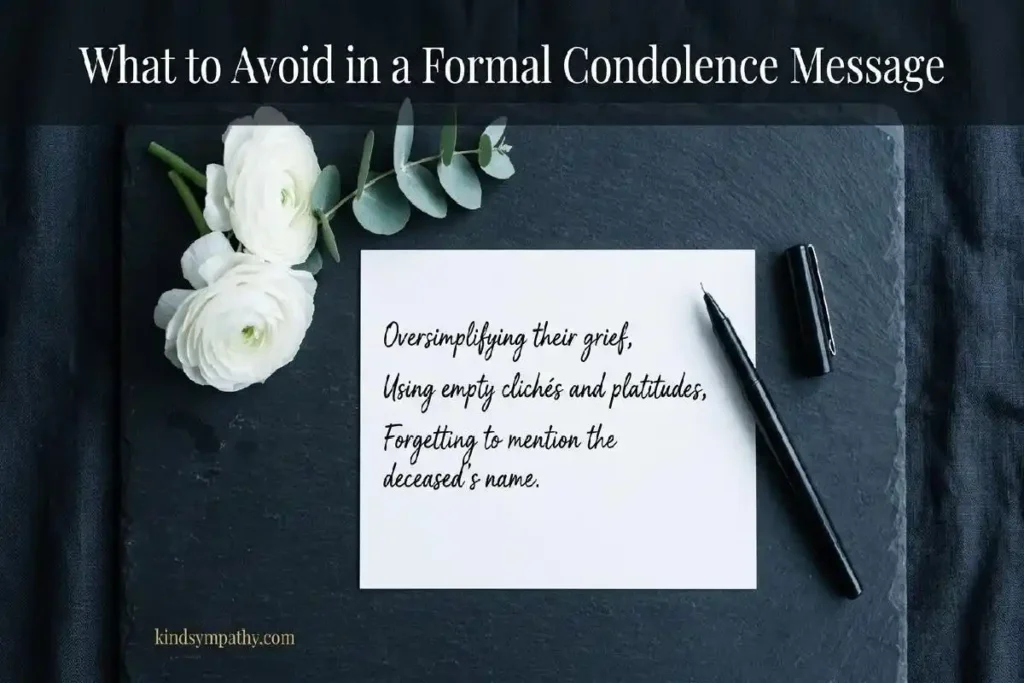
Formality doesn’t protect against bad condolence language — it can actually make certain phrases worse. These miss the mark in any official register.
❌ “They’re in a better place.” Why it fails formally: Assumes beliefs and registers as unprofessional in multi-faith or secular institutional contexts. ✅ Write instead: “We hope they rest in peace” or simply “Their memory endures.”
❌ “Our thoughts and prayers are with you.” Why it fails formally: Has become so formulaic it lands as meaningless, especially in a secular or professional context. ✅ Write instead: “Our deepest condolences go to the family and to all who mourn.”
❌ Generic institutional language with no reference to the person. Why it fails: A condolence that never names the deceased or acknowledges who they were reads as bureaucratic rather than sincere. ✅ Write instead: Always include one specific reference to the person — their role, their contribution, or their character.
❌ Mixing news or logistics into the condolence. Why it fails: “We are deeply saddened by the passing of [Name] — all meetings scheduled for this week will be rearranged accordingly” conflates grief with administration. ✅ Do instead: Send separate communications for logistics. The condolence should stand alone.
❌ Over-hedging language that distances the message. Why it fails: “We understand you may be experiencing a period of difficulty following this unfortunate event” is so distanced from the reality that it reads as parody. ✅ Write instead: “We are deeply saddened by the passing of [Name] and extend our sincerest condolences.”
One-Line Formal Condolence Messages ✨
For official captions, brief inscriptions, or the header of a formal communication.
- Our deepest condolences on the loss of [Name] — a person of exceptional character.
- It is with great sadness that we mark the passing of [Name]. Their legacy endures.
- [Name] served with distinction and will be long remembered.
- We honour the memory of [Name] and extend our sincere sympathies to all who mourn.
- A profound loss. Our heartfelt condolences to the family of [Name].
- The passing of [Name] leaves a significant and lasting void. We grieve this loss.
- Their contribution to [field/community] was extraordinary. They will not be forgotten.
- On behalf of [Organisation], our sincerest condolences to the family and loved ones of [Name].
- A life well-lived and a legacy well-earned. We mourn the passing of [Name].
- With deepest sympathy — the team at [Organisation Name].
Formal vs Warm — When to Use Which Register
The formal register is right when:
- You are communicating on behalf of an institution, not as an individual
- The relationship between sender and recipient is professional, not personal
- The message will be seen by a wider audience (a public statement, an all-staff email)
- The deceased was a public or official figure
- The context requires dignity above warmth (a legal, medical, or governmental communication)
The personal register is better when:
- You have a personal relationship with the bereaved, even if you’re a professional
- The communication is private and one-to-one
- Warmth would not seem out of place — and would likely be welcomed
For the personal-professional middle ground, our guide to what to write in a sympathy card and our full collection of professional condolence emails cover the spectrum between the two. And for the longest format — a formal written letter of condolence — our condolence letter guide with examples walks through the whole process.

💡 5 Tips for Writing Formal Condolence Messages That Actually Land
Tip 1: Name the person who died — always. A formal condolence that refers only to “your loss” or “this bereavement” feels clinical. [Name] them. Even in the most formal institutional message, naming the person who died is the single most humanising thing you can do.
Tip 2: Reference their contribution specifically. “[Name] made a significant contribution to our organisation” is fine. “[Name] brought intellectual rigour and genuine warmth to everything they did” is better. Even one specific quality or observation transforms a formal message from generic to dignified.
Tip 3: Keep it to three to four sentences. Formal condolences don’t benefit from length. Three sentences — acknowledge the loss, honour the person, offer sympathy — is enough. A formal message that runs too long starts to read as a performance rather than an expression of genuine sorrow.
Tip 4: Attribute clearly. Always be explicit about who is sending. “On behalf of [Organisation Name]” or “[Name], [Title]” at the close makes the message authoritative and ensures it doesn’t feel anonymous. Research on the psychology of grief and human connection shows that named, specific acknowledgment from institutions and colleagues matters enormously to bereaved people — a clearly attributed message carries more meaning than an unsigned one.
Tip 5: Send it promptly — and only once. Formal condolences should arrive within the first few days of the loss. A delayed institutional message can feel like an afterthought. At the same time, formal organisations should send one considered message rather than multiple follow-ups — the formality of the register means a single, well-crafted communication carries significant weight. Harvard Health’s work on grief and the role of community acknowledgment confirms that timely, sincere acknowledgment from professional communities positively affects how bereaved people feel held during loss. Get it right, and get it out.
❓ FAQ — Formal Condolence Messages
What is the best formal condolence message to send on behalf of an organisation?
The best formal condolence messages from an organisation combine three elements: official acknowledgment of the loss, a specific reference to the deceased’s contribution or character, and a clear expression of sympathy to the family. Try: “On behalf of [Organisation], we extend our deepest condolences on the passing of [Name]. [His/Her/Their] contributions to [field] were exceptional, and [he/she/they] will be greatly missed. Our thoughts are with the family.”
What are some short formal condolence message examples for an official statement?
Short formal condolence message examples for public statements or captions: “It is with great sadness that we mark the passing of [Name]. Their legacy endures.” Or: “[Organisation] extends its deepest condolences on the loss of [Name] — a person of exceptional character.” Dignified, specific, complete.
What do you write in a formal condolence letter from an institution?
A formal condolence letter from an institution should open with the acknowledgment, include one specific reference to the person who died, offer condolences to the family, and close formally. Our condolence letter guide with examples includes a full institutional letter template. Keep it to three or four paragraphs and sign with full name and title.
Should a formal condolence message be written or emailed?
For the highest register — public figures, senior professionals, institutional bereavement — a written letter on headed paper carries the most weight. For internal organisational communications, email is appropriate. For public statements, the format depends on the platform. Our guide to condolence email templates covers the email format in detail.
Is it appropriate to personalise a formal condolence message?
Yes — and it’s what elevates a formal message above the generic. Research on the psychology of grief and human connection shows that specific, named acknowledgment is more meaningful to bereaved people than any amount of elaborate formal language. And Harvard Health’s work on grief and the emotional role of community support confirms that personal recognition within professional and institutional contexts genuinely matters. The formality is in the structure and register — not in the absence of humanity.